
Master Your Trim: The Key to Safer, More Efficient Diving
Martin Gomez Jun 22, 2026
Master Your Trim: The Key to Safer, More Efficient Diving
Why Trim Matters More Than You Think
When divers focus on improving their skills, buoyancy often gets most of the attention. While buoyancy is essential, another equally important skill is frequently overlooked: trim.
Trim refers to your body's position and orientation in the water. A diver with good trim maintains a balanced, horizontal position that minimizes drag, improves efficiency, and allows for better control underwater.
Whether you're a newly certified diver or an experienced underwater explorer, mastering trim can significantly improve your comfort, safety, and enjoyment on every dive.
What Is Trim?
Trim is the relationship between your body's position, your equipment configuration, and the balance between buoyancy and weight distribution.
A properly trimmed diver remains nearly horizontal in the water, with the head, torso, hips, and fins aligned. This streamlined position allows movement through the water with minimal effort and maximum efficiency.
Good trim is closely linked to neutral buoyancy, but the two are not the same. You can be neutrally buoyant and still have poor trim if your body position is not balanced.
The Benefits of Good Trim
Less Effort
A streamlined position reduces drag, allowing you to move through the water more efficiently. Less resistance means less fatigue and a more comfortable dive.
Better Air Consumption
When your body is balanced and streamlined, you use less energy to swim and maintain position. Less effort translates directly into lower air consumption and longer bottom times.
Improved Control
Good trim helps divers maintain depth and position with greater precision. It also makes buoyancy adjustments more effective and predictable.
Increased Safety
A stable body position improves situational awareness and reduces the likelihood of accidental ascents, descents, or contact with the environment.
Greater Enjoyment
When you're not constantly fighting your equipment or body position, you can focus on the dive itself—marine life, photography, navigation, or simply enjoying the underwater world.
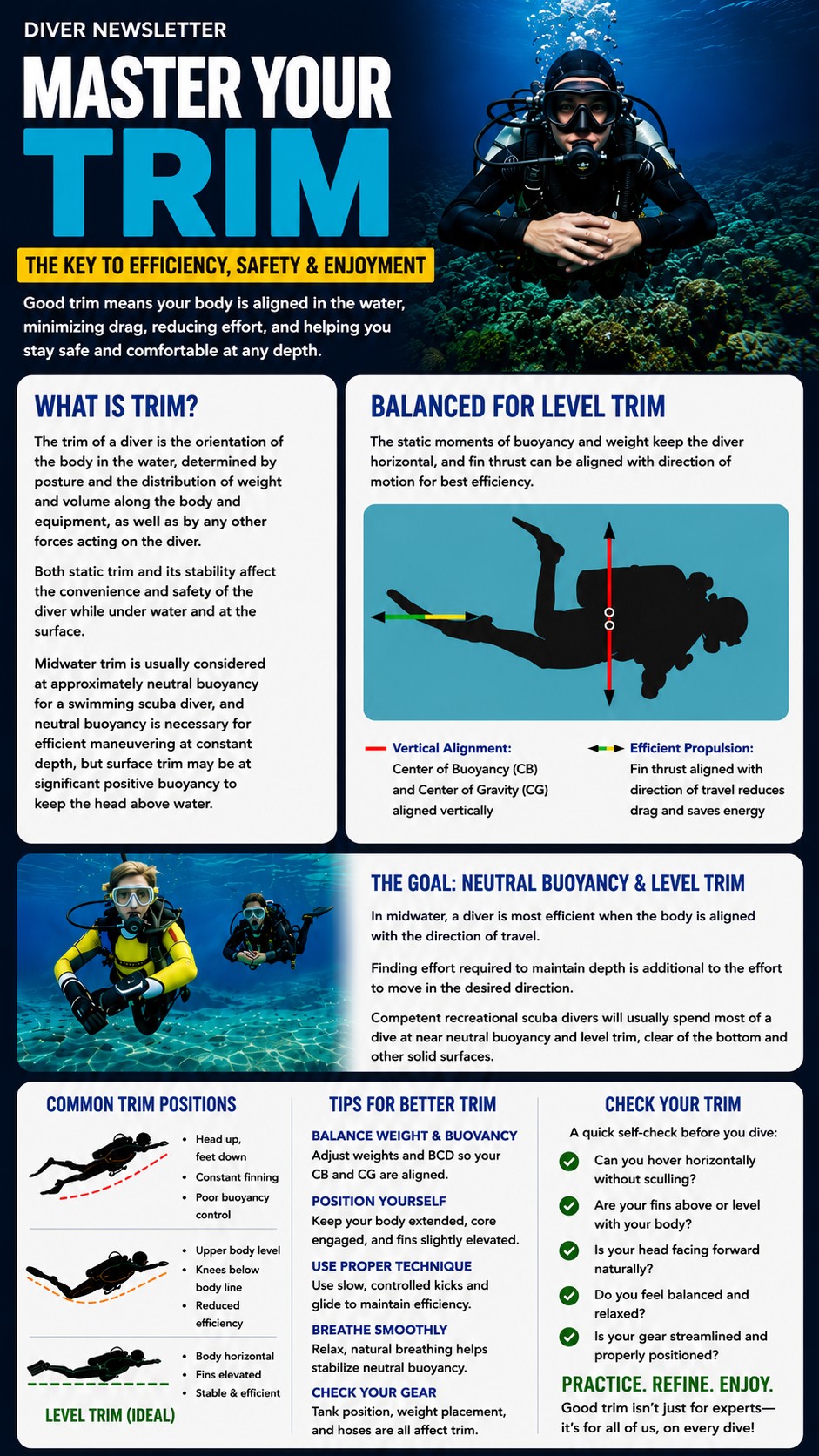
What Does Ideal Trim Look Like?
The ideal trim position is a horizontal body posture where:
- The body remains level in the water.
- The fins are slightly elevated.
- The head faces naturally forward.
- The diver moves efficiently with minimal drag.
- Buoyancy remains stable and controlled.
This position aligns your direction of movement with your propulsion, making every kick more effective.
Common Trim Problems
Many divers unknowingly develop inefficient trim habits.
Head Up, Feet Down
This position creates significant drag and often requires constant finning to maintain movement and depth.
Knees Dropped
Although the upper body may appear level, dropping the knees increases resistance and reduces propulsion efficiency.
Unbalanced Equipment
Poorly placed weights, tank positioning, or dangling accessories can shift your center of gravity and make maintaining trim difficult.
Tips for Improving Your Trim
Balance Your Weight and Buoyancy
Proper weighting is the foundation of good trim. Adjust your weights and tank position so your center of gravity and center of buoyancy are aligned.
Maintain a Streamlined Position
Keep your body extended and relaxed. Avoid bending excessively at the hips or knees.
Use Efficient Finning Techniques
Slow, controlled fin kicks help maintain stability and reduce unnecessary movement.
Focus on Breathing
Smooth, controlled breathing helps maintain neutral buoyancy and contributes to a more stable body position.
Evaluate Your Equipment Setup
Tank height, weight placement, hose routing, and accessory positioning all influence trim. Small adjustments can make a significant difference.
A Quick Trim Self-Assessment
Before or during a dive, ask yourself:
- Can I hover horizontally without sculling?
- Are my fins level with or slightly above my body?
- Is my head naturally facing forward?
- Do I feel balanced and relaxed?
- Is my equipment streamlined and properly positioned?
If the answer to most of these questions is yes, you're likely maintaining good trim.
The Connection Between Trim and Neutral Buoyancy
The most efficient divers combine neutral buoyancy with level trim. Together, these skills allow divers to move effortlessly through the water while conserving energy and protecting the underwater environment.
A diver who achieves both can hover comfortably, maintain precise control, and minimize contact with reefs, wrecks, and other sensitive areas.
Final Thoughts
Good trim isn't just a skill for technical divers. It's a fundamental part of safe, efficient, and enjoyable diving for everyone.
By improving your body position, refining your buoyancy control, and optimizing your equipment setup, you'll reduce effort, improve air consumption, increase safety, and become a more confident diver.
The goal is simple: stay balanced, stay streamlined, and enjoy every dive.
Practice. Refine. Enjoy.
