
Technology Is Great, But Navigation Skills Are Better
Martin Gomez Jun 22, 2026
Underwater Compass Navigation: Why Every Diver Should Master This Essential Skill
Technology Is Great, But Navigation Skills Are Better
Modern dive computers have transformed the way we dive, providing real-time depth, time, and decompression information. However, one of the most valuable skills a diver can develop is still traditional underwater navigation using a compass.
A dive compass is a simple, reliable tool that works independently of batteries, GPS signals, or electronic devices. When visibility decreases, currents increase, or unfamiliar environments challenge your sense of direction, a compass can be the difference between a smooth dive and a stressful one.
Why Underwater Navigation Matters
Many divers rely solely on natural navigation, using reefs, wrecks, sand channels, or landmarks to find their way. While these methods are useful, underwater conditions can change quickly.
Poor visibility, surge, currents, or featureless environments can make even experienced divers lose their orientation.
Good navigation skills help divers:
-
Return safely to the boat or shore.
-
Reduce air consumption by following efficient routes.
-
Avoid unnecessary stress and confusion underwater.
-
Stay with their dive buddy or team.
-
Improve overall situational awareness.
-
Increase confidence in unfamiliar dive sites.
Simply put, good navigation leads to safer diving.
Understanding the Parts of a Dive Compass
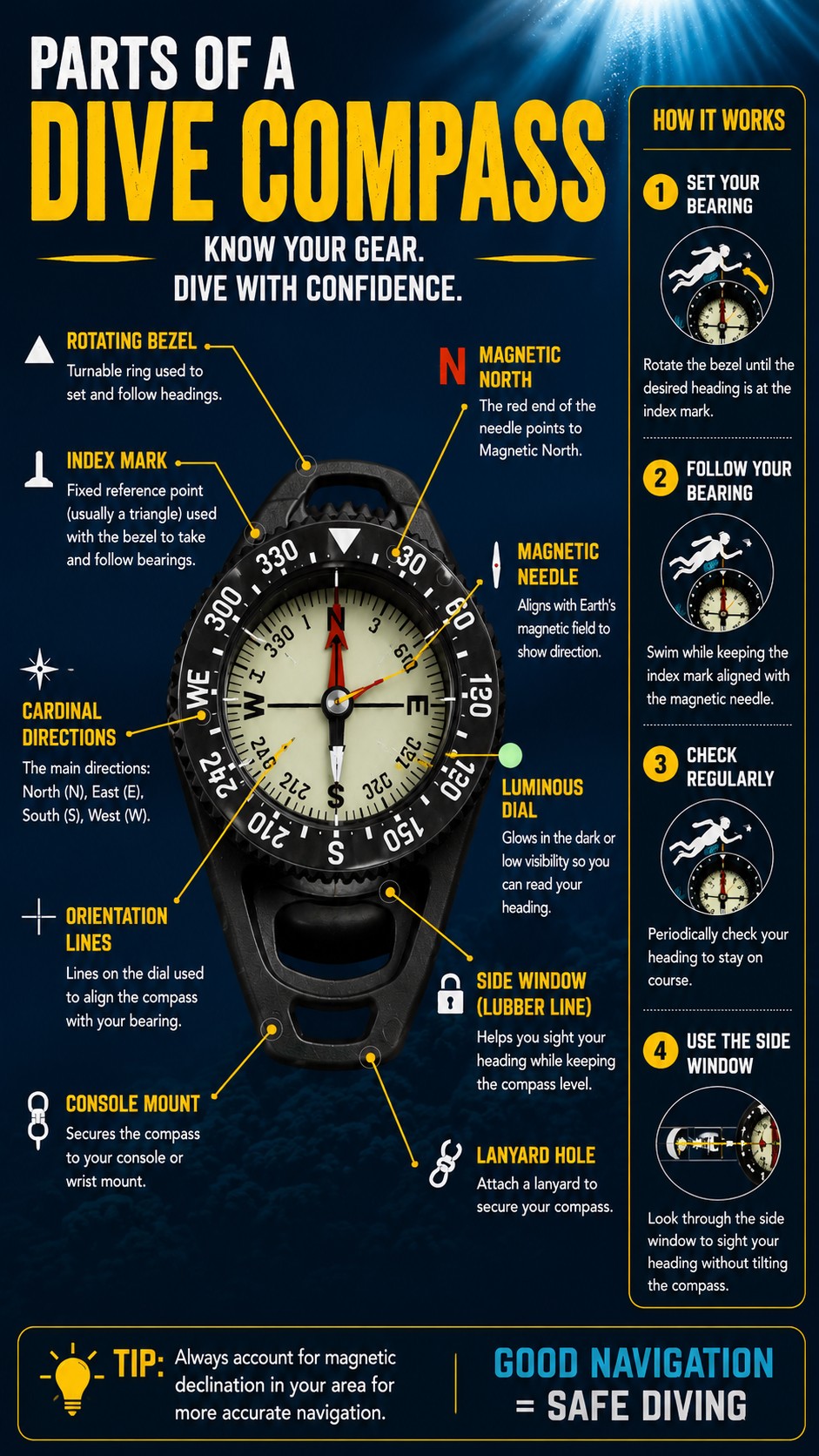
A dive compass may look simple, but each component serves an important purpose.
Rotating Bezel
The rotating bezel is the outer ring of the compass. It allows divers to set and track a heading during a dive.
Index Mark
The index mark is the fixed reference point used together with the bezel to establish a course.
Magnetic Needle
The magnetic needle aligns with the Earth's magnetic field. The red end of the needle always points toward magnetic north.
Cardinal Directions
Every compass displays the four primary directions:
-
North (N)
-
East (E)
-
South (S)
-
West (W)
These references help divers determine and maintain a desired heading.
Orientation Lines
These lines help align the compass correctly while following a course underwater.
Side Window (Lubber Line)
Many diving compasses include a side-view window that allows divers to read their heading while swimming without tilting the compass.
Luminous Dial
A glow-in-the-dark dial makes compass readings easier in low visibility, deeper water, or night diving conditions.
Mounting and Attachment Points
Most compasses are mounted on a wrist strap, console, or retractable lanyard to keep them secure and accessible.
How to Navigate with a Dive Compass
Using a compass underwater is easier than many divers think.
1. Set Your Heading
Before leaving the boat, shore, or descent point, determine the direction you want to travel.
Rotate the bezel until the desired heading aligns with the index mark.
2. Follow Your Bearing
As you swim, keep the magnetic needle aligned with the orientation marks inside the compass housing.
Maintaining this alignment ensures you stay on course.
3. Check Your Direction Frequently
Currents, buoyancy adjustments, and environmental conditions can gradually move you off course.
Regularly checking your compass allows you to make small corrections before they become major deviations.
4. Use the Side Window
If your compass has a side window, use it to monitor your heading while keeping your body streamlined and maintaining proper trim.
When Compass Navigation Becomes Critical
There are many situations where compass skills become essential:
Low Visibility Diving
In murky water, natural landmarks may disappear completely. A compass provides a dependable reference when visual cues are limited.
Drift Diving
Strong currents can quickly alter your direction. Compass navigation helps maintain awareness of your position and planned route.
Wreck Diving
Large wrecks can be confusing and disorienting. Following compass headings helps divers return to exit points safely.
Night Diving
At night, even familiar dive sites can look completely different. A compass becomes one of the most reliable navigation tools available.
Search and Recovery Operations
Many search patterns require precise compass headings to effectively cover an area.
Tips for Better Compass Navigation
-
Practice compass skills on every dive, not only when needed.
-
Hold the compass level for accurate readings.
-
Learn reciprocal headings for return navigation.
-
Combine compass navigation with natural navigation techniques.
-
Review your route before entering the water.
-
Account for local magnetic declination when planning precise navigation tasks.
-
Keep your compass easily accessible and regularly maintained.
The Confidence Factor
One of the greatest benefits of compass navigation is confidence.
Divers who understand navigation are less likely to become anxious when visibility decreases or conditions change. They know how to determine their position, maintain direction, and safely return to their starting point.
This confidence translates into better air consumption, improved decision-making, and a more enjoyable diving experience.
Final Thoughts
A dive compass is one of the most valuable and underrated pieces of scuba equipment. While modern electronics provide incredible support, navigation remains a fundamental diving skill that every diver should master.
Whether you're exploring reefs, wrecks, quarries, lakes, or open ocean environments, a compass helps you stay oriented, conserve energy, and dive more safely.
The best divers don't just know where they are—they always know how to get back.
Good Navigation = Safe Diving.
