
Use Your SMB: A Small Safety Tool That Makes a Big Difference
Martin Gomez Jun 22, 2026
Use Your SMB: A Small Safety Tool That Makes a Big Difference
Be Seen. Stay Safe. Dive Smart.
When divers think about essential scuba equipment, they often focus on regulators, BCDs, dive computers, and exposure protection. However, one of the most important safety tools you can carry on every dive is often overlooked: the Surface Marker Buoy (SMB).
An SMB is a simple device, but its role in diver safety is enormous. Whether you're diving from a boat, drifting with the current, or surfacing far from your exit point, an SMB helps ensure that boats, dive operators, and fellow divers know exactly where you are.
Why Every Diver Should Carry an SMB
Increased Visibility
One of the primary functions of an SMB is to make divers visible at the surface. Waves, currents, and changing weather conditions can make it difficult for boat operators to spot divers. A brightly colored SMB extends above the waterline, making it much easier to locate divers from a distance.
Improved Safety
By clearly marking your position, an SMB reduces the risk of accidents involving boats and personal watercraft. It provides a visual warning that divers are in the area and helps keep vessel traffic away from your location.
Better Dive Planning
Deploying an SMB during ascent allows your dive team and surface support crew to track your position throughout the final stages of the dive. This is especially important during drift dives or when surfacing away from the entry point.
Essential for Emergencies
If conditions change unexpectedly or you become separated from your group, an SMB can dramatically improve your chances of being located quickly. In many situations, it can be the most important piece of emergency signaling equipment you carry.
How to Use an SMB
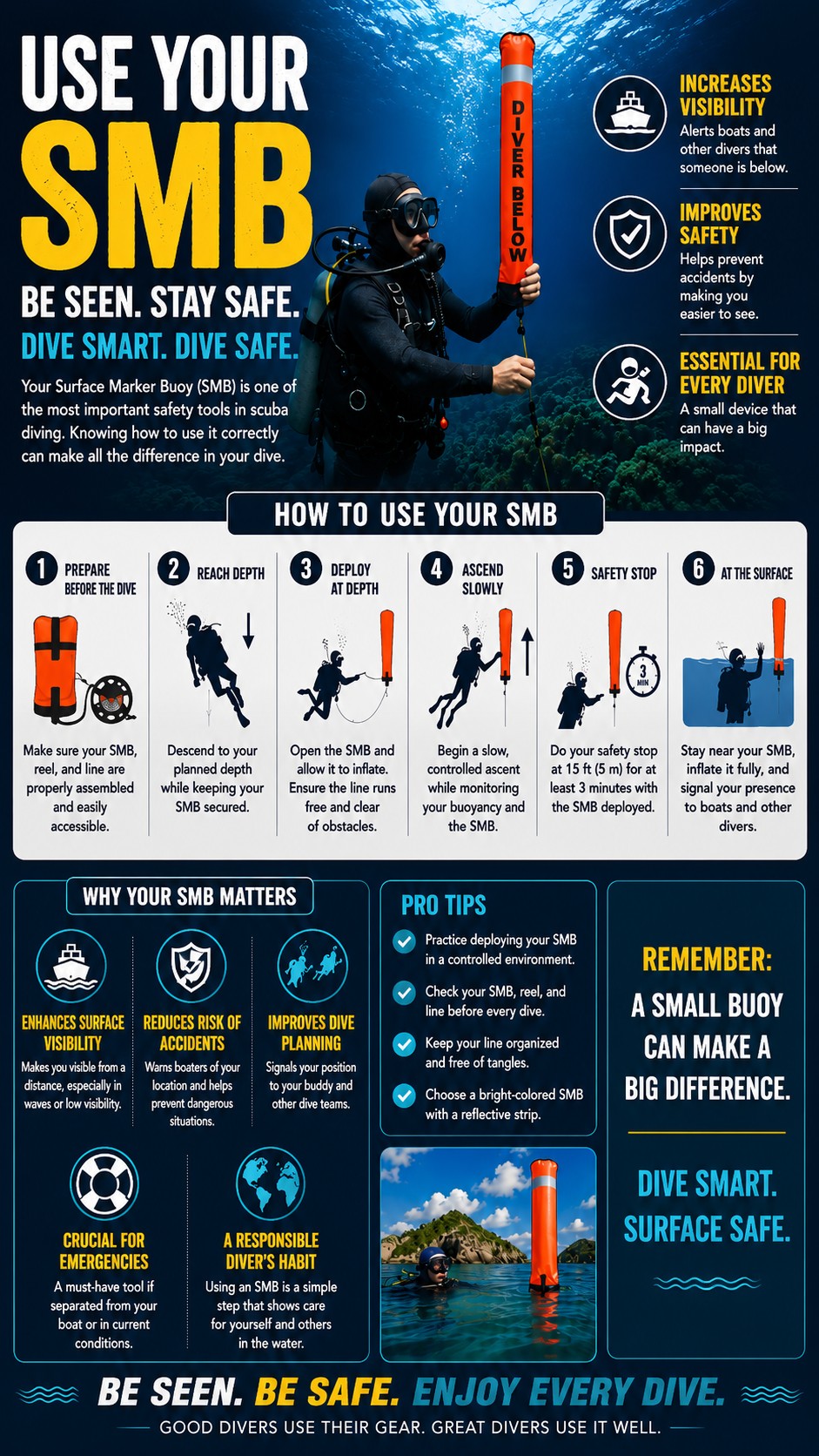
Proper SMB deployment should be practiced regularly in a controlled environment before relying on it during open-water dives.
Step 1: Prepare Before the Dive
Before entering the water, inspect your SMB, reel, spool, and line. Make sure everything is assembled correctly and easily accessible during the dive.
Step 2: Reach Your Deployment Depth
Descend to your planned depth while keeping your SMB secured and streamlined to avoid entanglement.
Step 3: Deploy the SMB
When ready, partially inflate the SMB using an alternate air source, exhaled air, or the device's inflation valve, depending on the model. Allow the SMB to rise while maintaining control of the spool or reel.
Step 4: Ascend Slowly
Begin a controlled ascent while monitoring your buoyancy and maintaining proper tension on the line connected to the SMB.
Step 5: Complete Your Safety Stop
Perform your safety stop at approximately 15 feet (5 meters) for at least three minutes while keeping the SMB deployed.
Step 6: Surface Safely
Upon reaching the surface, remain close to your SMB and use it as a visual reference for boats and support personnel.
Pro Tips for SMB Use
-
Practice deployment in calm conditions before using it in challenging environments.
-
Inspect your SMB, spool, and line before every dive.
-
Keep the line organized to avoid tangles.
-
Choose a brightly colored SMB with reflective markings for maximum visibility.
-
Learn multiple deployment techniques and understand which method works best for your equipment configuration.
-
Carry an SMB on every dive, even when conditions seem ideal.
Why Responsible Divers Use SMBs
Using an SMB demonstrates good dive planning and situational awareness. It shows respect for your own safety, your dive buddies, and the boating community sharing the water.
Many dive professionals consider an SMB to be as important as a dive computer or cutting device because it provides an additional layer of safety during every ascent and surface interval.
Final Thoughts
A Surface Marker Buoy may be small, lightweight, and inexpensive, but it can have a significant impact on diver safety. By improving visibility, reducing risks, assisting with dive planning, and providing a valuable emergency signaling device, the SMB has earned its place as a must-have piece of scuba equipment.
The best divers don't just own safety equipment—they know how to use it properly.
Be Seen. Be Safe. Enjoy Every Dive.
