
Why Is a Dive Computer Important?
Martin Gomez Jun 22, 2026
Why Is a Dive Computer Important?
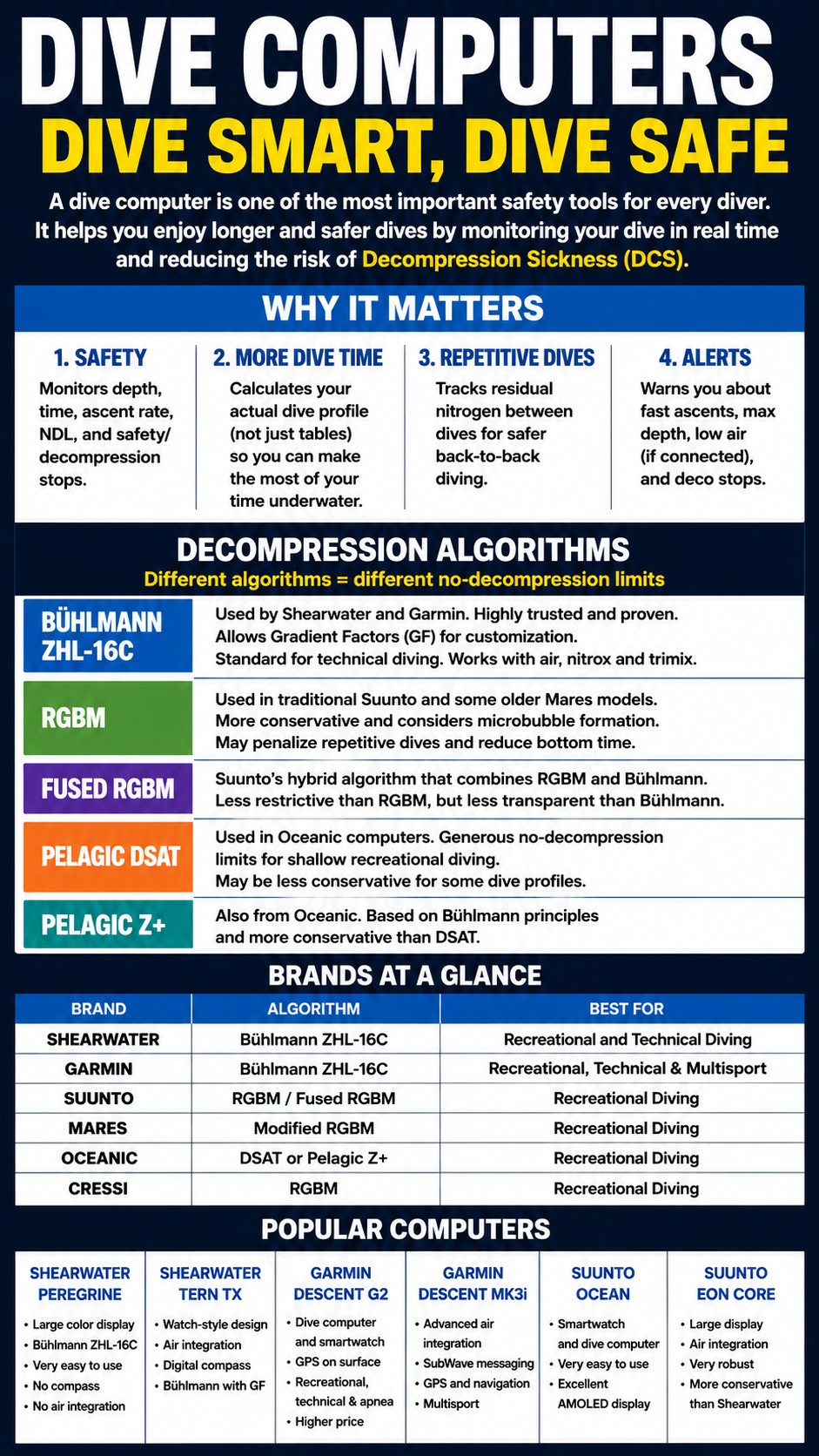
A dive computer is one of the most important pieces of safety equipment for any recreational or technical diver. Its primary function is to calculate in real time how much nitrogen (or helium in technical diving) your body absorbs during a dive and help reduce the risk of Decompression Sickness (DCS).
1. Safety
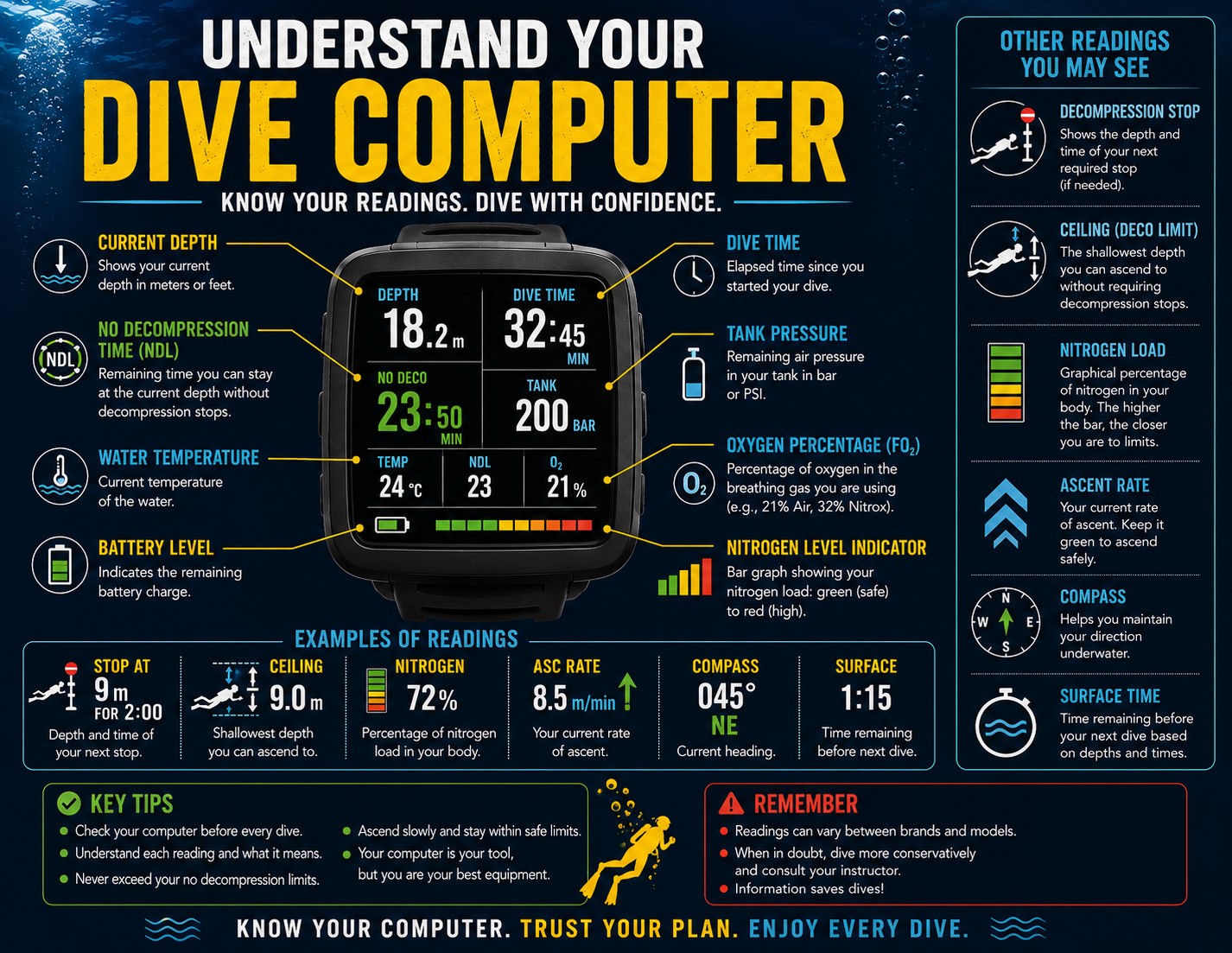
A dive computer continuously monitors:
-
Current depth
-
Bottom time
-
Ascent rate
-
No-Decompression Limits (NDL)
-
Safety and decompression stops
2. More Dive Time
Dive tables are conservative and assume square dive profiles. A dive computer calculates your actual dive profile, allowing you to maximize your underwater time safely.
3. Repetitive Dive Management
It automatically tracks residual nitrogen between dives, making repetitive diving safer and easier.
4. Alarms and Warnings
A dive computer alerts you to:
-
Excessive ascent rates
-
Maximum depth limits
-
Low air supply (when air-integrated)
-
Required decompression stops
What Is a Decompression Algorithm?
A decompression algorithm is the mathematical model a dive computer uses to estimate how gases are absorbed and released by the body's tissues.
Different algorithms may provide different no-decompression limits for the same dive profile.
Main Decompression Algorithms
1. Bühlmann ZHL-16C
Used by:
-
Shearwater
-
Garmin
-
Ratio
-
Heinrichs Weikamp
Advantages
✅ Extensively tested and proven
✅ Industry standard for technical diving
✅ Allows Gradient Factor (GF) customization
✅ Suitable for air, nitrox, and trimix diving
Disadvantages
❌ Requires some knowledge to properly adjust Gradient Factors
Best For
-
Advanced divers
-
Technical divers
-
Divers who want greater customization
2. RGBM (Reduced Gradient Bubble Model)
Used by:
-
Traditional Suunto computers
-
Some older Mares models
Advantages
✅ More conservative approach
✅ Considers microbubble formation
Disadvantages
❌ Can heavily penalize repetitive dives
❌ May significantly reduce available bottom time
Best For
-
Recreational divers seeking a more conservative profile
3. Fused RGBM
Used by:
-
Suunto EON Core
-
Suunto EON Steel
Advantages
✅ Combines RGBM and Bühlmann principles
✅ Less restrictive than traditional RGBM
Disadvantages
❌ Less transparent than Bühlmann-based models
4. Pelagic DSAT
Used by:
-
Oceanic
-
Aeris (historically)
Advantages
✅ Generous no-decompression limits on shallow dives
Disadvantages
❌ Can be less conservative for certain dive profiles
Best For
-
Warm-water recreational diving
5. Pelagic Z+
Used by:
-
Oceanic (optional setting)
Advantages
✅ Based on Bühlmann principles
✅ More conservative than DSAT
Comparison of Major Dive Computer Brands
| Brand | Algorithm | Conservatism | Best For |
|---|---|---|---|
| Shearwater | Bühlmann ZHL-16C | Adjustable | Recreational and Technical Diving |
| Garmin | Bühlmann ZHL-16C | Adjustable | Recreational, Technical, and Multisport |
| Suunto | RGBM / Fused RGBM | High | Recreational Diving |
| Mares | Modified RGBM | Medium-High | Recreational Diving |
| Oceanic | DSAT or Pelagic Z+ | Adjustable | Recreational Diving |
| Cressi | RGBM | High | Recreational Diving |
Popular Dive Computer Comparisons
Shearwater Peregrine
Advantages
-
Large color display
-
Bühlmann ZHL-16C algorithm
-
Very user-friendly
-
Excellent reputation
Disadvantages
-
No digital compass
-
No air integration
Best For
Instructors, Divemasters, and advanced recreational divers.
Shearwater Tern TX
Advantages
-
Watch-style design
-
Air integration
-
Digital compass
-
Bühlmann with Gradient Factors
Best For
Travelers and frequent divers.
Garmin Descent G2
Advantages
-
Dive computer and smartwatch
-
Surface GPS
-
Freediving, recreational, and technical modes
-
Bühlmann ZHL-16C algorithm
Disadvantages
-
Higher price point
Best For
Active divers who want an everyday sports watch.
Garmin Descent Mk3i
Advantages
-
Advanced air integration
-
SubWave underwater communication
-
GPS navigation
-
Multisport capabilities
Best For
Premium recreational and technical divers.
Suunto Ocean
Advantages
-
Smartwatch and dive computer
-
Easy to use
-
Excellent AMOLED display
Disadvantages
-
Less customizable than Shearwater
Best For
Recreational divers looking for simplicity and style.
Suunto EON Core
Advantages
-
Large display
-
Air integration
-
Extremely durable
Disadvantages
-
More conservative than Shearwater
Best For
Advanced recreational divers.
Recommendations by Diver Type
Beginner Diver
-
Suunto Zoop Novo
-
Mares Puck 4
-
Cressi Donatello
Frequent Recreational Diver
-
Shearwater Peregrine
-
Suunto Ocean
-
Garmin Descent G2
Divemaster or Instructor
-
Shearwater Peregrine
-
Shearwater Tern TX
-
Garmin Descent G2
Technical Diver
-
Shearwater Perdix 2
-
Shearwater Petrel 3
-
Garmin Descent Mk3i
Conclusion
If there is one dive computer that offers the best balance of safety, ease of use, reliability, and value, the Shearwater Peregrine is arguably the best choice for most recreational divers, Divemasters, and instructors.
For divers who want both a high-performance dive computer and a full-featured smartwatch, the Garmin Descent G2 and Mk3i are excellent options.
Suunto computers continue to stand out for their ease of use and conservative approach, making them particularly attractive for newer divers.
This version is written in a professional style suitable for dive shops, training agencies, instructor materials, blogs, or customer handouts.
