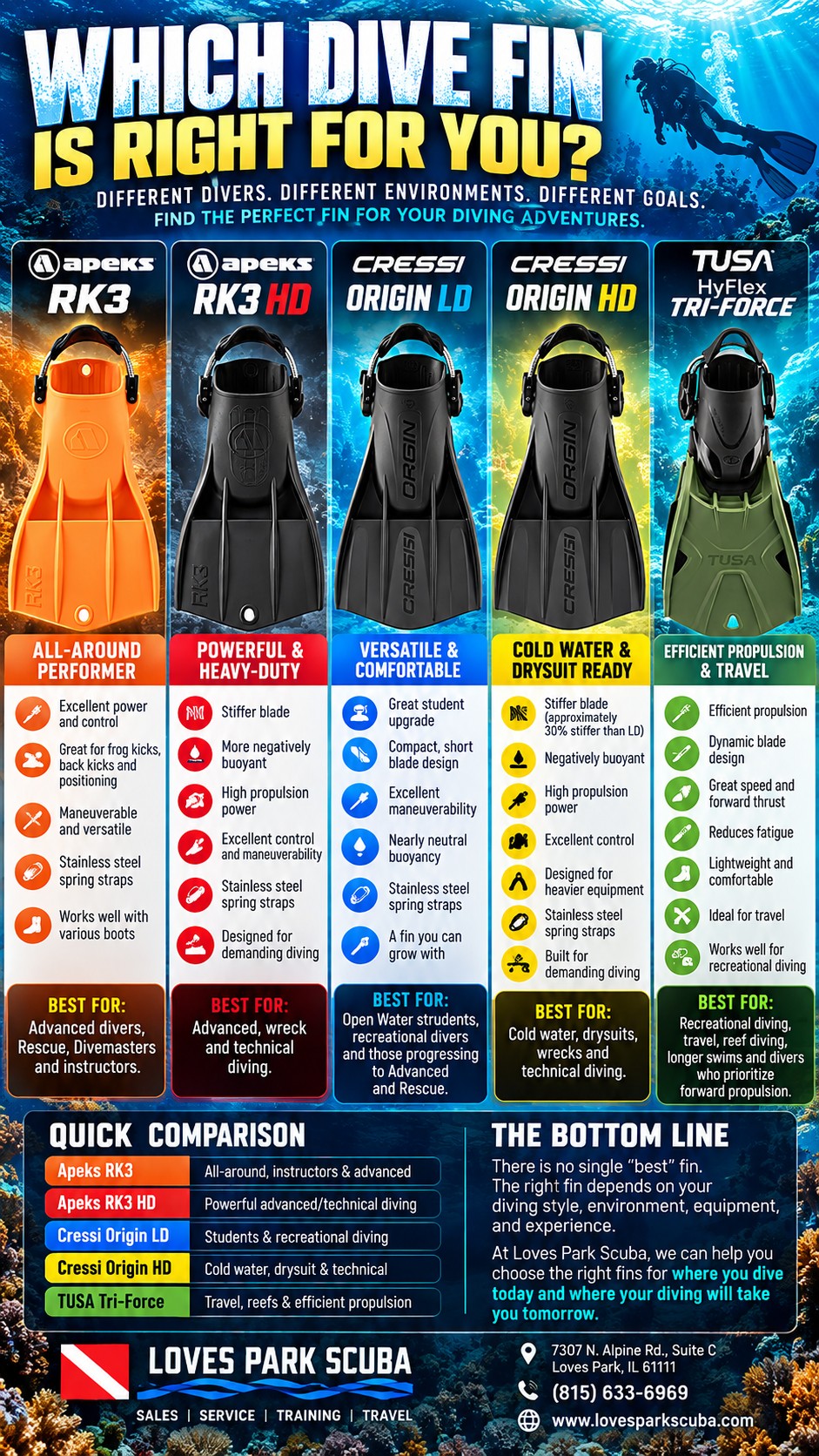
Apeks RK3 vs. RK3 HD vs. Cressi Origin LD vs. Origin HD vs. TUSA HyFlex Tri-Force
Martin Gomez Oct 06, 2026
Which Dive Fin Is Right for You?
Apeks RK3 vs. RK3 HD vs. Cressi Origin LD vs. Origin HD vs. TUSA HyFlex Tri-Force
Fins may look like a relatively simple piece of scuba equipment, but choosing the right pair can have a major effect on propulsion, comfort, maneuverability, fatigue, and even your underwater trim.
This becomes even more important for Midwest divers. At Loves Park Scuba, our divers may go from warm-water vacation diving to Pearl Lake in a 7 mm wetsuit, Lake Michigan wrecks, drysuit diving, or eventually technical diving.
So, which fin is best?
The answer depends on how you dive.
Today we're comparing five excellent options:
Apeks RK3 • Apeks RK3 HD • Cressi Origin LD • Cressi Origin HD • TUSA HyFlex Tri-Force
Apeks RK3 — The All-Around Control Fin
The Apeks RK3 has earned a strong reputation among recreational, professional, military, and technical-style divers.
Its relatively short and wide blade is designed to provide powerful propulsion while maintaining excellent maneuverability. This type of blade is especially useful when the objective isn't simply swimming forward, but controlling exactly where your body is underwater.
That makes the RK3 particularly effective for techniques such as:
Frog kick • Modified frog kick • Back kick • Helicopter turn • Precise positioning
For instructors, Divemasters, Rescue Divers, wreck divers, and advanced recreational divers, that control can be extremely valuable.
An instructor doesn't always need the fin that produces the greatest possible forward speed. We need to hover next to a student, move backward, rotate, demonstrate a skill, reposition quickly, and sometimes move rapidly to assist another diver.
Our Take
One of the best all-around choices for instructors and advanced recreational divers.
Apeks RK3 HD — More Rigidity and Negative Buoyancy
The RK3 HD takes the RK3 concept and uses a higher-density material.
That creates an important difference.
The HD is stiffer and more negatively buoyant than the standard RK3.
For some divers, that's exactly what they want. A stiffer fin can deliver powerful propulsion when moving heavier equipment, and additional negative buoyancy at the feet can sometimes help a diver whose legs naturally float upward.
But there's an important lesson here:
Heavier doesn't automatically mean better.
If your feet already tend to sink, adding negatively buoyant fins can make your trim problem worse.
For this reason, we wouldn't recommend the RK3 HD simply because someone assumes "HD must be better than RK3."
They're different tools for different divers.
Our Take
Excellent for experienced divers looking for a stiffer, more negative fin for demanding diving.
Cressi Origin LD — Versatility Without Excess Weight
The Cressi Origin LD is one of the most interesting fins in this comparison.
Cressi describes the LD as using a medium-density material with a Shore hardness of 60. The fin is approximately neutral or only slightly positive in the water, depending on size. Cressi's published data, for example, lists the M/L at approximately neutral in salt water.
That's important.
You get the benefits of a compact technical-style fin without adding a large amount of negative weight to your feet.
The Origin uses a short, wide, vented blade and stainless-steel spring straps. Cressi specifically highlights its suitability for frog kicks, helicopter turns, forward propulsion, and general maneuverability.
That makes the LD particularly attractive for the recreational diver who wants to develop better kicking techniques.
A Fin You Can Grow With
A new diver could potentially start with the Origin LD during Open Water and continue using it through:
Open Water → Advanced → Rescue → Deep → Wreck → Advanced Recreational Diving
without immediately outgrowing the fin.
Cressi Origin HD — The Heavy-Duty Option
Now things get considerably more serious.
The Origin HD uses higher-density material with a Shore hardness of 80. According to Cressi, it's approximately 30% stiffer than the LD version.
It is also negatively buoyant.
Cressi's published specifications put an M/L Origin HD at roughly 180–185 grams negative, depending on fresh versus salt water. Cressi specifically positions the HD for drysuits, heavier equipment, demanding underwater work, and technical applications.
That's a very different personality from the LD.
Think of it this way:
Origin LD = versatile sports car
Origin HD = underwater 4×4
In fact, Cressi itself describes the HD as essentially a powerful "4x4" fin.
Our Take
Excellent for cold-water, drysuit, wreck, technical, and heavy-equipment configurations—when the diver benefits from the additional negative buoyancy.
TUSA HyFlex Tri-Force — A Different Approach
This is where our comparison gets particularly interesting.
The TUSA HyFlex Tri-Force should not simply be grouped together with the RK3 and Origin because it takes a different approach to producing propulsion.
TUSA designed the Tri-Force around its HyFlex System, combined with an angled blade, vented design, Vortex Generator technology, anatomical/bungee strap system, and an ergonomic foot pocket.
TUSA's emphasis is very clear:
Power + Efficiency + Speed + Control
The company specifically describes the Tri-Force as providing strong propulsion while reducing fatigue and drag. It is also designed to be lightweight for easier transportation.
And that's where we see its biggest difference from something like an Origin HD.
The Tri-Force isn't trying to be a heavy rubber technical fin.
It is trying to efficiently convert the diver's kick into propulsion.
Where the TUSA Tri-Force Makes Sense
Imagine two divers.
One diver spends much of the dive performing:
Frog kicks → Back kicks → Helicopter turns → Precise positioning → Wreck penetration
The other spends much of the dive:
Swimming along a reef → Covering distance → Fighting occasional current → Exploring → Traveling
Their priorities aren't necessarily the same.
The first diver may appreciate the traditional short, heavy, technical-style characteristics of an Origin HD or RK3 HD.
The second may really appreciate the efficiency and propulsion characteristics of the TUSA Tri-Force.
This makes the Tri-Force especially interesting for the active recreational diver and traveling diver.