
CAPE TOWN, SOUTH AFRICA: KELP FORESTS & MARINE WILDLIFE! Top 10 Iconic Scuba Diving Destinations in the Atlantic Ocean — Episode 9
Martin Gomez Oct 29, 2026
CAPE TOWN, SOUTH AFRICA: KELP FORESTS & MARINE WILDLIFE!
Top 10 Iconic Scuba Diving Destinations in the Atlantic Ocean — Episode 9
Explore Magical Underwater Kelp Forests, Encounter Playful Cape Fur Seals, and Discover the Extraordinary Marine Life of South Africa's Spectacular Coastline!
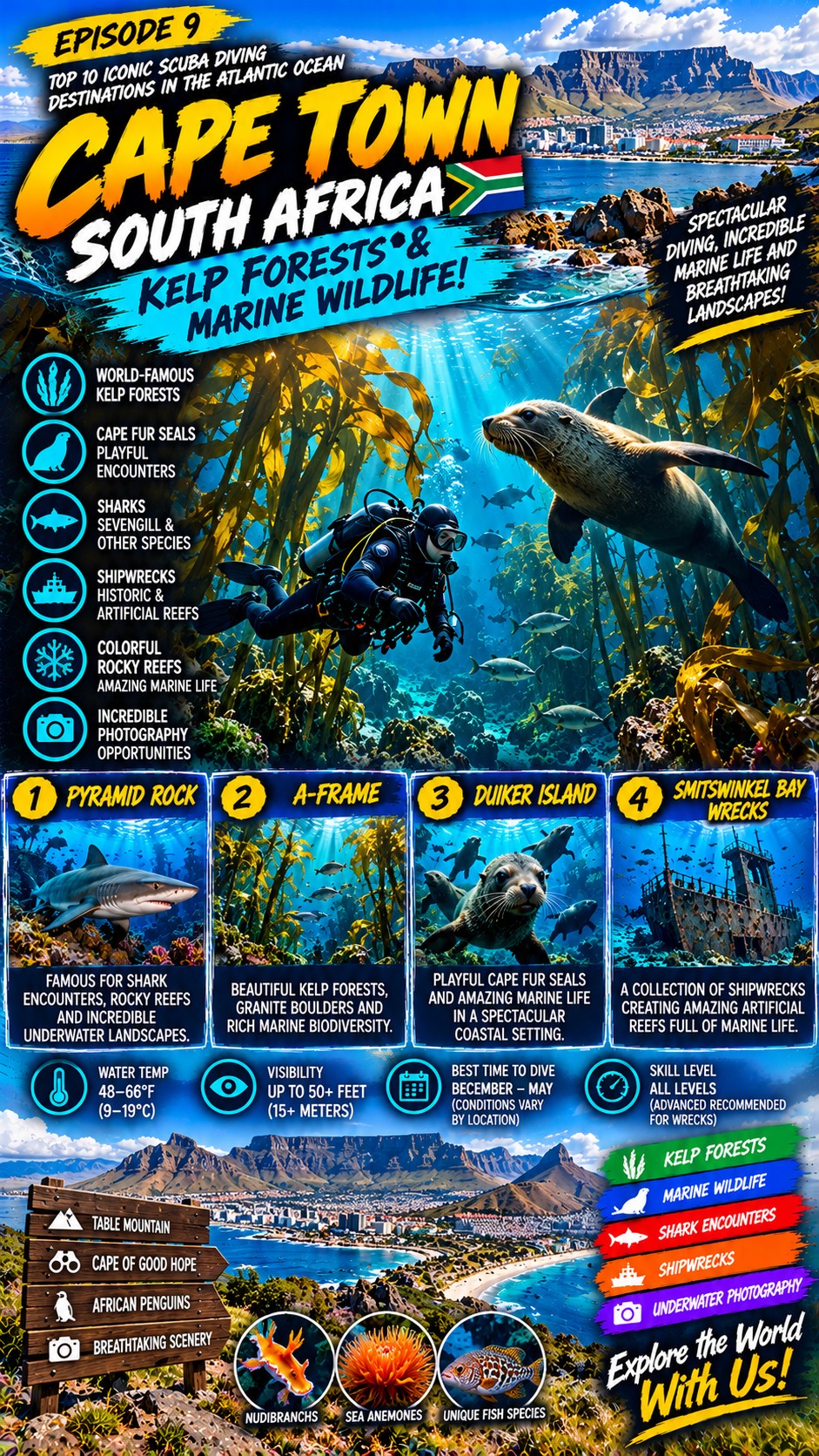
Welcome to Cape Town: Where Two Ocean Worlds Meet!
Imagine descending beneath the surface of the ocean into an extraordinary underwater forest.
Tall strands of golden-brown kelp rise toward the sunlight, creating enormous underwater canopies that move gently with the swell.
Schools of fish swim between the towering plants.
Colorful sea anemones cover the rocky reef.
Suddenly, a curious Cape fur seal appears, twisting effortlessly through the water before disappearing among the kelp.
Above the surface, dramatic mountains rise over the coastline, while the powerful Atlantic Ocean shapes one of the world's most spectacular marine environments.
Welcome to Cape Town, South Africa, one of the most fascinating cold-water diving destinations in the Southern Hemisphere!
Located near the southwestern tip of Africa, Cape Town offers an extraordinary combination of underwater kelp forests, rocky reefs, marine wildlife, shipwrecks, and dramatic coastal landscapes.
At Loves Park Scuba, we're excited to introduce Cape Town as the ninth destination in our series exploring the Top 10 Iconic Scuba Diving Destinations in the Atlantic Ocean.
1. What Makes Cape Town So Special?
Cape Town sits near the transition between the cold Atlantic waters influenced by the Benguela Current and the comparatively warmer marine environments farther east.
This oceanographic setting supports diverse underwater habitats and a remarkable variety of marine life.
Divers can enjoy:
-
Spectacular underwater kelp forests.
-
Encounters with Cape fur seals.
-
Colorful rocky reefs and marine invertebrates.
-
Fascinating shipwrecks.
-
Cold-water diving adventures.
-
Extraordinary underwater photography opportunities.
-
Unique endemic and regional marine species.
-
Beautiful coastal scenery and wildlife experiences.
Cape Town is not simply another coastal diving destination. It is an underwater wilderness filled with extraordinary marine life!
2. Kelp Forests: The Underwater Cathedrals of Cape Town
One of Cape Town's most remarkable attractions is its spectacular kelp forests.
These underwater ecosystems are dominated by large brown algae that attach to rocky seabeds and grow toward the sunlight.
Some kelp species create dense underwater canopies, forming habitats that resemble forests on land.
Why Are Kelp Forests So Important?
Kelp forests provide:
-
Shelter for fish and invertebrates.
-
Nursery habitat for many marine organisms.
-
Food for herbivorous marine species.
-
Protection from strong water movement.
-
Important ecological connections within coastal food webs.
-
Opportunities for marine research and conservation.
The Great African Seaforest
The Great African Seaforest is a vast kelp forest ecosystem extending along parts of southern Africa's coastline.
Cape Town's waters offer opportunities to explore portions of this remarkable marine environment.
Divers can swim through towering kelp fronds while observing fish, crustaceans, and colorful invertebrates.
Exploring a kelp forest is like entering a magical underwater cathedral built by nature!
3. Top Dive Sites in Cape Town
Pyramid Rock — Sharks & Rocky Reefs
Pyramid Rock, located in False Bay, is known for its rocky reef environment and historical associations with sevengill shark sightings.
Divers may encounter fish, invertebrates, and other marine species around its underwater structures.
Highlights: Rocky reefs, potential shark encounters, and underwater photography.
Shark sightings vary and are never guaranteed.
A-Frame — Kelp Forests & Marine Life
A-Frame is a popular shore-diving site near Simon's Town.
The area features granite boulders, kelp forests, and a rich variety of marine organisms.
Highlights: Kelp forests, rocky formations, and marine biodiversity.
Windmill Beach — Beautiful Underwater Landscapes
Windmill Beach offers access to rocky reefs and kelp-covered habitats.
Its underwater scenery makes it attractive for marine-life observation and photography.
Highlights: Kelp forests, boulders, colorful invertebrates, and underwater exploration.
Duiker Island — Cape Fur Seal Encounters
Duiker Island, near Hout Bay, is famous for its colony of Cape fur seals.
Some operators offer snorkeling experiences in nearby waters, allowing visitors to observe these energetic animals.
Scuba diving opportunities and access depend on local operator practices and conditions.
Highlights: Cape fur seals, marine wildlife, and coastal scenery.
Smitswinkel Bay Wrecks — An Underwater Shipwreck Collection
Smitswinkel Bay is known for a group of intentionally sunk vessels that serve as artificial reefs.
These wrecks provide habitat for marine life and offer fascinating opportunities for experienced wreck divers.
Highlights: Shipwrecks, artificial reefs, and underwater photography.
The wrecks lie at depths that may require advanced training and experience.
Important: Dive-site conditions, depth, visibility, currents, and access requirements should always be confirmed with a qualified local dive operator.
4. Cape Fur Seals: The Playful Acrobats of the Ocean
One of Cape Town's most exciting marine encounters is the opportunity to observe Cape fur seals (Arctocephalus pusillus pusillus).
These animals are extraordinary swimmers.
Underwater, they move with incredible speed, agility, and curiosity.
They may twist, roll, and dart around the water with remarkable ease.
What Makes Cape Fur Seals So Special?
-
Extraordinary underwater agility.
-
Curious behavior.
-
Impressive swimming ability.
-
Social colonies along the coastline.
-
Fascinating wildlife photography opportunities.
However, Cape fur seals are wild animals.
Divers and snorkelers should never touch, chase, feed, or attempt to interact physically with them.
Local authorities and operators may also impose restrictions on wildlife activities.
Watching a Cape fur seal move effortlessly through the water is one of South Africa's most unforgettable marine experiences!
5. Marine Life: What Can You Encounter?
Cape Town's waters support an extraordinary variety of marine organisms.
Cape Fur Seals
Among the region's most recognizable marine mammals.
Broadnose Sevengill Sharks
These large sharks inhabit coastal environments and have historically been observed around certain False Bay dive sites.
Catsharks
Several small shark species inhabit rocky reef and kelp forest environments.
Pyjama Sharks
These distinctive striped sharks are among the fascinating species associated with South African kelp forests.
Rays
Different ray species may be encountered over sandy areas and near rocky reefs.
Octopuses
Octopuses are important predators within kelp forest ecosystems and are fascinating photography subjects.
Nudibranchs
Colorful sea slugs provide extraordinary opportunities for macro photography.
Reef Fish
Hottentot seabream and other regional fish species inhabit kelp forests and rocky reefs.
Sea Anemones and Sponges
These colorful organisms cover rocks and add extraordinary beauty to underwater habitats.
Every dive offers a chance to discover the remarkable biodiversity of South Africa's coastal waters!
6. The Influence of the Atlantic Ocean
Cape Town's underwater environment is strongly influenced by ocean currents and seasonal weather.
The cold Benguela Current affects much of South Africa's west coast.
Cold, nutrient-rich water supports productive marine ecosystems, including kelp forests.
However, these same oceanographic conditions can produce cold temperatures and variable underwater visibility.
Divers should expect changing conditions.
Water temperature, wind direction, swell, and local geography can significantly affect dive-site selection.
Understanding local ocean conditions is essential for enjoying Cape Town's underwater environments safely.
7. When Is the Best Time to Dive Cape Town?
Cape Town offers diving opportunities throughout the year, but the best conditions depend on which side of the peninsula you plan to dive.
The Atlantic coast and False Bay often respond differently to seasonal winds and swell.
| Season | General Diving Conditions |
|---|---|
| December – February | Summer; Atlantic-side diving can benefit from favorable winds and upwelling, although water may be very cold |
| March – May | Transitional conditions with opportunities on both sides of the peninsula |
| June – August | Winter; False Bay may offer favorable diving windows between weather systems |
| September – November | Spring; variable conditions as seasonal patterns change |
Typical water temperatures range from approximately 48°F to 66°F (9–19°C), depending on location, season, depth, and upwelling.
Visibility can vary dramatically, from poor conditions to more than 50 feet (15 meters) during favorable periods.
Cape Town's diving conditions are highly site-dependent.
For this reason, local dive operators often select sites based on current weather and sea conditions rather than following a fixed itinerary.
8. Is Cape Town Suitable for Beginner Divers?
Cape Town offers dive sites for different experience levels.
Some sheltered shore dives can be suitable for newer divers under appropriate conditions.
However, cold water, swell, limited visibility, and complex underwater terrain can create additional challenges.
At Loves Park Scuba, we recommend considering:
Open Water Diver
Build the essential knowledge and skills for recreational scuba diving.
Advanced Adventure / Advanced Open Water
Gain experience in different underwater environments.
Dry Suit Diving
Develop skills for comfortable and controlled diving in colder water.
Perfect Buoyancy
Improve control while moving through kelp forests and rocky reefs.
Underwater Navigation
Develop confidence in environments where visibility can change.
Wreck Diving
Learn the fundamentals of responsible wreck exploration.
Underwater Photography
Capture kelp forests, seals, sharks, nudibranchs, and extraordinary marine scenery.
Enriched Air Nitrox
Learn enriched-air dive planning where appropriate for the dive profile.
Proper training, experience, and equipment preparation are essential for safe and enjoyable Cape Town diving.
9. Marine Conservation: Protecting the Great African Seaforest
Kelp forests are among the world's most important coastal marine ecosystems.
They provide habitat, food, and shelter for numerous species.
However, these ecosystems face threats from pollution, climate change, habitat disturbance, and other human activities.
Responsible diving practices include:
-
Maintain excellent buoyancy.
-
Avoid pulling or damaging kelp.
-
Never touch or chase marine wildlife.
-
Respect marine protected area regulations.
-
Avoid disturbing sharks and seals.
-
Secure equipment to prevent contact with the seabed.
-
Never remove marine organisms.
-
Support responsible conservation initiatives.
Protecting kelp forests helps preserve one of the Atlantic Ocean's most extraordinary underwater ecosystems.
10. Beyond Diving: Discover Cape Town's Extraordinary Beauty
Cape Town is internationally famous for its spectacular landscapes and cultural attractions.
Table Mountain
One of South Africa's most recognizable natural landmarks, offering breathtaking views of the city and coastline.
Cape Point
Explore dramatic coastal scenery within the Cape of Good Hope section of Table Mountain National Park.
Boulders Beach
Visit the famous African penguin colony near Simon's Town.
Chapman's Peak Drive
Enjoy one of the world's most spectacular coastal roads.
V&A Waterfront
Discover restaurants, shops, museums, and harbor attractions.
Kirstenbosch National Botanical Garden
Explore beautiful gardens located against the eastern slopes of Table Mountain.
Local Food and Culture
Experience Cape Town's diverse cuisine, history, and cultural heritage.
Cape Town combines extraordinary underwater adventures with some of Africa's most spectacular scenery.
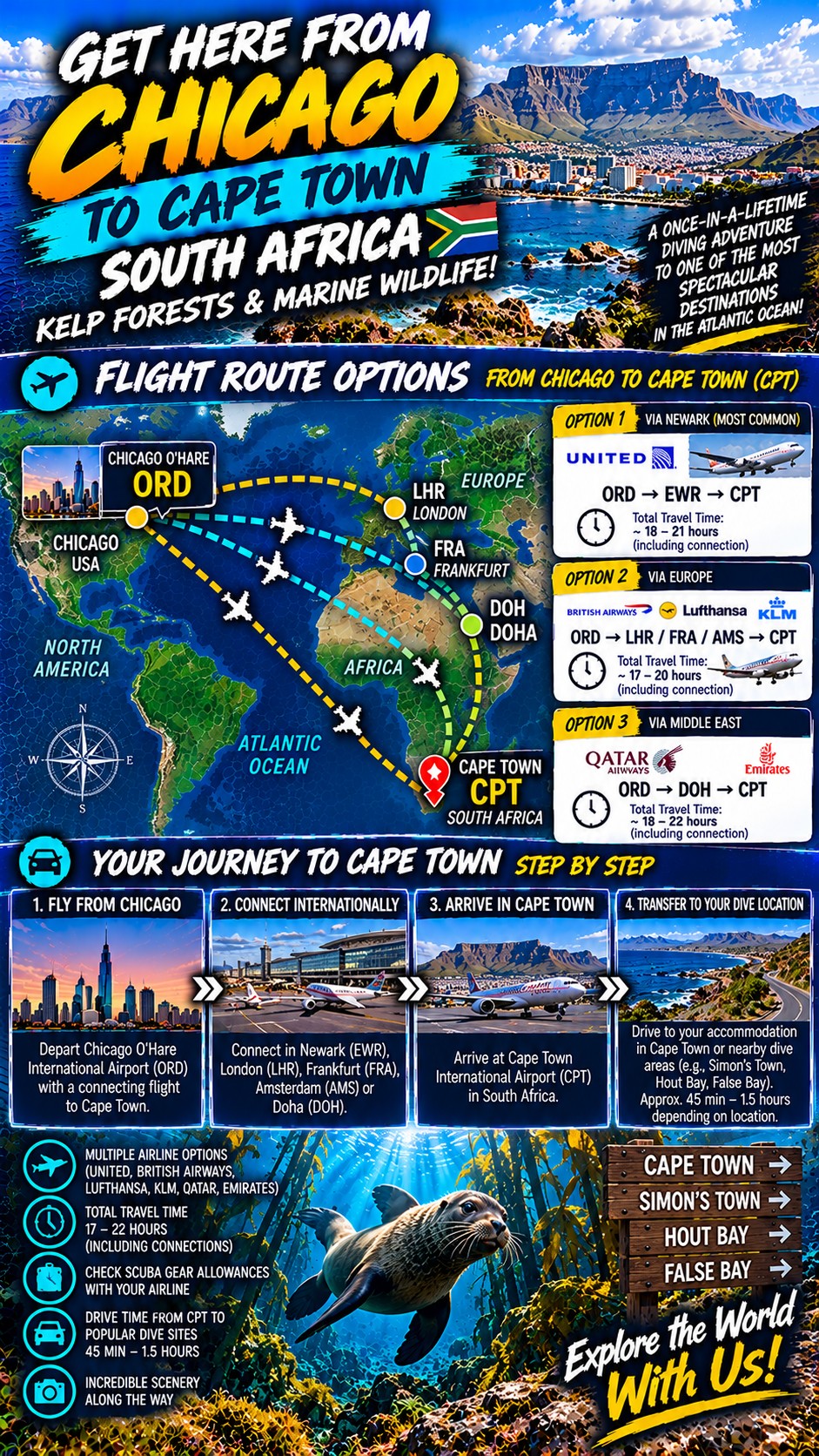
11. How Do You Get to Cape Town from Chicago?
Travelers departing from Chicago generally reach Cape Town through one or more international flight connections.
The main destination airport is Cape Town International Airport (CPT).
Possible itineraries include:
Chicago O'Hare (ORD) → Newark (EWR) → Cape Town (CPT)
Chicago O'Hare (ORD) → European Hub → Cape Town (CPT)
Chicago O'Hare (ORD) → Doha (DOH) → Cape Town (CPT)
Depending on airline schedules, connections may be available through cities such as London, Amsterdam, Frankfurt, or Doha.
After arriving in Cape Town, travelers can continue by road to their accommodation and dive operator.
Many popular diving areas are located around the Cape Peninsula, including Simon's Town and Hout Bay.
Travelers should confirm current flight schedules, baggage allowances, entry requirements, and transportation arrangements before booking.
For divers carrying heavy equipment, advance planning is especially important.
Why Cape Town Belongs on Your Diving Bucket List
There are many extraordinary scuba diving destinations throughout the Atlantic Ocean, but Cape Town offers something truly special.
Magical underwater kelp forests.
Playful Cape fur seals.
Fascinating shark species.
Colorful rocky reefs.
Historic shipwrecks.
Extraordinary marine biodiversity.
And some of the most breathtaking coastal scenery in the world.
Cape Town is not simply another diving destination. It is an underwater wilderness waiting to be explored!
Your Cape Town Adventure Starts at Loves Park Scuba!
At Loves Park Scuba, we believe scuba diving is about exploring the world, developing our skills, protecting marine ecosystems, and creating unforgettable memories.
Whether you dream of swimming through underwater kelp forests, photographing marine wildlife, exploring shipwrecks, or discovering South Africa's spectacular coastline, our team is here to help you prepare.
From scuba certification and advanced training to drysuit skills, equipment selection, and dive travel planning, we're ready to help.
Are you ready to discover Cape Town — Kelp Forests & Marine Wildlife?
Visit Loves Park Scuba and let us help you prepare for your next extraordinary Atlantic diving adventure!
LOVES PARK SCUBA
Dive Into Adventure — Explore the World With Us!
COMING NEXT IN OUR ATLANTIC DIVING SERIES
Episode 10 — Berlengas Islands, Portugal: Atlantic Reefs & Hidden Underwater Treasures!
Discover spectacular rocky reefs, fascinating underwater caves, colorful marine life, and extraordinary diving adventures in Portugal's beautiful Berlengas archipelago.
10 Iconic Atlantic Destinations. One Passion for Diving!
