
CHAPTER 1 — WHAT IS A DIVE COMPUTER ALGORITHM?
Martin Gomez Aug 11, 2026
CHAPTER 1 — WHAT IS A DIVE COMPUTER ALGORITHM?
Understanding Your Dive Computer — Part 1
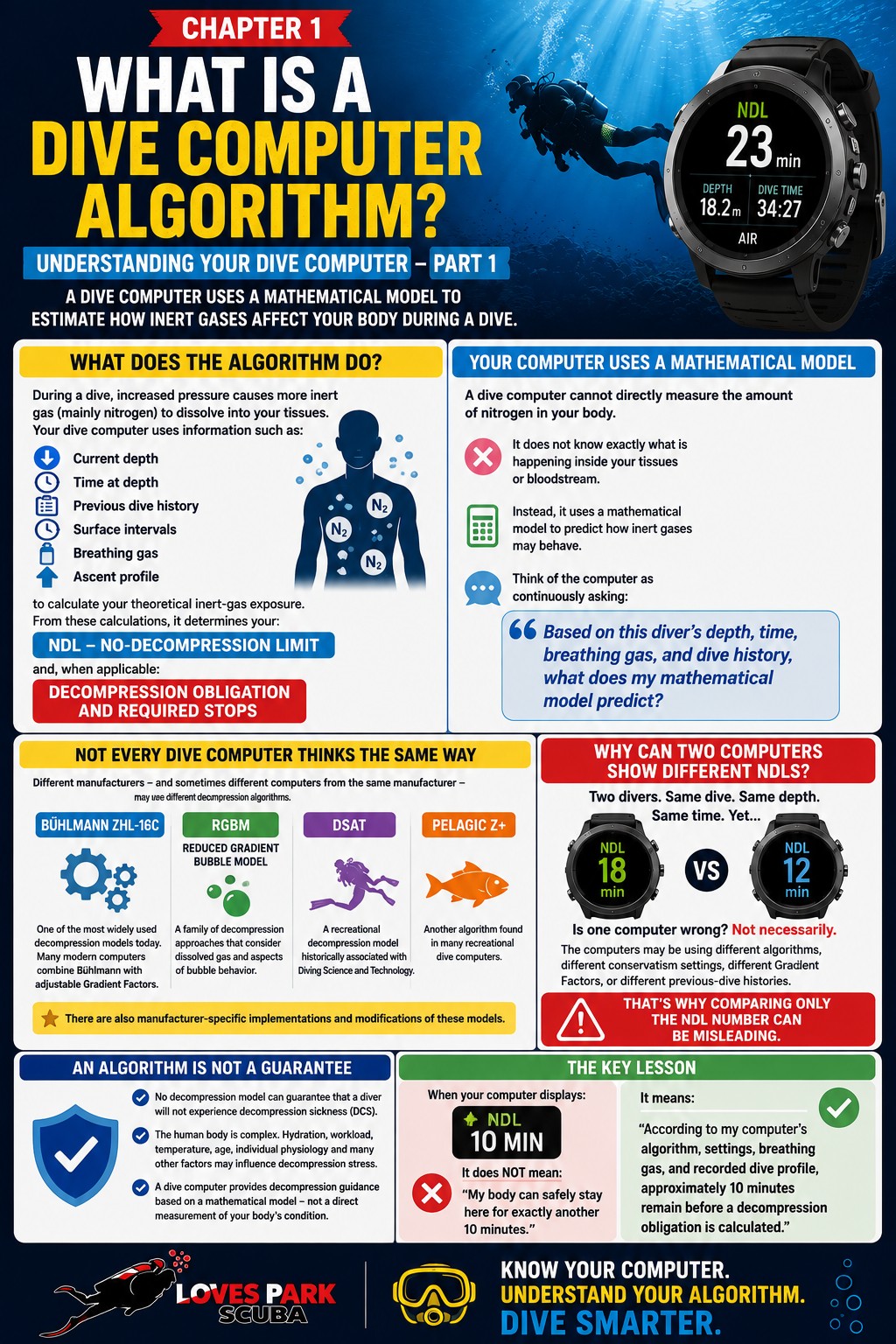
Every time you dive, your dive computer is doing much more than displaying your depth, dive time, and remaining NDL.
Behind the screen, it is continuously performing mathematical calculations designed to estimate how inert gases—primarily nitrogen—are being absorbed and released by your body throughout the dive.
The mathematical system used to make these calculations is called a decompression algorithm.
What Does the Algorithm Do?
During a dive, increased ambient pressure causes more inert gas to dissolve into the body's tissues.
Your dive computer uses information such as:
-
Current depth
-
Time at depth
-
Previous dive history
-
Surface intervals
-
Breathing gas
-
Ascent profile
to continuously calculate your theoretical inert-gas exposure.
From these calculations, the computer determines information such as your:
NDL — No-Decompression Limit
and, when applicable:
Decompression obligation and required stops.
Your Computer Is Using a Mathematical Model
This is one of the most important concepts for every diver to understand:
A dive computer cannot directly measure the amount of nitrogen in your body.
It does not know exactly what is happening inside your tissues or bloodstream.
Instead, it uses a mathematical model to predict how inert gases may behave in the body.
Think of the computer as continuously asking:
“Based on this diver's depth, time, breathing gas, and dive history, what does my mathematical model predict?”
That distinction is extremely important.
Not Every Dive Computer Thinks the Same Way
Different manufacturers—and sometimes different computers from the same manufacturer—may use different decompression algorithms.
Some of the names you may encounter include:
Bühlmann ZHL-16C
One of the most widely used decompression models today. Many modern computers combine Bühlmann with adjustable Gradient Factors.
RGBM — Reduced Gradient Bubble Model
A family of decompression approaches associated with modeling both dissolved gas and aspects of bubble behavior.
DSAT
A recreational decompression model historically associated with Diving Science and Technology.
Pelagic Z+
Another algorithm found in recreational dive computers.
There are also manufacturer-specific implementations and modifications of established decompression models.
So Why Can Two Computers Show Different NDLs?
Imagine two divers.
They enter the water together.
They descend together.
They remain at essentially the same depth.
They have the same bottom time.
Yet one computer shows:
NDL: 18 minutes
while the other shows:
NDL: 12 minutes
Is one computer wrong?
Not necessarily.
The computers may be using different algorithms, different conservatism settings, different Gradient Factors, or they may have different previous-dive histories.
This is why comparing only the NDL number without understanding the computer behind it can be misleading.
An Algorithm Is Not a Guarantee
No decompression model can guarantee that a diver will not experience decompression sickness.
The human body is considerably more complicated than any mathematical model.
Hydration, workload, temperature, age, individual physiology and many other factors may influence decompression stress.
A dive computer therefore provides decompression guidance based on a mathematical model—not a direct measurement of your body's condition.
The Key Lesson
When you look at your dive computer and see:
NDL 10 MIN
that does not mean:
“My body can safely stay here for exactly another 10 minutes.”
It means something closer to:
“Based on my algorithm, settings, breathing gas and recorded dive profile, approximately 10 minutes remain before my model calculates a decompression obligation.”
That is a much better way to understand what your computer is actually telling you.
