
CHAPTER 2 — WHY TWO DIVE COMPUTERS SHOW DIFFERENT NDLs
Martin Gomez Aug 11, 2026
CHAPTER 2 — WHY TWO DIVE COMPUTERS SHOW DIFFERENT NDLs
Understanding Your Dive Computer — Part 2
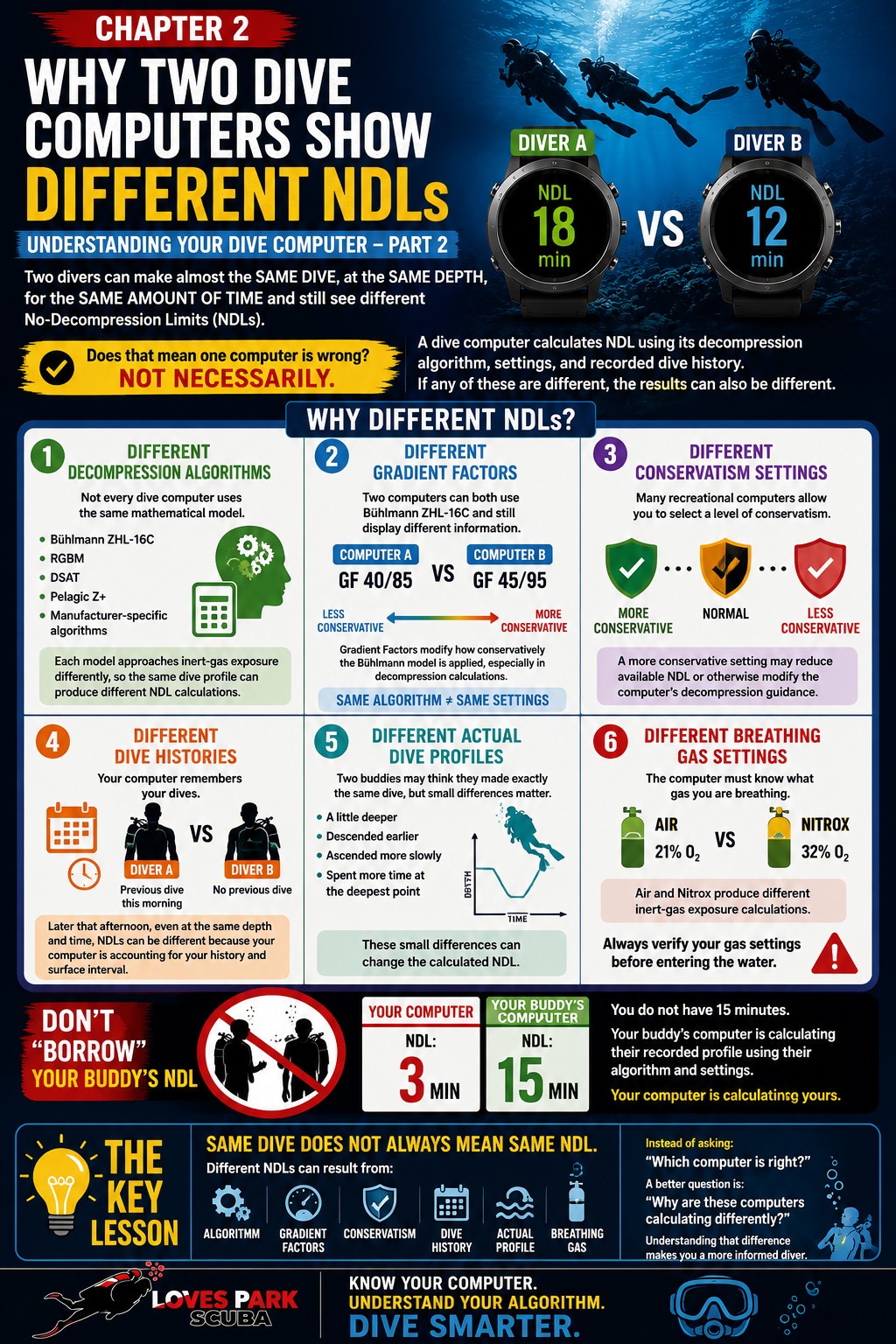
Two divers can make the same dive, at the same depth, for the same amount of time and still see different No-Decompression Limits (NDLs) on their computers.
Does that mean one computer is wrong?
Not necessarily.
A dive computer calculates NDL using its decompression algorithm, settings, and recorded dive history. If any of these are different, the results can also be different.
SAME DIVE — DIFFERENT NUMBERS
Imagine two divers at the same depth:
DIVER A → NDL: 18 MIN
DIVER B → NDL: 12 MIN
Both computers may be operating correctly.
So what causes the difference?
1. DIFFERENT DECOMPRESSION ALGORITHMS
Not every dive computer uses the same mathematical model.
Examples include:
-
Bühlmann ZHL-16C
-
RGBM
-
DSAT
-
Pelagic Z+
-
Manufacturer-specific algorithms
Each model approaches inert-gas exposure differently. As a result, the same dive profile can produce different NDL calculations.
2. DIFFERENT GRADIENT FACTORS
Two computers can both use Bühlmann ZHL-16C and still display different information.
Why?
One computer might be configured at:
GF 40/85
while another is configured at:
GF 45/95
Gradient Factors modify how conservatively the Bühlmann model is applied, particularly in decompression calculations.
So:
SAME ALGORITHM ≠ SAME SETTINGS
And therefore, the computers may not produce identical results.
3. DIFFERENT CONSERVATISM SETTINGS
Many recreational computers allow the diver to select a level of conservatism.
For example:
More Conservative → Normal → Less Conservative
A more conservative setting may reduce available NDL or otherwise modify the computer's decompression guidance.
This means two identical computers can potentially display different NDLs simply because their settings are different.
4. DIFFERENT DIVE HISTORIES
This is one of the most important reasons.
Your computer remembers your dives.
Imagine that Diver A made a morning dive, while Diver B did not.
Later that afternoon, they enter the water together.
Even though they are now:
At the same depth
At the same time
On the same dive
their computers may calculate different NDLs because Diver A's computer is accounting for the previous dive and surface interval.
Your computer's history matters.
5. DIFFERENCES IN THE ACTUAL DIVE PROFILE
Two buddies may think they made exactly the same dive, but their computers may have recorded slightly different profiles.
One diver may have been:
3 feet / 1 meter deeper
for several minutes.
One may have descended earlier.
One may have ascended more slowly.
One may have spent more time at the deepest portion of the dive.
Those small differences can affect the calculated NDL.
6. DIFFERENT BREATHING GAS SETTINGS
The computer must know what gas you are breathing.
For example:
Air — 21% O₂
versus
Nitrox — 32% O₂
will generally produce different nitrogen exposure calculations.
An incorrect gas setting can therefore produce misleading decompression information.
Always verify your gas settings before entering the water.
DON'T “BORROW” YOUR BUDDY'S NDL
Imagine:
YOUR COMPUTER
NDL: 3 MIN
YOUR BUDDY'S COMPUTER
NDL: 15 MIN
You should not assume that you have another 15 minutes simply because your buddy's computer says so.
Your buddy's computer is calculating their recorded profile using their computer's algorithm and settings.
Your computer is calculating yours.
THE KEY LESSON
SAME DIVE DOES NOT ALWAYS MEAN SAME NDL.
Different NDLs can result from:
Algorithm • Gradient Factors • Conservatism • Dive History • Actual Profile • Breathing Gas
Instead of asking:
“Which computer is right?”
A better question is:
“Why are these computers calculating differently?”
Understanding that difference makes you a more informed diver.
KNOW YOUR COMPUTER.
UNDERSTAND YOUR ALGORITHM.
DIVE SMARTER.
NEXT: CHAPTER 3 — UNDERSTANDING BÜHLMANN ZHL-16C
