
CHAPTER 3 — UNDERSTANDING BÜHLMANN ZHL-16C
Martin Gomez Aug 11, 2026
CHAPTER 3 — UNDERSTANDING BÜHLMANN ZHL-16C
Understanding Your Dive Computer — Part 3
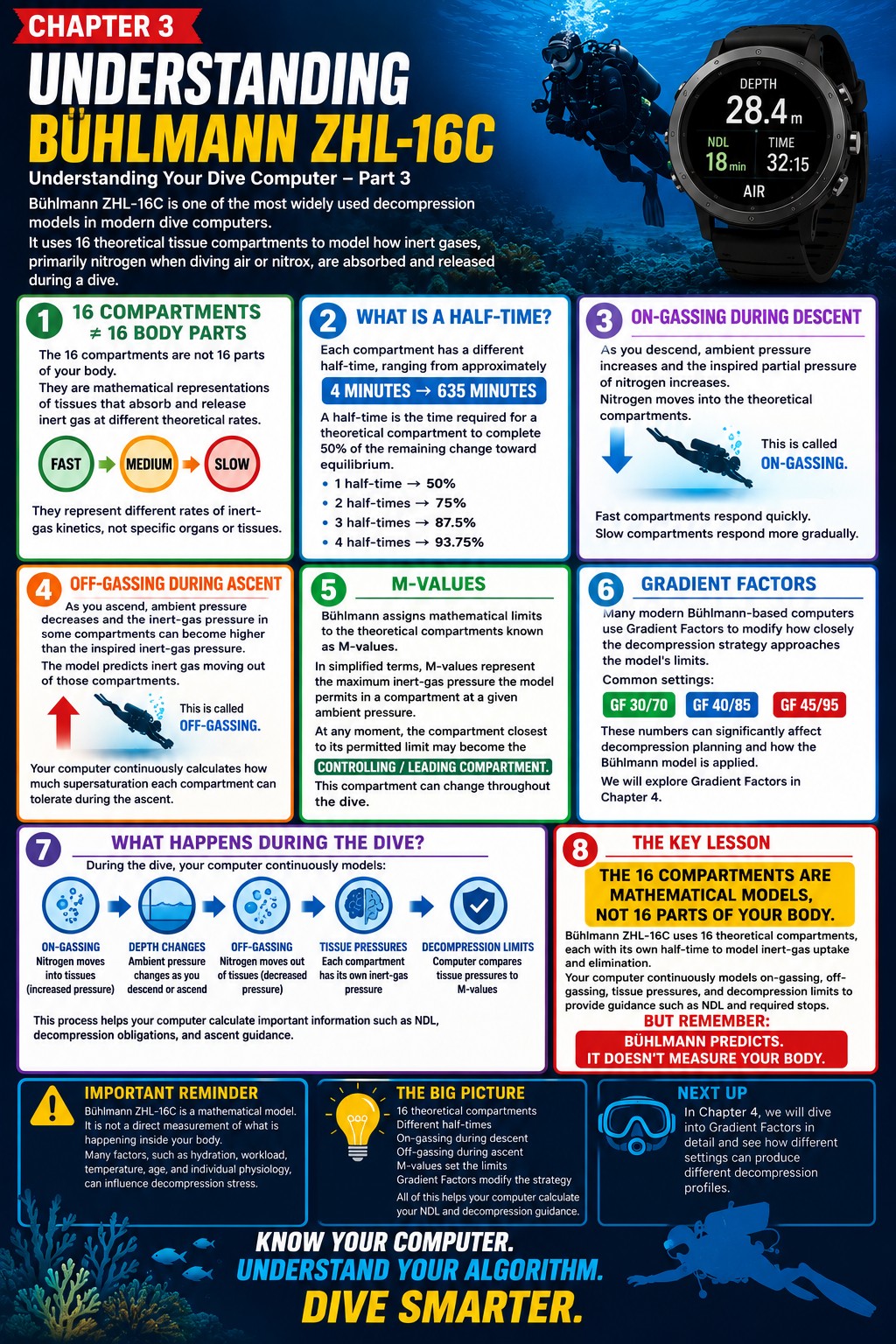
Bühlmann ZHL-16C is one of the most widely used decompression models in modern dive computers.
But what does ZHL-16C actually mean, and what are those famous 16 tissue compartments?
The first thing to understand is:
Your computer is NOT tracking 16 actual parts of your body.
The compartments are mathematical models used to represent tissues that absorb and release inert gases at different theoretical rates.
1. WHAT ARE TISSUE COMPARTMENTS?
When we descend, increased ambient pressure causes inert gases—primarily nitrogen when diving air or nitrox—to move into the body's tissues.
Different tissues do not absorb and release gas at the same rate.
To model this behavior mathematically, Bühlmann uses 16 theoretical compartments, each with a different half-time.
Think of them as:
FAST COMPARTMENTS → MEDIUM COMPARTMENTS → SLOW COMPARTMENTS
They do not correspond directly to specific organs.
For example, we should not say:
Compartment 1 = blood
Compartment 5 = muscle
Compartment 16 = bone
That would be an oversimplification.
They are mathematical representations of different rates of inert-gas uptake and elimination.
2. WHAT IS A HALF-TIME?
A half-time describes how quickly a theoretical compartment moves halfway toward equilibrium with the surrounding inert-gas pressure.
For nitrogen, the ZHL-16C compartments range from approximately:
4 MINUTES → 635 MINUTES
A fast compartment responds quickly to changes in pressure.
A slow compartment responds much more gradually.
Importantly, one half-time does not mean the compartment is completely saturated or completely cleared.
It means it has completed approximately 50% of the remaining change toward equilibrium.
Then another half-time moves it halfway through what remains.
Conceptually:
1 half-time → 50%
2 half-times → 75%
3 half-times → 87.5%
4 half-times → 93.75%
This exponential behavior is fundamental to understanding decompression models.
3. FAST VS. SLOW COMPARTMENTS
FAST COMPARTMENTS
Fast compartments react quickly to changes in depth.
They can become important during shorter and/or deeper exposures because inert-gas pressure changes rapidly.
SLOW COMPARTMENTS
Slow compartments take much longer to change.
They become increasingly relevant during:
-
Long dives
-
Repetitive dives
-
Multiple dives over several days
-
Long inert-gas exposures
This helps explain why your previous dive history and surface interval matter.
Your computer continues modeling inert-gas elimination even after you leave the water.
4. WHAT HAPPENS DURING DESCENT?
As you descend:
Ambient pressure increases.
The inspired partial pressure of nitrogen increases when breathing a nitrogen-containing gas.
The model predicts that nitrogen begins moving into the theoretical compartments.
This is commonly called:
ON-GASSING
Fast compartments respond relatively quickly.
Slow compartments respond more gradually.
5. WHAT HAPPENS DURING ASCENT?
As you ascend:
Ambient pressure decreases.
The inert-gas pressure in some theoretical compartments can now be higher than the inspired inert-gas pressure.
The model predicts inert gas moving out of those compartments.
This is commonly called:
OFF-GASSING
But we cannot simply ascend from any depth to the surface without considering how much supersaturation the model permits.
That's where another important Bühlmann concept appears.
6. M-VALUES
Bühlmann assigns mathematical limits to the theoretical compartments.
These limits are commonly referred to as:
M-VALUES
In simplified terms, an M-value represents the model's tolerated maximum inert-gas pressure for a compartment at a given ambient pressure.
As you ascend and ambient pressure decreases, the relationship between the compartment's calculated inert-gas pressure and its permitted limit becomes increasingly important.
Your computer continuously performs these calculations in the background.
7. THE CONTROLLING COMPARTMENT
At any particular moment, one compartment may be closest to its permitted limit.
This is often referred to as the:
CONTROLLING — OR LEADING — COMPARTMENT
But this can change throughout the dive.
A faster compartment might be controlling during one part of the profile, while another compartment becomes controlling later.
So there is no single compartment that controls every dive.
8. WHERE DO GRADIENT FACTORS COME IN?
Bühlmann provides the underlying mathematical limits.
Many modern dive computers use Gradient Factors to modify how closely the decompression strategy approaches those limits.
You might see settings such as:
GF 30/70
GF 40/85
GF 45/95
These numbers can significantly affect decompression planning and how the Bühlmann model is applied.
But Gradient Factors deserve their own chapter.
We'll cover them in:
