
CHAPTER 4 — UNDERSTANDING GRADIENT FACTORS
Martin Gomez Aug 11, 2026
CHAPTER 4 — UNDERSTANDING GRADIENT FACTORS
Understanding Your Dive Computer — Part 4
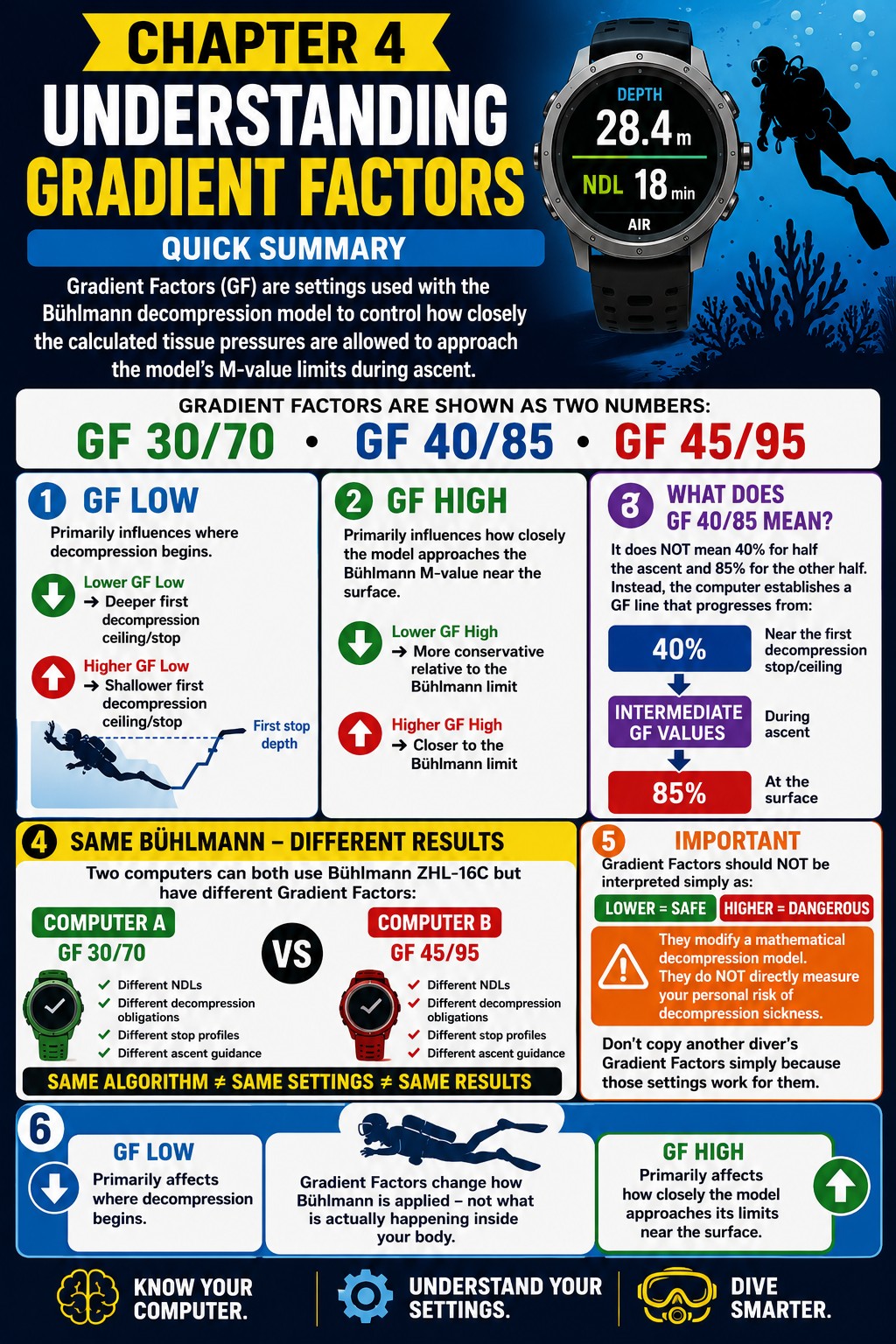
If your dive computer uses Bühlmann ZHL-16C, you may have seen settings such as:
GF 30/70
GF 40/85
GF 45/95
But what do these numbers actually mean?
GF stands for Gradient Factor.
Gradient Factors are a way of applying additional conservatism to the Bühlmann model by controlling how closely the calculated tissue inert-gas pressure is allowed to approach the model's M-value limits during decompression.
A Gradient Factor is expressed as a percentage.
1. FIRST, REMEMBER M-VALUES
In Chapter 3, we learned that Bühlmann uses mathematical limits called:
M-VALUES
An M-value represents, in simplified terms, the maximum inert-gas pressure that the model permits in a theoretical tissue compartment at a particular ambient pressure.
Gradient Factors allow us to operate at a selected fraction of the gradient between ambient pressure and that Bühlmann limit.
Think of it conceptually as:
Ambient Pressure → GF Limit → Bühlmann M-Value
A lower GF generally means staying farther away from the Bühlmann limit.
2. WHY ARE THERE TWO NUMBERS?
Gradient Factors are normally written as two numbers:
GF LOW / GF HIGH
For example:
40 / 85
These numbers perform different jobs during a decompression ascent.
3. WHAT IS GF LOW?
GF LOW primarily influences where decompression begins.
For a decompression dive, GF Low helps determine the pressure/depth at which the first decompression ceiling appears.
In general:
LOWER GF LOW
→ First stop may begin deeper.
HIGHER GF LOW
→ First stop may begin shallower.
For example:
GF 30/85
will generally begin decompression deeper than:
GF 50/85
for the same modeled profile.
But remember: GF Low should not simply be interpreted as:
“Lower number = safer.”
Decompression physiology is more complicated than that.
4. WHAT IS GF HIGH?
GF HIGH primarily influences how closely the model approaches the Bühlmann M-value near the surface.
This makes GF High especially important for the final portion of the ascent and overall decompression obligation.
In general:
LOWER GF HIGH
→ More conservative relative to the Bühlmann limit.
HIGHER GF HIGH
→ Closer to the Bühlmann limit.
For example:
GF 40/70
is more conservative relative to the Bühlmann M-value near the surface than:
GF 40/95
for the same modeled exposure.
5. LET'S COMPARE THREE SETTINGS
Consider:
