
COCOS ISLAND, COSTA RICA — THE HAMMERHEAD SHARK SANCTUARY! Top 10 Iconic Scuba Diving Destinations in the Pacific Ocean — Episode 3
Martin Gomez Oct 29, 2026
COCOS ISLAND, COSTA RICA — THE HAMMERHEAD SHARK SANCTUARY!
Top 10 Iconic Scuba Diving Destinations in the Pacific Ocean — Episode 3
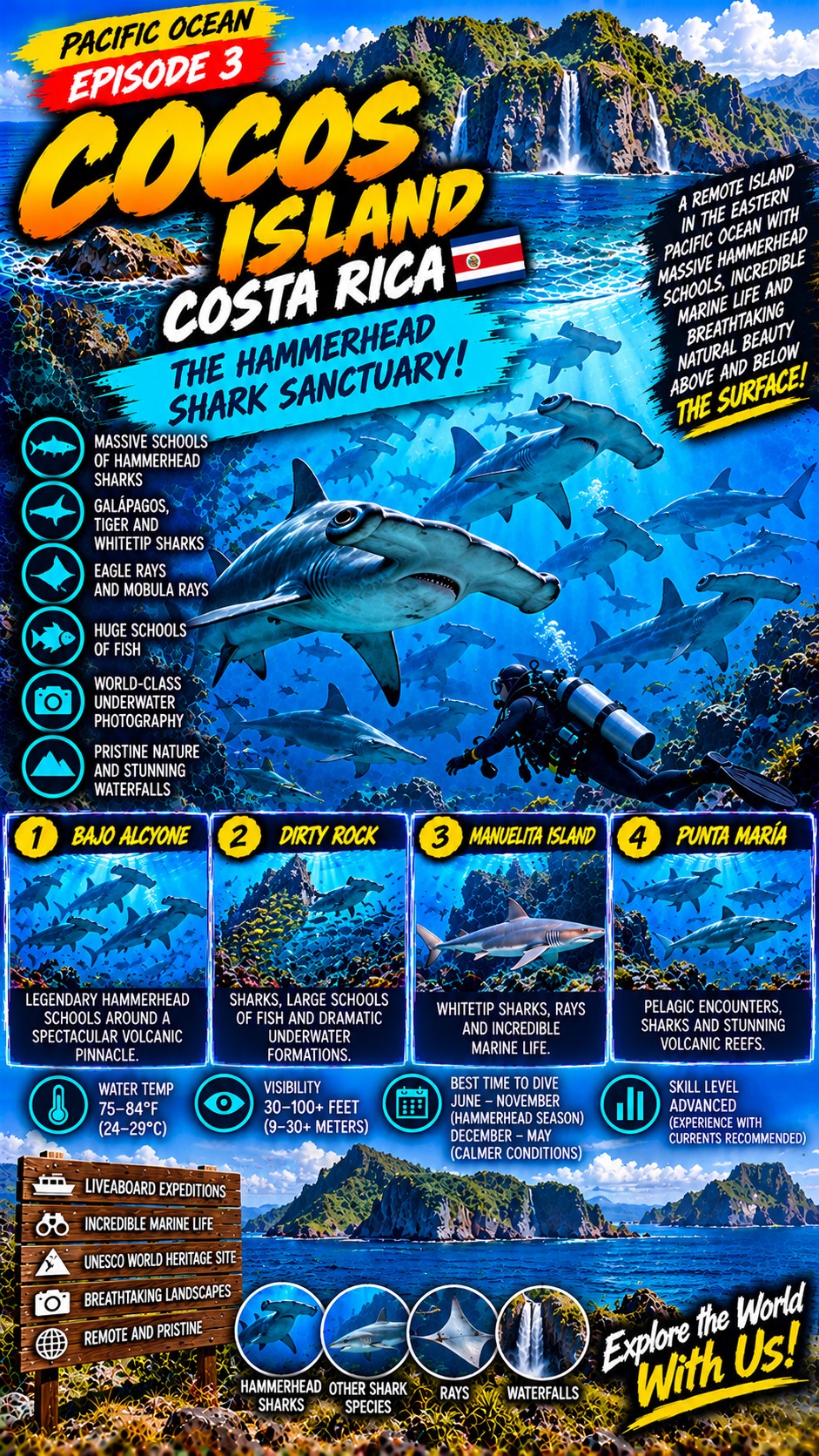
Discover Massive Schools of Hammerhead Sharks, Remote Volcanic Reefs, Powerful Ocean Currents, and One of the Wildest Marine Ecosystems on Earth!
Welcome to Cocos Island: Into the Wild Heart of the Pacific!
Imagine descending into the deep blue waters of the Pacific Ocean.
The surface disappears above you as you approach a massive underwater volcanic formation.
A school of jacks moves along the reef.
Whitetip reef sharks rest beneath rocky ledges while powerful currents carry nutrient-rich water through the surrounding ocean.
Suddenly, several shadows emerge from the blue.
One hammerhead shark appears.
Then another.
Within moments, an extraordinary school of scalloped hammerhead sharks moves across the underwater landscape.
Dozens of sharks swim together in a spectacular formation, creating one of the most unforgettable experiences in scuba diving.
Above the surface, towering green cliffs rise from the ocean, covered in dense tropical rainforest.
Waterfalls cascade down the mountains toward the sea.
There are no beach resorts, busy marinas, or crowded coastal towns.
Only an isolated tropical island surrounded by an immense wilderness of blue water.
Welcome to Cocos Island, Costa Rica — The Hammerhead Shark Sanctuary!
At Loves Park Scuba, we're excited to continue our journey through the world's most extraordinary Pacific diving destinations.
TOP 10 ICONIC SCUBA DIVING DESTINATIONS IN THE PACIFIC OCEAN!
Our third adventure takes us to a remote island where marine predators, spectacular volcanic landscapes, and ocean conservation come together.
1. Where Is Cocos Island?
Cocos Island, known in Spanish as Isla del Coco, belongs to Costa Rica.
It is located approximately 340 miles (550 kilometers) southwest of mainland Costa Rica, deep in the eastern tropical Pacific Ocean.
Unlike Costa Rica's popular mainland beaches, Cocos Island is an isolated oceanic island surrounded by deep water.
The island is covered in lush tropical rainforest and is famous for its dramatic cliffs, waterfalls, and extraordinary biodiversity.
Cocos Island National Park is a UNESCO World Heritage Site.
The surrounding marine environment is especially important for migratory sharks and other large ocean predators.
What Makes Cocos Island Extraordinary?
-
Large aggregations of scalloped hammerhead sharks.
-
Whitetip reef sharks.
-
Galápagos sharks.
-
Tiger sharks.
-
Eagle rays.
-
Mobula rays.
-
Large schools of jacks.
-
Tuna and other pelagic fish.
-
Volcanic underwater pinnacles.
-
Strong ocean currents.
-
Remote, protected marine environments.
Cocos Island is one of the world's most extraordinary destinations for experienced divers seeking encounters with sharks and large pelagic marine life!
2. Scalloped Hammerhead Sharks: The Kings of Cocos Island
The most famous attraction at Cocos Island is the scalloped hammerhead shark (Sphyrna lewini).
These magnificent sharks are known for their distinctive hammer-shaped heads and their tendency to form large aggregations.
Cocos Island has long been recognized as an important location for hammerhead sharks.
Why Do Hammerheads Gather Here?
The island's position in the eastern Pacific provides access to productive oceanic waters.
Underwater pinnacles and rocky formations create important habitats and cleaning areas.
Hammerhead sharks may gather around these locations, where cleaner fish remove parasites from their bodies.
The Ultimate Hammerhead Encounter
Imagine positioning yourself near a rocky underwater formation.
Your dive guide signals toward the blue water.
A group of hammerheads approaches.
More sharks appear behind them.
Soon, an entire school moves past the reef.
The experience is breathtaking.
Responsible Shark Diving
At Loves Park Scuba, we believe shark encounters should always respect natural animal behavior.
Divers should:
-
Never chase sharks.
-
Never attempt to touch them.
-
Avoid blocking their swimming paths.
-
Maintain excellent buoyancy.
-
Follow the dive guide's instructions.
-
Respect cleaning stations and protected habitats.
Observing wild hammerhead sharks in their natural environment is a privilege that deserves respect and conservation.
3. Bajo Alcyone: The Legendary Hammerhead Dive
One of the most famous dive sites at Cocos Island is Bajo Alcyone.
This submerged volcanic pinnacle rises from deep ocean water and is internationally recognized for its hammerhead shark encounters.
What Makes Bajo Alcyone So Famous?
The pinnacle attracts marine life and provides opportunities to observe sharks moving through the surrounding blue water.
Divers may encounter:
-
Scalloped hammerhead sharks.
-
Galápagos sharks.
-
Eagle rays.
-
Large schools of jacks.
-
Tuna.
-
Other pelagic species.
Diving Conditions
Bajo Alcyone is an advanced dive site.
Currents can be strong, and divers must be comfortable descending and positioning themselves around exposed underwater formations.
The dive plan depends on current conditions, visibility, and the experience of the group.
For many experienced divers, Bajo Alcyone represents one of the greatest hammerhead shark diving experiences on Earth!
4. Dirty Rock: Sharks, Fish Schools, and Volcanic Walls
Despite its unusual name, Dirty Rock is one of the most exciting dive sites around Cocos Island.
This offshore volcanic formation attracts a remarkable variety of marine life.
What Can Divers Encounter?
-
Hammerhead sharks.
-
Whitetip reef sharks.
-
Large schools of jacks.
-
Eagle rays.
-
Reef fish.
-
Occasional larger pelagic visitors.
The rocky structure creates a dramatic underwater environment.
Divers may observe large schools of fish moving around the formation while sharks patrol the surrounding waters.
Underwater Photography
Dirty Rock offers opportunities to capture images of:
-
Sharks swimming through blue water.
-
Massive schools of fish.
-
Dramatic rocky walls.
-
Marine life interacting with ocean currents.
Dirty Rock is an unforgettable combination of volcanic scenery and Pacific marine biodiversity.
5. Manuelita Island: A Spectacular Underwater Ecosystem
Manuelita is a small island near Cocos Island.
Its underwater environment includes rocky formations, walls, and marine habitats that attract a wide variety of species.
Manuelita Outside
This area is known for shark encounters and impressive underwater scenery.
Depending on conditions, divers may observe hammerheads, Galápagos sharks, rays, and large fish schools.
Manuelita Coral Garden
The more sheltered areas around Manuelita can offer opportunities to observe reef life and underwater biodiversity.
Marine life may include:
-
Reef fish.
-
Whitetip reef sharks.
-
Rays.
-
Sea turtles.
-
Various invertebrates.
Why Manuelita Is Special
Manuelita offers a combination of pelagic wildlife encounters and rocky reef exploration.
It is one of the essential diving areas on many Cocos Island expeditions.
6. Punta María: Sharks and Dramatic Underwater Formations
Punta María is another recognized dive site at Cocos Island.
This underwater formation provides opportunities to observe marine life around rocky pinnacles and deeper structures.
Marine Life Highlights
-
Hammerhead sharks.
-
Galápagos sharks.
-
Whitetip reef sharks.
-
Large schools of fish.
-
Rays.
-
Other ocean predators.
As with other Cocos Island sites, conditions can change rapidly.
Divers must follow the guidance of experienced local dive professionals.
Punta María adds another spectacular chapter to the underwater adventure of Cocos Island.
7. The Sharks of Cocos Island
Although hammerheads are the most famous attraction, several other shark species inhabit or visit the waters surrounding Cocos Island.
Whitetip Reef Sharks
These sharks are commonly observed resting near rocky formations or swimming along the reef.
Galápagos Sharks
Large sharks that inhabit offshore islands and oceanic environments.
Tiger Sharks
Powerful predators that are sometimes encountered around the island.
Silky Sharks
Open-water sharks that may appear around offshore environments.
Scalloped Hammerhead Sharks
The most iconic shark species associated with Cocos Island.
Whale Sharks
Occasional visitors to the region, although sightings are not guaranteed.
Cocos Island offers one of the most impressive shark-diving experiences in the eastern Pacific Ocean!
Every encounter depends on natural wildlife behavior and environmental conditions.
8. More Than Sharks: The Extraordinary Marine Life of Cocos Island
Cocos Island is not exclusively about sharks.
The surrounding waters support an impressive variety of marine animals.
Eagle Rays
Graceful rays that may move through the currents around underwater formations.
Mobula Rays
These beautiful rays are occasional visitors to offshore waters.
Sea Turtles
Turtles may be observed swimming around rocky reefs and marine habitats.
Large Schools of Jacks
Dense schools of fish can create extraordinary underwater scenes.
Tuna
Large pelagic fish frequently move through productive offshore waters.
Dolphins
Dolphins may be encountered around the island, particularly during surface navigation.
Reef Fish
Numerous species inhabit the island's rocky underwater environments.
Marine Invertebrates
Octopuses, crustaceans, and other organisms contribute to the region's biodiversity.
Every dive at Cocos Island offers the possibility of discovering something extraordinary.
9. When Is the Best Time to Dive Cocos Island?
Scuba diving expeditions operate during different parts of the year, but conditions vary considerably between seasons.
| Season | General Conditions | Marine Life Opportunities |
|---|---|---|
| December – May | Generally drier conditions and potentially calmer seas | Sharks, rays, fish schools, and varied pelagic life |
| June – November | Rainier conditions, potentially stronger currents and rougher seas | Hammerhead aggregations and other large pelagic encounters |
Water Temperature
Typical water temperatures range approximately from:
75–84°F (24–29°C)
Colder thermoclines can occur.
Visibility
Visibility often ranges approximately from:
30–100 feet (9–30 meters)
Conditions can change significantly between dive sites and seasons.
Best Time for Hammerhead Sharks
The rainier season, particularly June through November, is often associated with excellent hammerhead shark opportunities.
However, sightings are possible throughout the year.
Best Time for Calmer Surface Conditions
The drier season, generally December through May, may offer more favorable sea conditions.
Exposure Protection
A 3–5 mm wetsuit is commonly used, although some divers prefer additional thermal protection.
The best season depends on your priorities: potentially calmer conditions or the opportunity for particularly impressive hammerhead aggregations.
10. Is Cocos Island Suitable for Beginner Divers?
Cocos Island is generally considered an advanced diving destination.
Many of its famous dive sites are exposed to strong ocean currents and variable conditions.
Divers may encounter:
-
Strong currents.
-
Open-ocean swell.
-
Deep underwater pinnacles.
-
Blue-water ascents.
-
Variable visibility.
-
Remote diving locations.
-
Multiple dives on consecutive days.
-
Long distances from emergency medical facilities.
Because of these conditions, operators typically require advanced certification and significant recent diving experience.
Recommended Training at Loves Park Scuba
Advanced Adventure / Advanced Open Water
Develop confidence in more challenging diving environments.
Deep Diving
Improve planning and awareness for deeper recreational diving.
Drift Diving
Learn how to manage current-related diving procedures.
Enriched Air Nitrox
Understand enriched-air dive planning and oxygen exposure management.
Perfect Buoyancy
Improve stability and underwater control.
Rescue Diver
Develop emergency awareness and response skills.
Underwater Photography
Learn how to photograph sharks and marine wildlife responsibly.
Additional Experience
Divers should also be comfortable with:
-
Surface marker buoy deployment.
-
Blue-water ascents.
-
Diving from small tenders.
-
Conservative gas management.
-
Strong-current procedures.
-
Following guide instructions.
-
Emergency planning in remote environments.
Cocos Island is a destination where experience, preparation, and sound diving judgment are essential.
11. Liveaboard Expeditions: The Journey to Cocos Island
Cocos Island is remote and does not have conventional tourist resorts.
Visitors normally reach the island aboard authorized expedition vessels.
For scuba divers, specialized liveaboards provide the practical way to explore the surrounding dive sites.
Where Do Expeditions Depart?
Most diving expeditions depart from Puntarenas, Costa Rica, or another designated embarkation point arranged by the operator.
How Long Is the Ocean Crossing?
The crossing from mainland Costa Rica to Cocos Island generally takes approximately 30–40 hours, depending on the vessel and sea conditions.
What Is a Typical Expedition Like?
Many trips last approximately 8–11 days or longer.
A typical itinerary may include:
-
Boarding the liveaboard.
-
Crossing the Pacific Ocean.
-
Multiple days of diving.
-
Visits to different dive sites.
-
Guided underwater excursions.
-
Marine life presentations.
-
Meals and accommodation aboard the vessel.
-
Return crossing to mainland Costa Rica.
Why Is a Liveaboard Necessary?
The island's distance from the mainland makes ordinary daily dive excursions impractical.
A liveaboard allows divers to spend several days exploring the marine environment.
Traveling to Cocos Island is a true expedition into the remote Pacific Ocean!
12. Cocos Island National Park: A Conservation Treasure
Cocos Island is one of Costa Rica's most important protected natural areas.
The island was designated a UNESCO World Heritage Site in 1997.
Its surrounding marine habitats are important for migratory sharks, rays, and other oceanic species.
Why Is Cocos Island Important?
The region serves as an important habitat and movement corridor for large marine animals.
Researchers study the movements of sharks and other pelagic species throughout the eastern tropical Pacific.
Cocos Island is connected ecologically to other major marine areas, including Galápagos and the waters surrounding the Revillagigedo Archipelago.
Conservation Challenges
Threats include:
-
Illegal fishing.
-
Shark bycatch.
-
Marine pollution.
-
Climate change.
-
Ocean warming.
-
Disturbance of sensitive habitats.
Responsible Diving Practices
At Loves Park Scuba, we encourage divers to:
-
Respect marine park regulations.
-
Never touch or chase sharks.
-
Maintain excellent buoyancy.
-
Avoid disturbing wildlife.
-
Secure equipment and accessories.
-
Travel with authorized operators.
-
Support marine conservation programs.
Protecting Cocos Island helps preserve one of the most important shark habitats in the Pacific Ocean.
13. Beyond Diving: Discover the Wild Beauty of Cocos Island
Although diving is the main attraction for most visitors, Cocos Island is also famous for its spectacular landscapes.
Tropical Rainforest
The island is covered in dense green vegetation.
Waterfalls
Heavy rainfall creates dramatic waterfalls cascading down volcanic cliffs.
Volcanic Mountains
The island's geological history has produced steep mountains and rugged coastal formations.
Wildlife
The island supports fascinating terrestrial species, including endemic birds and other wildlife.
Historical Legends
Cocos Island is famous for stories about pirates and hidden treasure.
These legends have inspired generations of adventurers.
Protected Wilderness
Visitors can experience an extraordinary environment with very limited human development.
Land access and activities are controlled by national park authorities and may not be available on every expedition.
Cocos Island is one of the rare places where a spectacular tropical rainforest meets an extraordinary underwater wilderness.
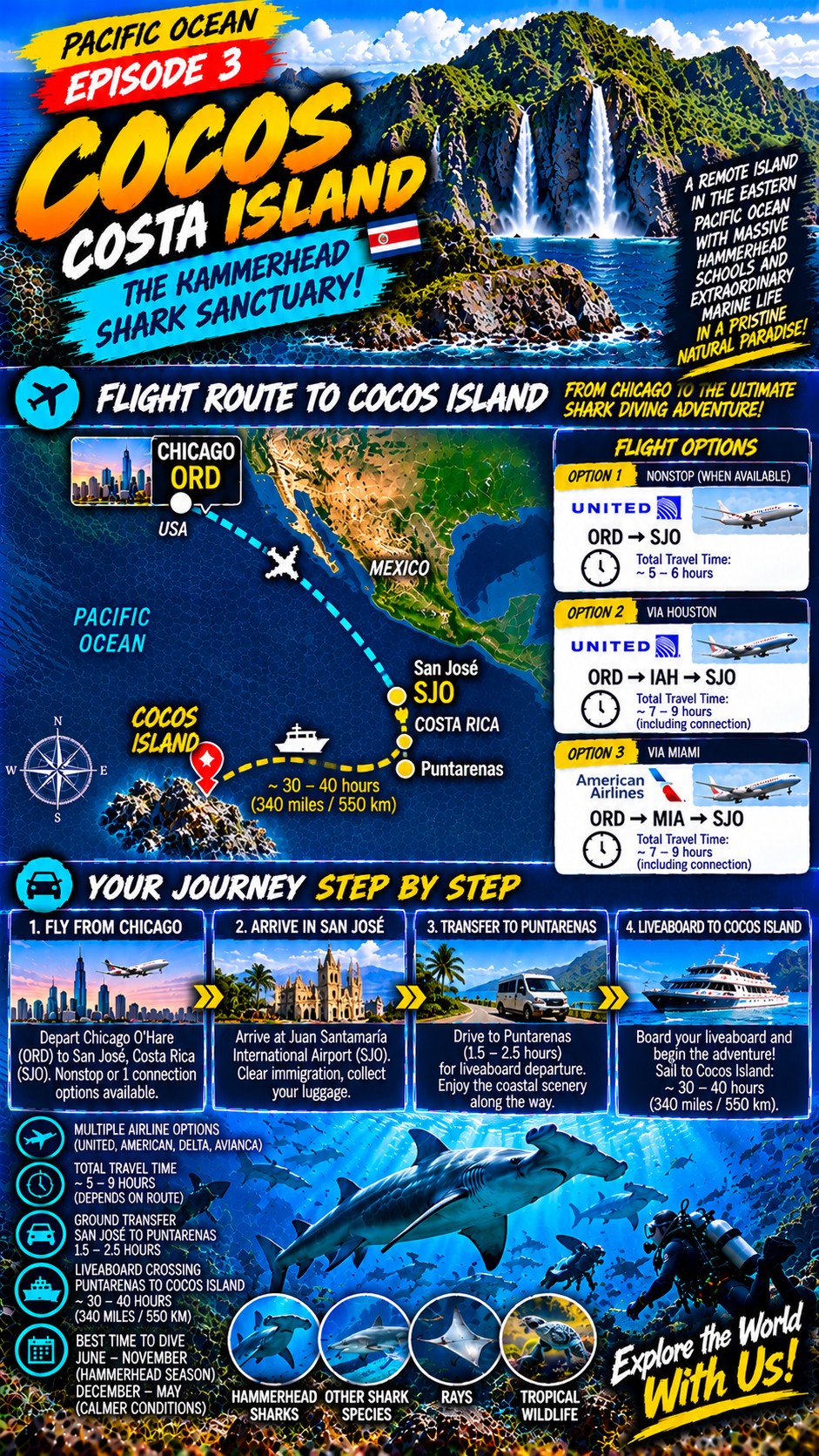
14. How Do You Get to Cocos Island from Chicago?
For travelers departing from Chicago, the adventure begins with a flight to Costa Rica.
Main International Airport
Juan Santamaría International Airport — SJO
Located near San José, Costa Rica.
Possible Flight Route 1
Chicago O'Hare (ORD) → San José, Costa Rica (SJO)
Nonstop service may be available depending on airline schedules and travel dates.
Possible Flight Route 2
Chicago O'Hare (ORD) → Houston (IAH) → San José (SJO)
Possible Flight Route 3
Chicago O'Hare (ORD) → Miami (MIA) → San José (SJO)
Possible Flight Route 4
Chicago O'Hare (ORD) → Atlanta (ATL) → San José (SJO)
These are illustrative flight possibilities rather than confirmed itineraries.
Ground Transportation
After arriving at SJO, travelers transfer to the designated liveaboard departure point.
For expeditions departing from Puntarenas, the journey commonly takes approximately 1.5–2.5 hours, depending on traffic and the exact location.
Ocean Crossing
Puntarenas → Cocos Island
Approximately 30–40 hours by liveaboard, depending on conditions.
Recommended Travel Planning
Because of the remote location and lengthy ocean crossing, travelers should plan carefully.
We recommend arriving in Costa Rica at least one day before the scheduled departure.
Important considerations include:
-
Flight schedules and connections.
-
Equipment baggage allowances.
-
Liveaboard boarding procedures.
-
Travel and dive insurance.
-
Emergency evacuation coverage.
-
Marine park fees.
-
Required diving experience.
-
Seasickness preparation.
-
Passport and entry requirements.
-
Appropriate no-fly intervals after diving.
From Chicago to Costa Rica and across the Pacific Ocean, reaching Cocos Island is an adventure in itself!
15. Why Cocos Island Belongs on Every Advanced Diver's Bucket List
There are many incredible scuba diving destinations around the world.
But few offer the combination of wilderness, marine life, and adventure found at Cocos Island.
Imagine:
Massive schools of hammerhead sharks.
Whitetip reef sharks resting along rocky ledges.
Galápagos sharks patrolling underwater pinnacles.
Huge schools of jacks surrounding volcanic formations.
Powerful ocean currents bringing life to the reefs.
Dense tropical rainforest rising above the sea.
And spectacular waterfalls cascading from the mountains.
Cocos Island is not simply another dive destination. It is one of the wildest and most extraordinary marine adventures in the Pacific Ocean!
For experienced divers who dream of encounters with large sharks and remote ocean environments, Cocos Island deserves a place on the bucket list.
16. Your Cocos Island Adventure Starts at Loves Park Scuba!
At Loves Park Scuba, we believe extraordinary diving adventures begin with proper training, reliable equipment, and a passion for ocean exploration.
Whether you dream of observing massive schools of hammerhead sharks, photographing marine predators, or exploring remote underwater volcanic formations, our team can help you prepare.
We offer opportunities to develop your skills through:
-
Open Water Diver certification.
-
Advanced diving education.
-
Enriched Air Nitrox training.
-
Rescue Diver courses.
-
Buoyancy improvement.
-
Equipment selection.
-
Dive travel preparation.
Are you ready to explore Cocos Island — The Hammerhead Shark Sanctuary?
Visit Loves Park Scuba and begin preparing for your next extraordinary Pacific Ocean adventure!
LOVES PARK SCUBA
DIVE INTO ADVENTURE — EXPLORE THE WORLD WITH US!
COMING NEXT IN OUR PACIFIC DIVING SERIES
EPISODE 4 — SEA OF CORTEZ, MEXICO: THE AQUARIUM OF THE WORLD!
Our next adventure takes us to one of the most fascinating marine environments in Mexico.
Imagine swimming near playful sea lions, exploring spectacular rocky reefs, and observing enormous schools of fish in the beautiful waters of the Sea of Cortez.
Discover why this extraordinary region has earned the nickname:
THE AQUARIUM OF THE WORLD!
10 ICONIC PACIFIC DESTINATIONS. ONE PASSION FOR DIVING!
