
Day 2 – La Reina: Our First Dives in the Sea of Cortez
Martin Gomez Sep 29, 2026
A Week in the Sea of Cortez Aboard the Valentina
Day 2 – La Reina: Our First Dives in the Sea of Cortez
Our second day began very early.
Actually, while most of us were still sleeping, the Valentina had already been navigating through the night, eventually anchoring in a protected bay near Cerralvo Island.
Our first diving destination of the expedition would be one of the best-known dive sites in this part of the Sea of Cortez:
La Reina.
Located north of Cerralvo Island, La Reina is a rocky reef and small islet known for its abundant marine life and its colony of California sea lions, including adult and younger males.
During the summer and early fall, this area also brings another exciting possibility: encounters with giant oceanic manta rays.
Of course, nothing in the ocean is guaranteed.
And that uncertainty is part of what makes diving here so exciting.
You never know what the Sea of Cortez is going to show you.
4:00 AM – The Sound of the Anchor
Anyone who has spent time aboard a liveaboard knows that there are certain sounds you quickly learn to recognize.
One of them is unmistakable:
the sound of the anchor being raised.
At around 4:00 AM, that very particular sound announced that the Valentina was getting underway again.
The plan was to leave our overnight anchorage and position the boat close to La Reina by approximately 6:00 AM.
Some of us probably heard the anchor and rolled over for another hour of sleep.
Others already knew what that sound meant:
our first real day of diving had begun.
By 6:30 AM, a continental-style breakfast was waiting for us.
Coffee was especially important at that hour.
By 7:00 AM, everyone was gathering in the dive area, ready for the first briefing of the trip.
This briefing was particularly important because it would not only explain our first dive at La Reina, but also establish the diving procedures we would follow for the rest of our expedition.
Sharks, Sea Lions and Mobulas
For the diving operation, we were divided into three teams.
The first team was the Sharks, consisting of six divers, all from Loves Park Scuba.
The second team was the Sea Lions, with four more divers from Loves Park Scuba.
And the third team was appropriately named the Mobulas.
This was a wonderfully international group. It included a young married couple from Spain, two young women from Japan, and a young couple from New Mexico.
Different countries, different backgrounds and different diving experiences—but everyone had come aboard the Valentina for the same reason:
to explore the Sea of Cortez.
An Experienced Dive Crew
Taking care of the diving operation was a very experienced team led by Lorenzo, who has more than 30 years of experience in the Sea of Cortez.
For me, having Lorenzo aboard made this trip particularly special.
Many years ago, I had the opportunity to work with him during previous dive trips in the Sea of Cortez. Now, after all that time, we were once again diving these waters together—this time with our group from Loves Park Scuba.
Joining him was Memo, a marine biologist by profession who has worked as a dive guide aboard the Valentina for more than nine years.
The third member of the dive team was Mariana, a psychologist by profession and an experienced scuba instructor with more than a decade of experience diving and teaching in the Mexican Caribbean and the Sea of Cortez.
Lorenzo, Memo and Mariana made an excellent team.
Their combination of local knowledge, diving experience and familiarity with the marine environment gave us confidence that our divers were in very capable hands.
And now it was finally time to get wet.
Dive #1 – Welcome to La Reina
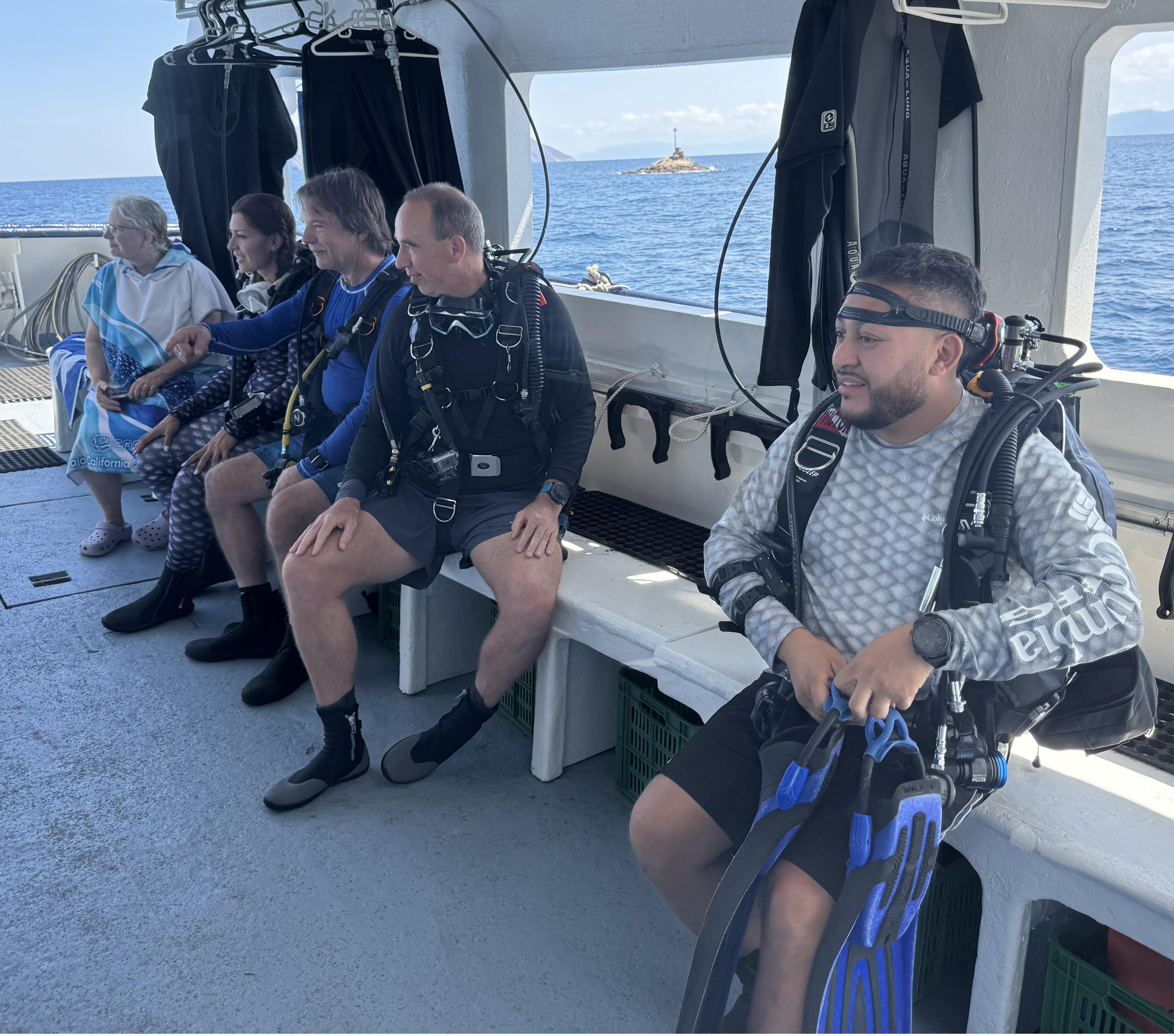
After all the months of preparation, traveling from Chicago, flying across the country, driving through Baja California Sur and spending our first night aboard the Valentina, the moment had arrived.
Our first dive in the Sea of Cortez.
And La Reina gave us a very warm welcome.
Literally.
The water temperature was an incredible 86°F or higher.
Visibility was more than 30 feet, giving us a good view of the reef and the tremendous amount of marine life moving around it.
We descended toward the reef and immediately began seeing schools of fish surrounding the rocky structure.
Part of the attraction of La Reina is the combination of the natural reef and the remains of an old wreck scattered around the area. Fish moved through and around the structure while we explored the site.
Near the lower section of the small islet, some of the resident sea lions made appearances.
For more than 40 minutes, we explored the reef at an average depth of approximately 60 feet.
Warm water.
Schools of fish.
Sea lions.
Rocky formations.
Wreck remains.
After months of talking about the trip, we were finally doing exactly what we had traveled all this way to do.
We were diving the Sea of Cortez.
Dive, Eat, Rest, Repeat
Back aboard the Valentina, we quickly began to understand the wonderful rhythm of liveaboard diving.
Dive.
Come back aboard.
Eat.
Rest.
And start getting ready to dive again.
After our first dive, we returned to the boat for a full breakfast.
With our tanks being prepared for the next dive, we had approximately an hour and a half to eat, relax, talk about what we had seen underwater and enjoy being aboard the boat.
Then it was time to put our gear back on.
Exploring Different Sides of La Reina
Our second and third dives would continue at La Reina, but rather than simply repeating the same dive, we followed different routes around the reef.
This allowed us to discover more of the site.
We moved between rocky formations and through small underwater canyons, constantly looking into cracks and beneath rocks.
This is where slowing down becomes important.
Instead of simply swimming over the reef, we began searching for some of its smaller residents:
moray eels, lobsters, stonefish and the many species of reef fish characteristic of the Sea of Cortez.
Every route revealed something different.
Sometimes the most interesting part of a dive isn't a large animal swimming past you. It can be stopping beside a rock, looking carefully into a small opening and suddenly realizing that something has been watching you the entire time.
By our third dive, everyone was beginning to settle into the routine.
We knew our teams.
We knew our guides.
We knew where our equipment belonged.
And we were beginning to understand how the diving operation aboard the Valentina would work for the rest of the week.
Dive #4 – An Afternoon at La Reinita
After lunch and another well-deserved break, there was still one more dive waiting for us.
Our fourth and final dive of the day would be at La Reinita, another reef in the Cerralvo Island area.
By the time we entered the water, the afternoon was already beginning to fade.
There was less sunlight penetrating the water, giving the reef a darker and completely different atmosphere from our morning dives.
Visibility and light may change throughout the day, but that is part of what makes returning to the water interesting.
A reef never looks exactly the same twice.
The reduced light encouraged us to explore more carefully, searching through the reef and observing the marine life as our first full day of diving slowly came to an end.
Four dives.
Not bad for our first day underwater.
Back Online… for a Moment
There was also a funny reminder of modern life.
As the Valentina moved closer to Cerralvo Island, our cell phone signals suddenly became stronger.
After being disconnected while traveling and diving, phones began reconnecting to the outside world.
Messages appeared.
Notifications arrived.
For a little while, civilization had found us again.
But not for long.
Because after our fourth dive, the Valentina began moving once more.
And this time, our destination was Espíritu Santo Island.
Sailing Toward Espíritu Santo
As daylight disappeared, we left the Cerralvo Island area behind and began navigating toward Espíritu Santo.
The plan was to enter one of the island's protected bays, drop anchor and spend the night there.
After four dives, a full day on the water and an early morning start, nobody needed much convincing to get some rest.
But there was plenty to look forward to.
Because the following morning, we would head toward one of the most famous places in the Sea of Cortez:
Los Islotes.
At the northern end of Espíritu Santo, these rocky islets are home to a large California sea lion colony.
And that would be the setting for our next underwater adventure.
Our first full day aboard the Valentina had given us a taste of what the coming week would be like.
We had explored La Reina, encountered our first sea lions, crossed rocky canyons, searched for moray eels and lobsters, completed four dives and begun adapting to the unique rhythm of life aboard a dive boat.
The group was relaxing.
The dive teams were coming together.
And we were beginning to enjoy what we had traveled so far to experience.
Eat. Dive. Rest. Explore. Repeat.
The Sea of Cortez adventure was officially underway.
Day 2 – Dive Log
Dive #1 – La Reina
Dive #2 – La Reina
Dive #3 – La Reina
Dive #4 – La Reinita
Water temperature: 86°F+
Visibility: 30+ ft
Average depth on the first dive: approximately 60 ft
First dive: 40+ minutes
Sea lions
Large schools of reef fish
Rock formations and underwater canyons
Lobsters, moray eels, stonefish and local marine life
Next: Day 3 – Espíritu Santo and Los Islotes: Diving with the Sea Lions.
