
Episode 4: Lake Michigan Wrecks – Exploring America’s Underwater History
Martin Gomez Aug 03, 2026
TOP DIVE DESTINATIONS IN THE USA
Episode 4: Lake Michigan Wrecks – Exploring America’s Underwater History
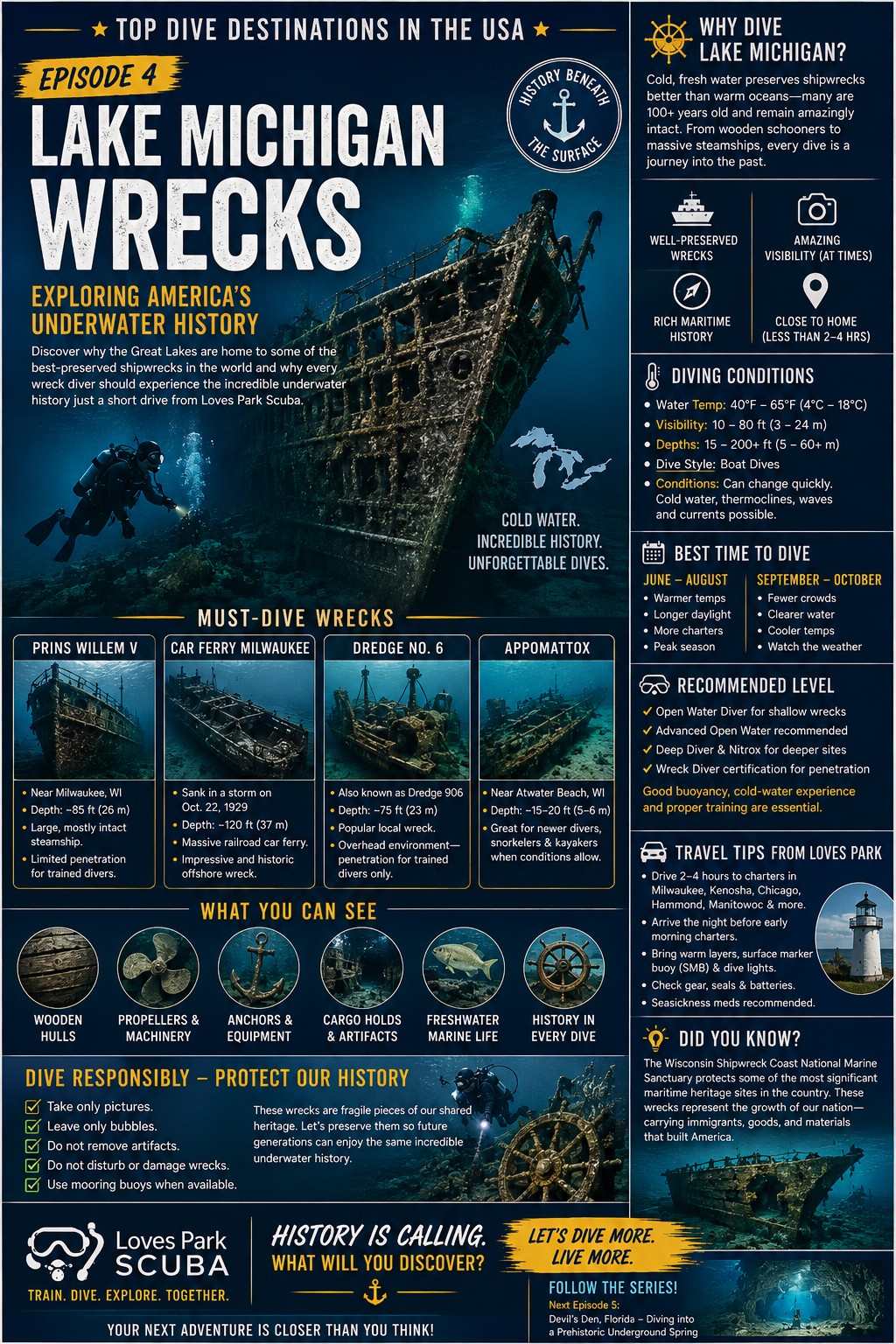
Beneath the cold, dark-blue waters of Lake Michigan lies an extraordinary collection of shipwrecks that tells the story of America’s industrial growth, maritime commerce, immigration, and transportation.
Wooden schooners, steamships, cargo vessels, tugboats, and railroad car ferries rest on the lakebed—many remarkably preserved after spending decades or even more than a century underwater.
For divers who love history, exploration, and adventure, Lake Michigan offers one of the most unique wreck-diving experiences in the United States.
Why Dive Lake Michigan?
The Great Lakes are often called freshwater seas, and their cold, fresh water helps preserve shipwrecks far better than warm saltwater environments. Wooden hulls, machinery, railroad cars, anchors, tools, and other structural details can remain visible long after a vessel sinks. (Michigan)
These wrecks are more than underwater attractions. They are historic sites that reveal how people and goods traveled across the Great Lakes before modern highways and aviation.
The vessels protected within the Wisconsin Shipwreck Coast National Marine Sanctuary represent the evolution of Great Lakes transportation, from early wooden sailing ships to steel steam-powered vessels. (NOAA Sanctuaries)
Every descent is a journey into the past.
What Makes These Wrecks Special?
Lake Michigan wreck diving offers experiences that are completely different from tropical reef diving.
Divers can encounter:
-
Intact wooden schooners
-
Large steamships and cargo vessels
-
Railroad car ferries
-
Machinery and boilers
-
Anchors and deck equipment
-
Open cargo holds
-
Historic construction details
-
Freshwater fish
-
Dramatic underwater photography opportunities
Because there is no coral growth covering the structures, many wreck features remain clearly visible.
Must-Dive Lake Michigan Wrecks
Prins Willem V
Located near Milwaukee, the Prins Willem V is one of Wisconsin’s most frequently visited shipwrecks.
The vessel rests in approximately 85 feet of water and remains largely intact. Its accessible location and impressive structure make it popular with intermediate wreck divers. Limited penetration opportunities exist, but divers should enter the wreck only when properly trained and equipped. (Wisconsin Shipwrecks)
Car Ferry Milwaukee
The Milwaukee was a steam-powered railroad car ferry that sank during a violent storm on October 22, 1929.
Today, the vessel rests about three miles east of Fox Point, Wisconsin, in approximately 120 feet of water. Archaeological investigations have helped document the vessel and clarify details surrounding its final voyage. (Wisconsin Shipwrecks)
This is an impressive advanced dive that combines maritime history with a large and dramatic wreck site.
Dredge No. 6
Also known as Dredge 906, this wreck lies in approximately 75 feet of water near Milwaukee.
It is one of the region’s most popular sites for intermediate divers. However, the wreck contains a significant overhead environment, so penetration should only be attempted by divers with the appropriate wreck training. (Wisconsin Shipwrecks)
Appomattox
The remains of the wooden steamship Appomattox lie in relatively shallow water near Atwater Beach.
At approximately 15–20 feet deep, the site can be enjoyed by newer divers, snorkelers, and kayakers when lake conditions are favorable. (Wisconsin Shipwrecks)
It is an excellent introduction to the maritime history hidden below Lake Michigan.
Diving Conditions
Lake Michigan requires a different mindset than warm-water tropical diving.
Divers should be prepared for:
-
Cold water
-
Thermoclines
-
Variable visibility
-
Changing surface conditions
-
Waves and currents
-
Boat traffic
-
Limited natural light at depth
-
Possible entanglement hazards
-
Deep profiles on advanced wrecks
Conditions can change quickly, and water near the bottom may remain cold even during the summer.
Proper exposure protection, good buoyancy control, careful gas planning, and familiarity with cold-water equipment are essential.
Best Time to Dive
The primary Lake Michigan diving season generally runs from late spring through early fall.
June – August
-
Warmer surface temperatures
-
Longer daylight hours
-
More charter availability
-
Popular season for recreational divers
September – October
-
Potentially clearer water
-
Fewer recreational boats
-
Cooler temperatures
-
More variable weather conditions
Lake conditions should always be checked before departure. Even during summer, wind and waves can cause a dive charter to be delayed, relocated, or canceled.
Recommended Certification Level
The appropriate certification depends on the wreck, depth, and dive conditions.
For Shallower Exterior Wreck Dives
-
Open Water Diver
-
Good buoyancy control
-
Cold-water diving experience
For Deeper Wrecks
-
Advanced Open Water Diver
-
Deep Diver training
-
Nitrox certification
-
Experience with boat diving and low visibility
For Wreck Penetration
-
Wreck Diver certification
-
Redundant equipment when appropriate
-
Primary and backup lights
-
Guideline and reel training
-
Proper gas-management procedures
A recreational certification does not automatically prepare a diver to enter a shipwreck. Penetration creates an overhead environment and should only be attempted by divers with specialized training. Illinois diving guidance also emphasizes that wreck penetration requires wreck-diver qualifications. (Illinois Department of Natural Resources)
Protecting Underwater History
Shipwrecks are fragile historical and archaeological resources.
Divers should follow a simple principle:
Take only pictures. Leave only bubbles.
Do not remove artifacts, disturb equipment, damage wooden structures, or tie directly to a wreck. Mooring buoys are used at many sites to provide safer descent and ascent points while reducing anchor damage. (Wisconsin Shipwrecks)
Michigan regulations allow recreational access to shipwrecks, but that access does not include the right to remove artifacts as souvenirs. (Michigan)
Preserving these sites allows future generations to experience the same underwater history.
Travel Tips from Loves Park, Illinois
One of the greatest advantages of Lake Michigan wreck diving is its proximity to Loves Park Scuba.
Depending on the charter and wreck location, divers can travel to departure points around:
-
Chicago
-
Hammond
-
Kenosha
-
Racine
-
Milwaukee
-
Port Washington
-
Sheboygan
-
Manitowoc
Before leaving home:
-
Confirm your charter departure time.
-
Bring your certification cards.
-
Check your regulator and dive computer.
-
Test your primary and backup lights.
-
Bring appropriate thermal protection.
-
Pack seasickness medication when needed.
-
Carry an SMB and audible signaling device.
-
Secure all equipment for the boat ride.
-
Bring warm, dry clothing for after the dives.
Divers should also consider arriving the night before an early charter to avoid rushing and to allow time for proper preparation.
Did You Know?
The Wisconsin Shipwreck Coast National Marine Sanctuary was designated in 2021 to protect nationally significant maritime heritage sites in Lake Michigan.
Its protected wrecks represent vessels that carried grain, lumber, coal, manufactured goods, raw materials, and settlers across the Great Lakes during the development of the United States. (NOAA Sanctuaries)
The Wisconsin Historical Society also provides detailed dive guides containing wreck diagrams, site maps, vessel histories, and diving information. (Wisconsin Shipwrecks)
Loves Park Scuba Recommendation
Lake Michigan is the perfect destination for divers who want to expand beyond tropical reefs and experience a completely different side of scuba diving.
Wreck diving helps develop:
-
Better buoyancy control
-
Stronger navigation skills
-
Improved gas management
-
Greater awareness of depth and time
-
Cold-water diving experience
-
Respect for maritime history
Best of all, these extraordinary underwater museums are located only a few hours from Loves Park.
Whether you are making your first exterior wreck dive or preparing for deeper and more advanced exploration, Lake Michigan offers a lifetime of discovery.
Every wreck has a name.
Every wreck has a story.
And every dive is an opportunity to experience a piece of American history preserved beneath the surface.
Coming Next...
Episode 5: Devil’s Den, Florida – Diving into a Prehistoric Underground Spring
Discover a crystal-clear underground world where ancient rock formations, natural light, and prehistoric history create one of the most photographed freshwater dives in the United States.
Este texto también se puede adaptar a una versión más corta para newsletter o Facebook antes de crear el póster del Episode 4.
