
Episode 6: Monterey, California – Exploring the Giant Kelp Forests of the Pacific
Martin Gomez Aug 03, 2026
TOP DIVE DESTINATIONS IN THE USA
Episode 6: Monterey, California – Exploring the Giant Kelp Forests of the Pacific
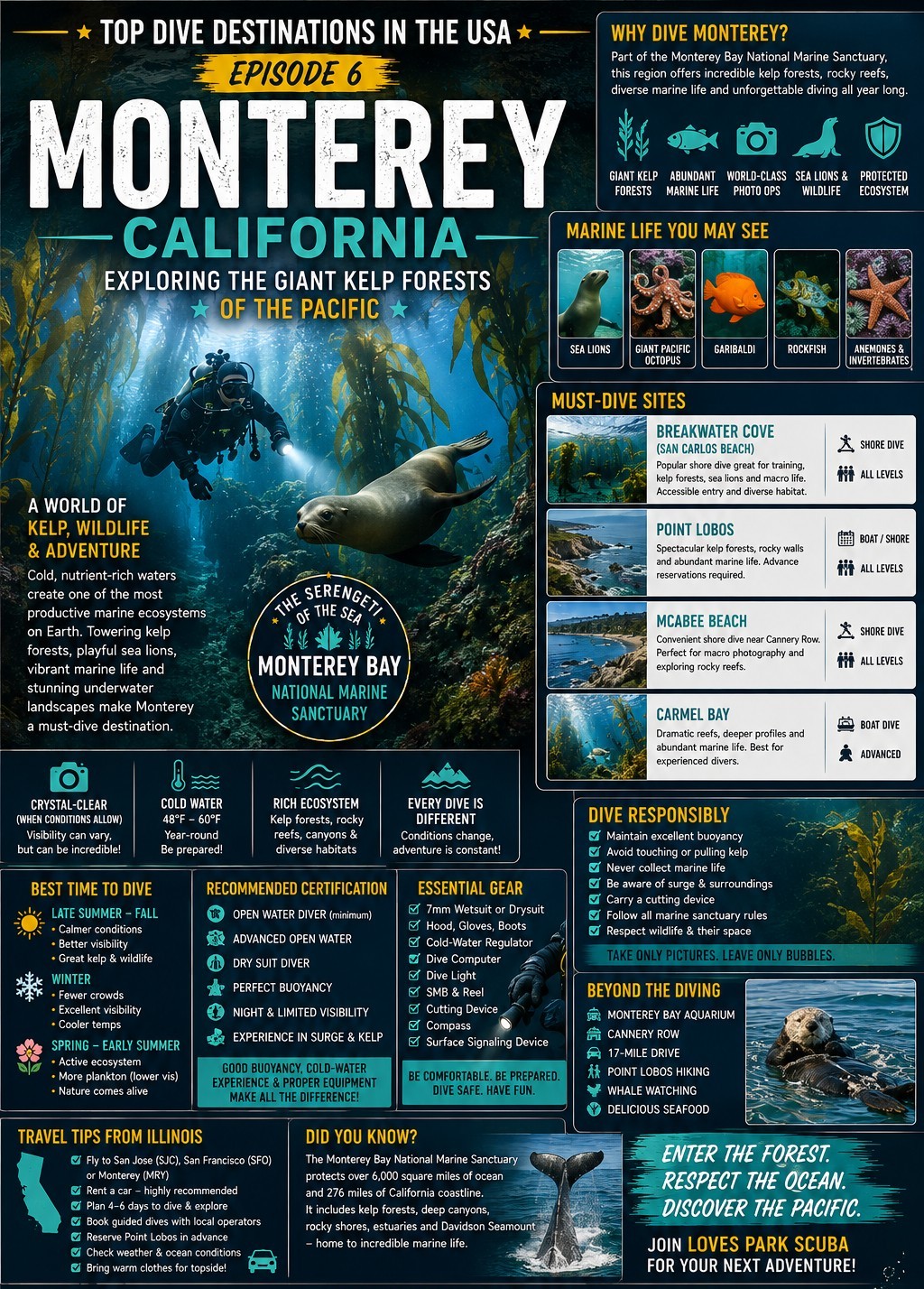
Imagine descending into a living underwater forest where giant kelp rises toward the surface, sunlight filters through golden fronds, and curious sea lions glide between towering columns of marine vegetation.
Welcome to Monterey, California, one of the most spectacular cold-water diving destinations in the United States.
Located within the Monterey Bay National Marine Sanctuary, this region offers extensive kelp forests, rocky reefs, underwater canyons, and an exceptionally productive marine ecosystem often described as the “Serengeti of the Sea.” (Monterey Bay National Marine Sanctuary)
Why Dive Monterey?
Monterey offers an underwater experience completely different from tropical destinations.
Instead of coral gardens, divers explore giant kelp forests that move gently with the surge. Rocky reefs are covered with colorful anemones, sponges, sea stars, nudibranchs, and other cold-water species.
These kelp forests provide food, protection, and habitat for fish, invertebrates, marine mammals, and countless smaller organisms. (Monterey Bay Aquarium)
Every dive feels like entering another world.
The Giant Kelp Forest Experience
Giant kelp can form towering underwater forests extending from the rocky bottom all the way to the surface.
As divers move between the kelp stalks, sunlight creates beautiful patterns in the water. Schools of fish pass through the vegetation, harbor seals may observe from a distance, and playful sea lions occasionally approach divers.
Good buoyancy control is important because divers must move carefully through the kelp without becoming tangled or damaging this fragile ecosystem.
Marine Life Highlights
Monterey Bay supports an extraordinary variety of marine life.
Divers may encounter:
-
California sea lions
-
Harbor seals
-
Sea otters at the surface
-
Giant Pacific octopuses
-
Wolf eels
-
Rockfish
-
Lingcod
-
Leopard sharks
-
Bat rays
-
Cabezon
-
Nudibranchs
-
Sea stars
-
Crabs
-
Anemones
-
Schools of sardines
-
Colorful cold-water invertebrates
The giant Pacific octopus is the largest octopus species, with arms that can span more than 13 feet in large individuals. It is also an expert at camouflage and can blend almost completely into rocky surroundings. (Monterey Bay Aquarium)
Must-Dive Sites
Breakwater Cove
Also known as San Carlos Beach, this is one of Monterey’s most popular shore-diving locations.
It is commonly used for:
-
Open Water training
-
Cold-water orientation
-
Underwater photography
-
Night diving
-
Sea lion encounters
The relatively convenient entry makes it a good introduction to Monterey diving, although conditions can still vary.
Point Lobos State Natural Reserve
Point Lobos is considered one of California’s richest marine habitats and one of the premier dive locations in the Monterey area. Its protected waters feature kelp forests, rocky formations, steep walls, and abundant marine life. (CA State Parks)
Reservations are required in advance, and divers must follow the reserve’s specific team and access rules. California State Parks does not rent scuba equipment at the site. (CA State Parks)
McAbee Beach
Located near Cannery Row, McAbee Beach provides convenient shore access and is popular with local divers.
Divers can explore:
-
Kelp beds
-
Rocky reefs
-
Small marine creatures
-
Interesting bottom formations
It is particularly attractive for macro photographers searching for nudibranchs, crabs, octopuses, and small fish.
Carmel Bay
Carmel Bay offers dramatic underwater terrain, deeper profiles, and beautiful rocky reefs.
Some locations are more appropriate for experienced divers because of depth, surge, entries, exits, and changing Pacific conditions.
Diving Conditions
Monterey is a true cold-water diving destination.
Typical conditions may include:
-
Water temperature: Approximately 48°F–60°F
-
Visibility: Frequently variable
-
Dive style: Shore and boat diving
-
Conditions: Surge, waves, kelp and changing visibility
-
Bottom terrain: Sand, rock reefs, walls and underwater canyons
Divers should expect the water to feel significantly colder than Lake Michigan during some portions of the year, especially during longer or deeper dives.
Exposure Protection
A thick wetsuit may be suitable for shorter dives, but many regular Monterey divers prefer a dry suit.
Recommended equipment may include:
-
7 mm wetsuit with hood and gloves
-
Drysuit with appropriate thermal undergarments
-
Hood
-
Cold-water gloves
-
Cold-water regulator
-
Dive light
-
Cutting device
-
Surface marker buoy
-
Compass and dive computer
Divers using a dry suit should receive proper training before relying on it in open water.
Best Time to Visit
Monterey can be dived throughout the year, but every season offers something different.
Late Summer and Fall
-
Potentially calmer conditions
-
Often considered an excellent period for visibility
-
Comfortable weather above the water
-
Strong opportunities for kelp diving and photography
Winter
-
Cooler air and water
-
Fewer visitors
-
Possible periods of excellent visibility
-
More demanding surface conditions
Spring and Early Summer
-
Active marine ecosystem
-
Nutrient-rich water
-
Possible reduced visibility from plankton and natural seasonal activity
Pacific weather and ocean conditions can change quickly, so local forecasts and professional guidance are essential.
Recommended Certification
Open Water Diver may be sufficient for protected, beginner-friendly sites when diving with experienced local supervision.
However, Monterey diving becomes much more enjoyable with:
-
Advanced Open Water training
-
Dry Suit certification
-
Perfect Buoyancy training
-
Navigation experience
-
Night and Limited Visibility training
-
Experience with shore entries and exits
Divers should be comfortable managing cold water, surge, lower visibility and heavier exposure protection.
Photography Opportunities
Monterey is a paradise for both wide-angle and macro photography.
Wide-Angle Subjects
-
Giant kelp forests
-
Sea lions
-
Rocky reefs
-
Sunlight filtering through kelp
-
Large schools of fish
Macro Subjects
-
Nudibranchs
-
Small octopuses
-
Crabs
-
Anemones
-
Juvenile fish
-
Colorful invertebrates
A dive light can help restore the vivid natural colors that disappear quickly in deeper or darker water.
Protect the Kelp Forest
Kelp forests are beautiful but sensitive ecosystems.
Divers should:
-
Maintain excellent buoyancy.
-
Avoid pulling on kelp.
-
Never remove marine life or natural objects.
-
Secure gauges and alternate air sources.
-
Carry an appropriate cutting device.
-
Follow all marine reserve regulations.
-
Maintain a respectful distance from wildlife.
Point Lobos and other protected areas enforce strict rules against collecting or disturbing natural resources.
Travel Tips from Illinois
-
Fly from Chicago to San Jose International Airport, San Francisco International Airport, or Monterey Regional Airport.
-
Rent a vehicle for transportation to dive sites.
-
Plan at least four to six days for diving and sightseeing.
-
Arrange guided dives with a knowledgeable local operator.
-
Reserve Point Lobos well in advance.
-
Confirm whether tanks and weights are included.
-
Bring warm clothing for surface intervals.
-
Allow time for changing weather and possible dive-plan adjustments.
Monterey diving requires more equipment and preparation than many warm-water destinations, but the experience is worth the effort.
Beyond the Diving
Monterey offers many attractions for divers and non-divers.
Popular activities include:
-
Monterey Bay Aquarium
-
Cannery Row
-
17-Mile Drive
-
Carmel-by-the-Sea
-
Point Lobos hiking trails
-
Whale-watching tours
-
Kayaking
-
Coastal photography
-
Seafood restaurants
-
Big Sur day trips
The Monterey Bay Aquarium’s kelp forest exhibit gives visitors a diver’s-eye view of kelp, sardines, leopard sharks, wolf eels, and other local species. (Monterey Bay Aquarium)
Did You Know?
The Monterey Bay National Marine Sanctuary protects more than 6,000 square miles of ocean and extends along approximately 276 miles of California coastline.
Its protected environment includes kelp forests, deep submarine canyons, rocky shores, estuaries, and Davidson Seamount—an underwater mountain rich with marine life. (Monterey Bay National Marine Sanctuary)
Loves Park Scuba Recommendation
Monterey is an ideal destination for divers ready to expand their experience beyond warm tropical water.
It challenges divers to improve:
-
Buoyancy control
-
Cold-water equipment management
-
Navigation
-
Awareness in surge and kelp
-
Shore-diving skills
-
Underwater photography techniques
The reward is an unforgettable journey through one of the richest and most beautiful marine environments in North America.
Monterey is not simply another place to dive.
It is an underwater wilderness where sunlight, kelp, rock, and wildlife come together to create a completely different kind of adventure.
Enter the forest. Respect the ocean. Discover the Pacific.
Coming Next...
Episode 7: Catalina Island, California – Diving California’s Island Paradise
Explore clear Pacific waters, towering kelp forests, bright orange Garibaldi, rocky reefs, sea lions, rays, and one of California’s most celebrated island-diving destinations.
