
GALÁPAGOS ISLANDS, ECUADOR: THE KINGDOM OF HAMMERHEAD SHARKS! Top 10 Iconic Scuba Diving Destinations in the Pacific Ocean — Episode 1
Martin Gomez Oct 29, 2026
GALÁPAGOS ISLANDS, ECUADOR: THE KINGDOM OF HAMMERHEAD SHARKS!
Top 10 Iconic Scuba Diving Destinations in the Pacific Ocean — Episode 1
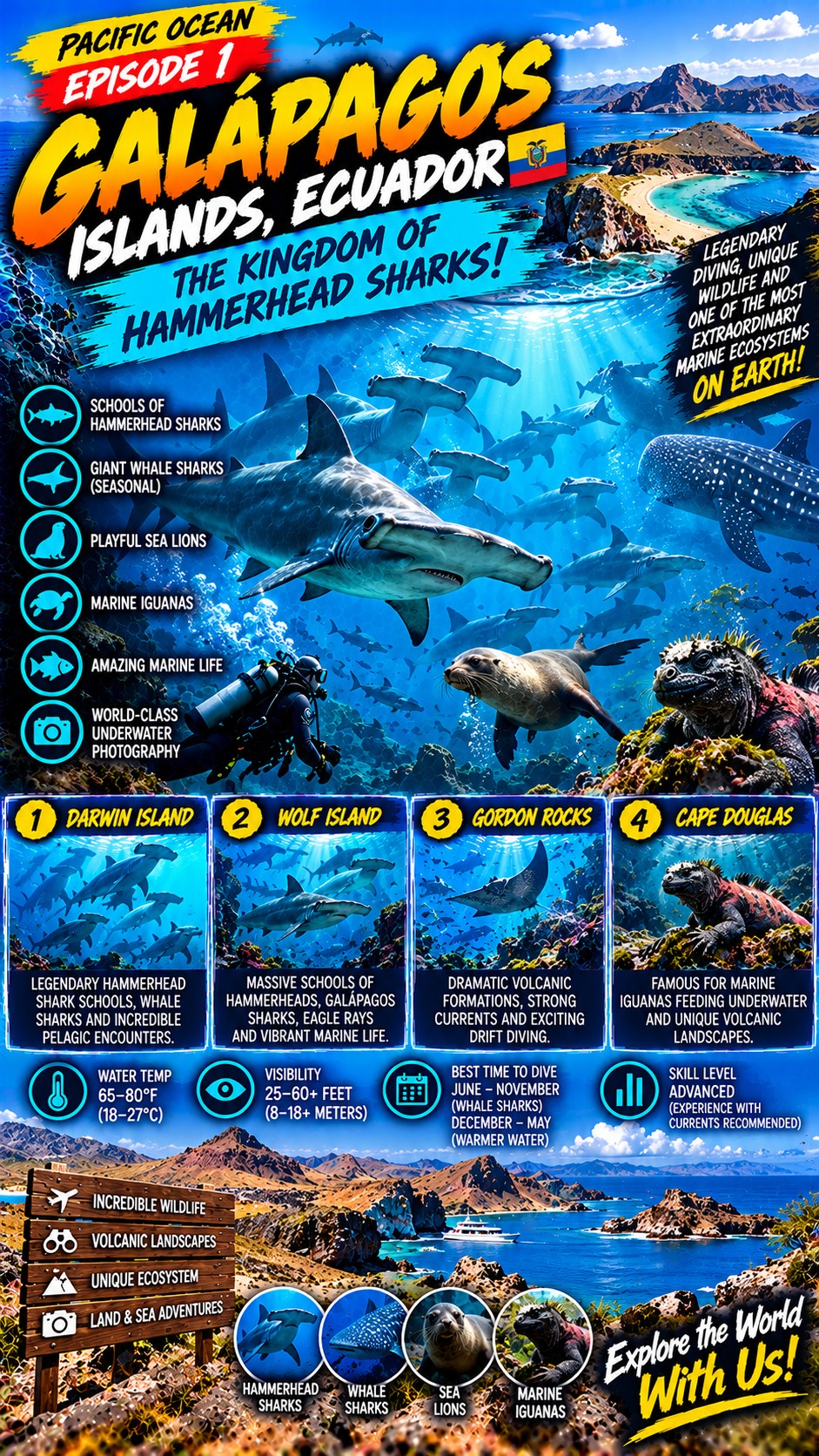
Explore Legendary Hammerhead Shark Schools, Giant Whale Sharks, Playful Sea Lions, and One of the Most Extraordinary Marine Ecosystems on Earth!
Welcome to Galápagos: Where the Pacific Ocean Comes Alive!
Imagine descending into the deep blue waters of the Pacific Ocean.
The current moves steadily around a dramatic volcanic reef.
Schools of fish gather along the rocky formations while a sea turtle swims effortlessly through the water.
Suddenly, a shadow appears in the distance.
Then another.
And another.
Within moments, an extraordinary school of scalloped hammerhead sharks emerges from the blue.
Dozens of magnificent sharks move together in an incredible underwater formation, their distinctive heads creating one of the most unforgettable sights in the diving world.
Farther offshore, enormous whale sharks cruise through nutrient-rich waters, while curious sea lions perform acrobatic movements around the islands.
Welcome to the Galápagos Islands, Ecuador — The Kingdom of Hammerhead Sharks!
Located approximately 600 miles (1,000 kilometers) west of mainland Ecuador, the Galápagos Islands are among the world's most celebrated destinations for marine wildlife encounters.
At Loves Park Scuba, we're excited to introduce Galápagos as the first destination in our new series:
TOP 10 ICONIC SCUBA DIVING DESTINATIONS IN THE PACIFIC OCEAN!
1. What Makes the Galápagos Islands So Extraordinary?
The Galápagos archipelago consists of volcanic islands surrounded by a remarkable marine ecosystem.
Its location near the convergence of several major ocean currents creates conditions that support exceptional marine productivity.
Cold, nutrient-rich water rises from the depths and mixes with warmer tropical waters, helping sustain a remarkable diversity of marine life.
These conditions attract large populations of fish, sharks, rays, marine mammals, and other ocean predators.
Divers can experience:
-
Spectacular schools of scalloped hammerhead sharks.
-
Giant whale sharks during favorable seasons.
-
Galápagos sharks and other shark species.
-
Playful Galápagos sea lions.
-
Green sea turtles.
-
Marine iguanas feeding underwater.
-
Eagle rays and other rays.
-
Fascinating volcanic underwater landscapes.
-
Strong currents and exciting drift-diving opportunities.
-
Extraordinary marine conservation experiences.
Galápagos is not simply another diving destination. It is one of the most extraordinary wildlife encounters the Pacific Ocean has to offer!
2. Darwin Island: The Legendary Shark Diving Destination
Darwin Island is one of the most famous scuba diving destinations in the world.
Located in the remote northern Galápagos archipelago, the waters surrounding Darwin are internationally recognized for their extraordinary pelagic marine life.
The area's rocky formations and ocean currents attract numerous shark species.
The Famous Hammerhead Schools
Scalloped hammerhead sharks are among Darwin's most celebrated attractions.
These sharks may gather in impressive schools, creating unforgettable underwater scenes.
Divers often position themselves in suitable locations along rocky formations while observing the sharks moving through the current.
Giant Whale Sharks
Darwin is also famous for seasonal encounters with whale sharks.
These enormous filter-feeding fish are the largest fish species on Earth.
During the cooler, nutrient-rich season, large whale sharks may pass through the waters around Darwin.
Some individuals observed in the region are exceptionally large females.
What Makes Darwin So Special?
-
Legendary hammerhead shark encounters.
-
Seasonal whale shark sightings.
-
Galápagos sharks.
-
Large schools of fish.
-
Dramatic underwater formations.
-
Extraordinary blue-water photography opportunities.
Diving Darwin Island is a dream experience for many advanced scuba divers!
Because of its remote location, strong currents, and challenging conditions, Darwin is generally visited through specialized liveaboard expeditions.
3. Wolf Island: The Kingdom of Hammerhead Sharks
Wolf Island is another legendary diving destination in the northern Galápagos.
Together with Darwin, it forms one of the world's most celebrated regions for encounters with large marine animals.
What Can Divers Encounter at Wolf Island?
Scalloped Hammerhead Sharks
Large schools may gather around underwater rocky formations.
Galápagos Sharks
These powerful sharks patrol the surrounding waters.
Eagle Rays
Graceful rays may move through the current around reef structures.
Sea Turtles
Green sea turtles are frequently observed around the islands.
Large Schools of Fish
The nutrient-rich waters support extraordinary concentrations of marine life.
Occasional Whale Sharks
Whale sharks may also be encountered during suitable seasonal conditions.
Wolf Island is particularly attractive to experienced divers comfortable with strong currents, negative entries where required, and demanding open-water conditions.
Darwin and Wolf represent the ultimate Galápagos shark-diving adventure!
4. Top Dive Sites in the Galápagos Islands
Darwin Island — The Ultimate Pelagic Encounter
One of the most famous locations for hammerhead sharks and seasonal whale shark encounters.
Highlights: Hammerhead schools, whale sharks, and extraordinary pelagic biodiversity.
Recommended experience: Advanced diving, strong-current experience, and specialized liveaboard preparation.
Wolf Island — Sharks Everywhere!
A legendary location for large schools of hammerheads and other marine predators.
Highlights: Hammerhead sharks, Galápagos sharks, eagle rays, and dramatic volcanic reefs.
Recommended experience: Advanced diving and confidence in strong currents.
Gordon Rocks — The Washing Machine
Located near Santa Cruz Island, Gordon Rocks is famous for its dramatic volcanic formations and strong currents.
It is sometimes called The Washing Machine because of its challenging water movement.
Divers may encounter hammerhead sharks, rays, turtles, and schools of fish.
Highlights: Volcanic formations, shark encounters, and exciting underwater conditions.
Recommended experience: Advanced certification and appropriate logged dive experience, according to the operator's requirements.
Cousins Rock — Marine Life & Underwater Photography
Cousins Rock is known for its rocky underwater formations and diverse marine life.
Divers may encounter sea turtles, rays, fish, and other fascinating species.
Highlights: Rocky reefs, marine biodiversity, and photography opportunities.
North Seymour — Sharks, Rays & Reef Life
North Seymour offers fascinating underwater environments with rocky reefs and marine wildlife.
Depending on conditions, divers may encounter sharks, rays, sea turtles, and schools of fish.
Highlights: Marine life, volcanic reefs, and guided recreational diving.
Cape Douglas, Fernandina — Marine Iguanas Underwater
Cape Douglas is especially famous for opportunities to observe marine iguanas feeding on algae underwater.
These remarkable reptiles are among the most unusual animals divers can encounter.
Access is limited to appropriate authorized itineraries, and wildlife sightings depend on conditions.
Highlights: Marine iguanas, unusual wildlife, and volcanic scenery.
Important: Not every site is accessible on every itinerary. Dive-site access, depth, currents, operator authorization, and certification requirements must always be confirmed before booking.
5. Scalloped Hammerhead Sharks: The Stars of Galápagos
One of the most extraordinary features of Galápagos diving is the opportunity to observe scalloped hammerhead sharks.
The scalloped hammerhead (Sphyrna lewini) is recognized by its distinctive hammer-shaped head.
These sharks may form large aggregations around offshore islands and underwater formations.
Why Do Hammerheads Gather in Galápagos?
Several environmental factors help make the region attractive to hammerheads:
-
Nutrient-rich ocean currents.
-
Productive marine food webs.
-
Suitable underwater habitats.
-
Oceanographic conditions around offshore islands.
-
Important migration and aggregation areas.
Large groups of hammerheads may move through the water in spectacular formations.
For underwater photographers, the experience can be extraordinary.
Imagine watching dozens of sharks swimming together through the deep blue Pacific.
Few underwater encounters compare with witnessing a massive school of hammerhead sharks in the Galápagos Islands!
As always, wildlife sightings are never guaranteed.
Divers should observe sharks respectfully and never chase, touch, or feed them.
6. Whale Sharks: The Gentle Giants of the Pacific
Another extraordinary attraction is the possibility of encountering whale sharks (Rhincodon typus).
Despite their enormous size, whale sharks are filter-feeding fish that consume plankton and small marine organisms.
The northern Galápagos Islands are internationally recognized for seasonal sightings of these magnificent animals.
When Can Divers Encounter Whale Sharks?
The cooler season, generally from June through November, offers increased opportunities for whale shark encounters around Darwin and Wolf.
Sightings are often especially sought during the middle and later portions of that season.
However, whale sharks are migratory wild animals, and their presence cannot be guaranteed.
Why Are Whale Sharks Important?
Whale sharks play a fascinating role in ocean ecosystems and are the focus of important scientific research.
Researchers study their migrations, population structure, and use of marine habitats.
Encountering a whale shark in the open Pacific Ocean is one of the most unforgettable experiences a diver can have!
7. Marine Life: What Else Can You Encounter?
Galápagos is home to an extraordinary variety of marine species.
Galápagos Sea Lions
These playful marine mammals are famous for their underwater agility and curiosity.
Marine Iguanas
Galápagos marine iguanas are the world's only living lizards that regularly forage in the ocean.
Green Sea Turtles
Sea turtles are frequently observed swimming and feeding around the islands.
Galápagos Sharks
Large sharks that inhabit offshore marine environments.
Eagle Rays
Graceful rays that may be observed swimming around rocky formations.
Ocean Sunfish
The unusual ocean sunfish, commonly called mola, may be encountered at certain locations.
Galápagos Penguins
These remarkable penguins live near the equator and are associated with the archipelago's productive cold-water environments.
Reef Fish
Numerous fish species inhabit the rocky reefs and underwater formations.
Dolphins
Different dolphin species may be encountered around the archipelago.
Galápagos offers one of the most remarkable combinations of marine species found anywhere in the Pacific Ocean!
8. When Is the Best Time to Dive Galápagos?
Scuba diving is possible throughout the year, but conditions change significantly between the warmer and cooler seasons.
| Season | General Diving Conditions | Marine Life Highlights |
|---|---|---|
| December – May | Generally warmer water and calmer seas | Hammerheads, rays, turtles, sea lions |
| June – November | Cooler, nutrient-rich water; stronger currents and potentially rougher seas | Hammerheads, seasonal whale sharks, other large pelagic animals |
Water Temperature
Warmer season: Approximately 70–80°F (21–27°C).
Cooler season: Approximately 65–75°F (18–24°C), with colder thermoclines possible.
Underwater Visibility
Visibility commonly ranges from approximately 25 to 60 feet (8–18 meters), although it can be substantially better or worse depending on location and conditions.
Galápagos is not always a destination for crystal-clear tropical water.
The nutrients that support extraordinary marine life can also reduce visibility.
Best Season for Whale Sharks
June through November, particularly at remote northern dive sites.
Best Season for Warmer Water
December through May.
Best Season for Hammerhead Sharks
Hammerheads can be encountered throughout the year, although aggregation patterns and visibility vary.
The best time to visit depends on whether your priority is warmer diving conditions or encounters with large pelagic species.
9. Is Galápagos Suitable for Beginner Divers?
Galápagos offers some diving opportunities for less experienced divers, but many of its most famous sites are best suited to advanced divers.
The legendary northern sites around Darwin and Wolf can feature:
-
Strong currents.
-
Challenging entries and exits.
-
Cooler water and thermoclines.
-
Variable visibility.
-
Significant surface swell.
-
Remote offshore locations.
-
Demanding underwater conditions.
These challenges require experience, confidence, and proper preparation.
Recommended Training at Loves Park Scuba
Open Water Diver
Develop the essential knowledge and skills required for recreational scuba diving.
Advanced Adventure / Advanced Open Water
Build experience with deeper dives, navigation, and different underwater environments.
Drift Diving
Develop skills for managing current-related diving procedures and staying with the group.
Deep Diving
Learn appropriate planning, gas management, and safety procedures for deeper recreational profiles.
Enriched Air Nitrox
Learn enriched-air planning and oxygen exposure management.
Perfect Buoyancy
Improve underwater stability, control, and efficient movement.
Underwater Photography
Prepare to photograph sharks, rays, sea turtles, and other wildlife responsibly.
Rescue Diver
Develop stronger awareness, problem-solving, and emergency response skills.
Additional Preparation
Before booking a demanding Galápagos liveaboard, divers should develop experience with boat diving, currents, surface marker buoys, controlled ascents, and diving in lower visibility.
A suitable 5–7 mm wetsuit, hood, and other thermal protection may be needed depending on the season and individual tolerance.
Galápagos rewards preparation. The better prepared the diver, the more enjoyable the adventure!
10. Liveaboard or Land-Based Diving?
There are two main ways to experience scuba diving in Galápagos.
Option 1 — Liveaboard Diving Expedition
For experienced divers who dream of visiting Darwin and Wolf, a specialized liveaboard is generally the preferred option.
These vessels travel to remote dive sites that cannot realistically be reached on ordinary day trips from the populated islands.
Advantages include:
-
Access to remote northern dive sites.
-
Multiple diving opportunities.
-
A dedicated dive-focused itinerary.
-
Greater opportunities to explore pelagic environments.
-
Accommodation and meals aboard the vessel.
Liveaboard trips require careful consideration of certification, experience, medical fitness, and operator requirements.
Option 2 — Land-Based Diving
Travelers can also stay on populated islands such as Santa Cruz or San Cristóbal and participate in authorized day-diving excursions.
Advantages include:
-
A combination of diving and land activities.
-
Accommodation choices.
-
Opportunities for mixed groups of divers and non-divers.
-
Access to selected central and southern dive sites.
-
More flexibility for exploring the islands.
For experienced divers focused on Darwin and Wolf, a liveaboard expedition is usually the most appropriate choice.
11. Marine Conservation: Protecting a Living Laboratory
The Galápagos Islands are internationally recognized for their extraordinary ecological importance.
The archipelago has played a major role in the history of evolutionary science and conservation.
The surrounding Galápagos Marine Reserve protects important marine habitats and wildlife.
The islands are also part of a UNESCO World Heritage Site.
However, the region faces conservation challenges, including:
-
Illegal and unsustainable fishing.
-
Climate change.
-
Ocean warming.
-
Marine pollution.
-
Invasive species.
-
Pressure from tourism and human activities.
Responsible Diving Practices
At Loves Park Scuba, we encourage divers to:
-
Never touch, chase, or feed marine animals.
-
Maintain excellent buoyancy.
-
Avoid damaging underwater habitats.
-
Follow national park and marine reserve regulations.
-
Respect wildlife viewing distances.
-
Never remove natural materials or artifacts.
-
Secure all diving equipment.
-
Travel with authorized operators.
-
Support responsible conservation initiatives.
Protecting Galápagos helps preserve one of the most extraordinary marine ecosystems on Earth for future generations.
12. Beyond Diving: Discover the Extraordinary Galápagos Islands
Galápagos offers spectacular wildlife and natural experiences above the surface.
Giant Galápagos Tortoises
Observe the famous giant tortoises that have become symbols of the islands.
Charles Darwin Research Station
Learn about scientific research, biodiversity, and conservation programs.
Bartolomé Island
Enjoy one of the archipelago's most iconic volcanic landscapes, including spectacular views of Pinnacle Rock.
Santa Cruz Island
Explore beautiful coastal scenery, wildlife, and volcanic environments.
San Cristóbal Island
Discover beaches, sea lions, and fascinating natural attractions.
North Seymour Island
Observe extraordinary seabirds and other wildlife during authorized excursions.
Marine Iguanas
Watch these remarkable reptiles resting on volcanic rocks and feeding along the coast.
Volcanic Landscapes
Discover lava formations, dramatic cliffs, and extraordinary geological scenery.
Galápagos offers an unforgettable combination of underwater exploration, wildlife encounters, and natural history!
13. How Do You Get to Galápagos from Chicago?
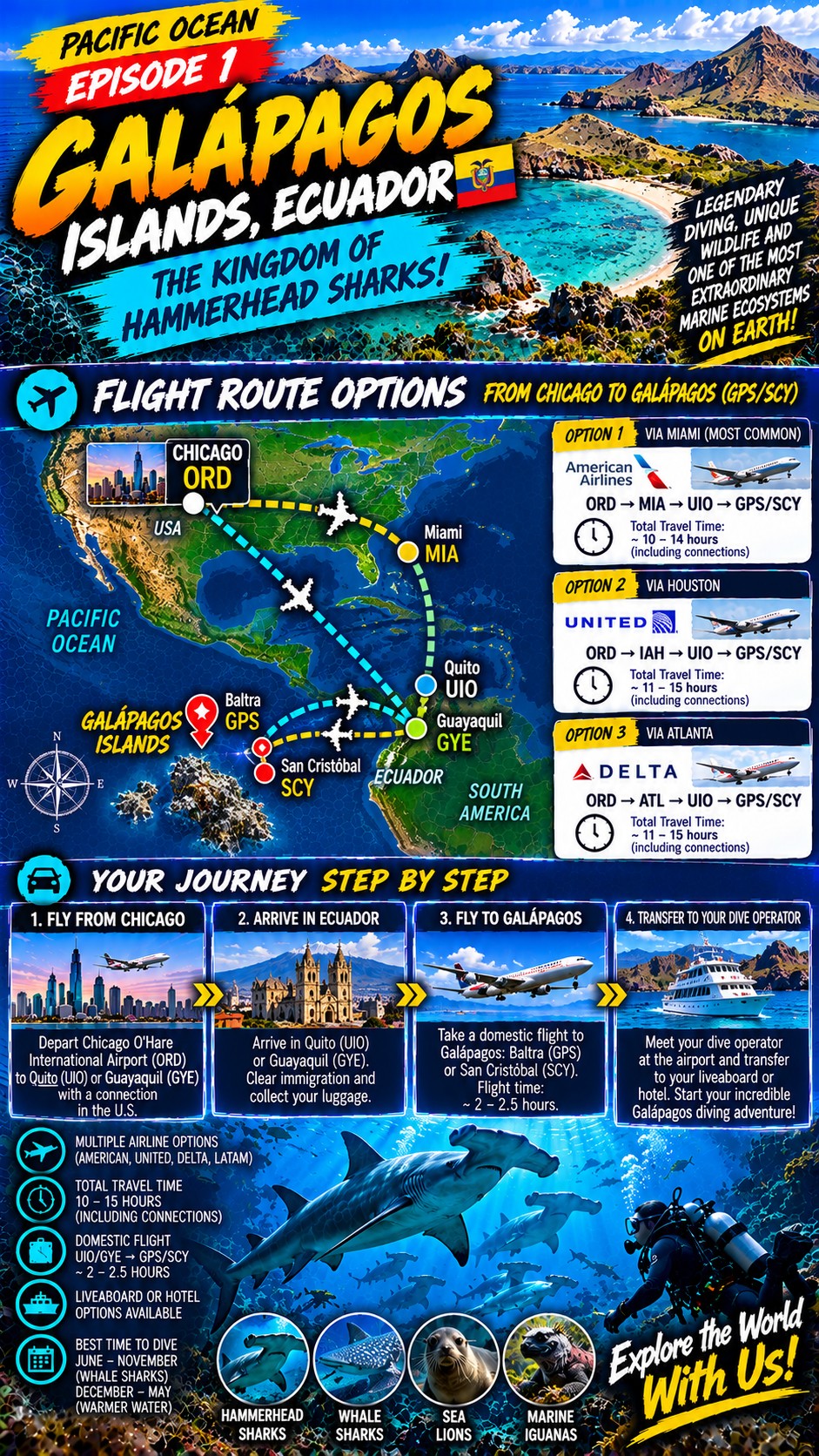
For travelers departing from Chicago, reaching Galápagos involves international flights to mainland Ecuador followed by a domestic flight to the islands.
The principal mainland gateways are:
Quito — Mariscal Sucre International Airport (UIO)
Guayaquil — José Joaquín de Olmedo International Airport (GYE)
The two main Galápagos airports are:
Baltra — Seymour Airport (GPS)
San Cristóbal — Airport (SCY)
Possible Flight Route 1
Chicago O'Hare (ORD) → Miami (MIA) → Quito (UIO) → Baltra (GPS)
Possible Flight Route 2
Chicago O'Hare (ORD) → International Connection → Guayaquil (GYE) → Baltra (GPS)
Possible Flight Route 3
Chicago O'Hare (ORD) → International Connection → Quito (UIO) → San Cristóbal (SCY)
Flight routes depend on airline schedules and availability.
Travelers should confirm current schedules before booking.
Important Travel Considerations
Visitors must complete the applicable Galápagos transit-control procedures and biosecurity inspections.
The Galápagos National Park also charges an entrance fee, which varies according to visitor category.
Additional requirements may apply depending on nationality and residency.
For scuba divers, advance planning should include:
-
International and domestic flight connections.
-
Appropriate baggage allowances.
-
Scuba equipment transportation.
-
Liveaboard boarding schedules.
-
Marine park fees.
-
Travel and diving insurance.
-
Appropriate exposure protection.
-
Current entry requirements.
-
Time for weather-related travel contingencies.
With proper planning, Galápagos can become one of the most extraordinary international diving adventures of your life!
14. Why Galápagos Belongs on Every Advanced Diver's Bucket List
There are many extraordinary scuba diving destinations throughout the Pacific Ocean, but Galápagos offers something truly special.
Massive schools of hammerhead sharks.
Giant whale sharks.
Playful sea lions.
Marine iguanas.
Galápagos sharks.
Spectacular volcanic landscapes.
Remote offshore diving expeditions.
And one of the most fascinating marine ecosystems on Earth.
Galápagos is not simply another scuba diving destination. It is an extraordinary encounter with the wild heart of the Pacific Ocean!
15. Your Galápagos Adventure Starts at Loves Park Scuba!
At Loves Park Scuba, we believe scuba diving is about exploring the world, developing our skills, protecting marine ecosystems, and creating unforgettable memories.
Whether you dream of swimming near massive schools of hammerhead sharks, encountering a giant whale shark, photographing sea lions, or exploring the legendary waters of Darwin and Wolf, our team is here to help you prepare.
From scuba certification and advanced training to equipment selection and dive travel preparation, we're ready to help.
Are you ready to discover Galápagos — The Kingdom of Hammerhead Sharks?
Visit Loves Park Scuba and let us help you prepare for your next extraordinary Pacific diving adventure!
LOVES PARK SCUBA
DIVE INTO ADVENTURE — EXPLORE THE WORLD WITH US!
COMING NEXT IN OUR PACIFIC DIVING SERIES
Episode 2 — Socorro Islands, Mexico: The Kingdom of Giant Oceanic Mantas!
Imagine enormous oceanic manta rays gliding directly above you, curious dolphins approaching divers, and powerful sharks patrolling spectacular volcanic underwater formations.
Our next adventure takes us to Mexico's remote Revillagigedo Archipelago, one of the Pacific Ocean's most extraordinary destinations for encounters with large marine animals.
10 Iconic Pacific Destinations. One Passion for Diving!
