
HAWAII, USA — MANTA RAYS & VOLCANIC REEFS! TOP 10 ICONIC SCUBA DIVING DESTINATIONS IN THE PACIFIC OCEAN — EPISODE 7
Martin Gomez Oct 29, 2026
HAWAII, USA — MANTA RAYS & VOLCANIC REEFS!
TOP 10 ICONIC SCUBA DIVING DESTINATIONS IN THE PACIFIC OCEAN — EPISODE 7
Experience Magical Night Dives with Giant Manta Rays, Explore Ancient Volcanic Lava Formations, Swim Alongside Hawaiian Green Sea Turtles, and Discover the Extraordinary Underwater World of the Hawaiian Islands!
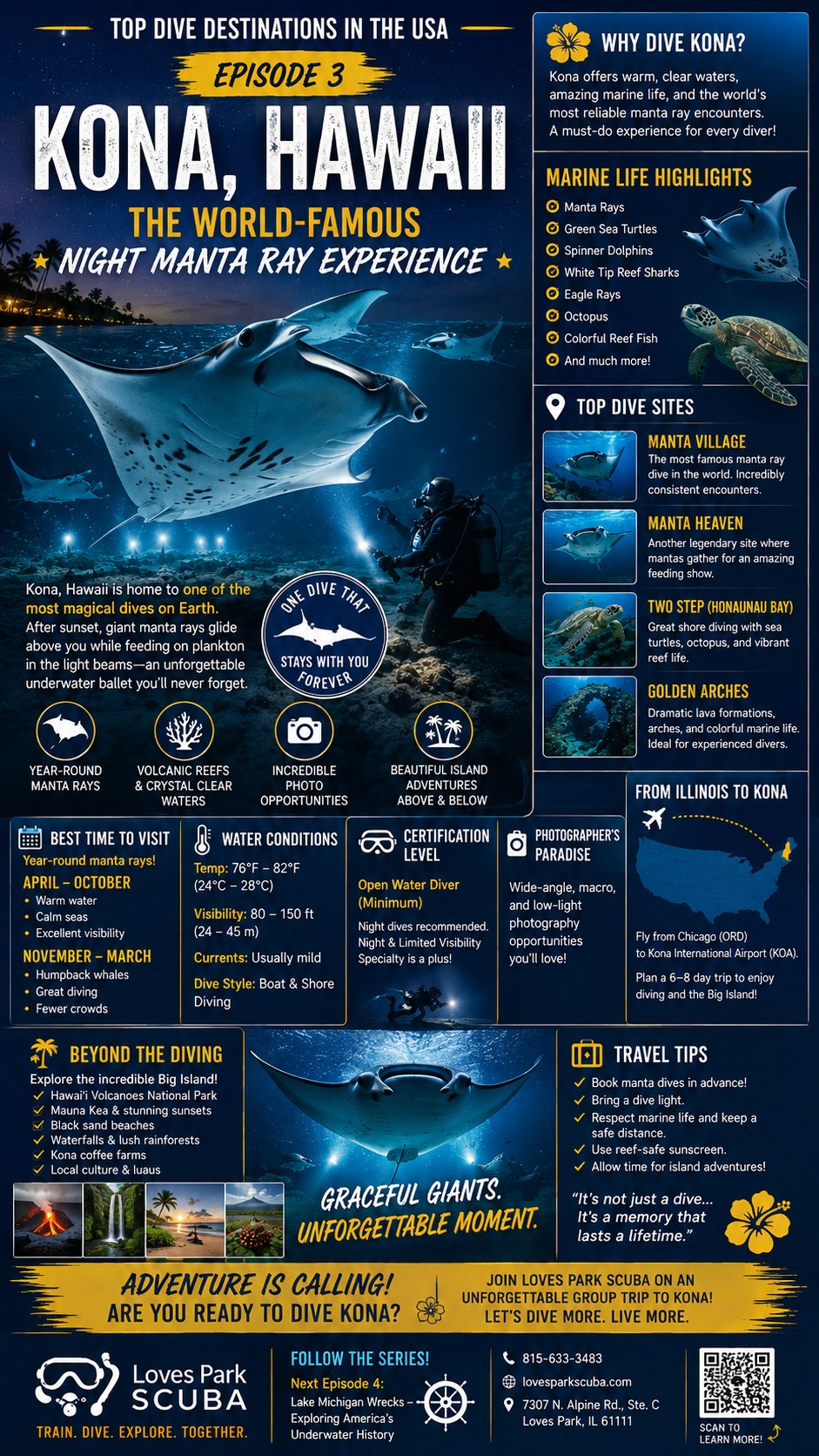
Welcome to Hawaii — Where Fire Meets the Ocean!
Imagine descending into the warm, deep-blue waters of the Pacific Ocean just as the sun begins to disappear behind the horizon.
The volcanic coastline of Hawaii slowly fades into darkness.
Your dive guide leads the group toward a designated underwater observation area.
Powerful dive lights illuminate the water.
Tiny plankton begin gathering in the beams.
Then something extraordinary happens.
A massive shadow appears above you.
An enormous manta ray glides gracefully through the illuminated water.
Its wings stretch across the ocean like those of an underwater bird.
It approaches the light, performs a spectacular somersault, and disappears into the darkness.
Moments later, another manta ray arrives.
Then another.
For several unforgettable minutes, you watch these magnificent animals feeding naturally in the illuminated water.
The experience feels almost unreal.
And this is only the beginning.
The following morning, you explore ancient volcanic lava tubes, underwater arches, coral reefs, and dramatic rocky formations created by Hawaii's extraordinary geological history.
Welcome to Hawaii, USA — Manta Rays & Volcanic Reefs!
At Loves Park Scuba, we're excited to continue our journey through the world's most extraordinary Pacific Ocean diving destinations.
Our seventh adventure takes us to a place where volcanoes, marine biodiversity, and unforgettable underwater encounters come together.
1. Where Is Hawaii?
Hawaii is a volcanic archipelago located in the central North Pacific Ocean, approximately 2,400 miles southwest of California.
The main Hawaiian Islands include:
-
Hawaii Island, commonly called the Big Island.
-
Maui.
-
Oahu.
-
Kauai.
-
Molokai.
-
Lanai.
-
Niihau.
-
Kahoolawe.
Each island offers its own unique combination of underwater landscapes, marine wildlife, and diving opportunities.
What Makes Hawaiian Diving Extraordinary?
Hawaii is internationally recognized for:
-
Night diving with manta rays.
-
Volcanic underwater formations.
-
Lava tubes and arches.
-
Hawaiian green sea turtles.
-
Reef sharks.
-
Colorful tropical fish.
-
Endemic marine species.
-
Coral reefs.
-
Seasonal humpback whale encounters.
-
Excellent underwater photography.
Because the islands are geographically isolated, Hawaii supports numerous endemic species found nowhere else on Earth.
Hawaii is one of the most distinctive scuba diving destinations in the Pacific Ocean!
2. Kona Manta Ray Night Dive — An Unforgettable Underwater Spectacle!
One of the most famous scuba diving experiences in Hawaii takes place along the Kona Coast of the Big Island.
The Kona Manta Ray Night Dive is internationally recognized as one of the world's most extraordinary marine wildlife encounters.
Imagine Diving with Giant Manta Rays!
You enter the water shortly after sunset.
The dive guide leads your group toward a designated observation area.
Underwater lights illuminate the surrounding water.
Plankton gather in the beams.
Suddenly, an enormous manta ray approaches.
It opens its mouth and begins filtering plankton from the water.
As it moves through the illuminated area, it performs graceful loops and somersaults.
Another manta ray arrives.
Soon, several rays may be feeding around the observation area.
What Makes This Dive Special?
-
Wild reef manta rays.
-
Spectacular nighttime encounters.
-
Incredible underwater photography.
-
Close observation of natural feeding behavior.
-
A unique diving experience.
How Large Are the Manta Rays?
Reef manta rays can have wingspans exceeding 10 feet, with particularly large individuals reaching considerably greater widths.
Their size and graceful movements create an extraordinary underwater spectacle.
Responsible Manta Ray Diving
Manta rays are protected wildlife.
Divers must follow established observation procedures.
Important rules include:
-
Never touch manta rays.
-
Never chase them.
-
Never block their swimming paths.
-
Remain in the designated observation area.
-
Follow the dive guide's instructions.
-
Avoid shining lights directly into their eyes.
The animals are wild, and sightings are never guaranteed.
The Kona Manta Ray Night Dive is one of the most unforgettable experiences in recreational scuba diving!
3. Kealakekua Bay — Coral Reefs and Hawaiian Marine Life!
Located along the western coast of the Big Island, Kealakekua Bay is one of Hawaii's most beautiful marine environments.
The bay is famous for its clear water, spectacular coastal scenery, and protected marine habitats.
What Makes Kealakekua Bay Special?
The bay contains extensive coral reef habitats supporting a wide variety of marine species.
Visitors may observe:
-
Hawaiian green sea turtles.
-
Colorful reef fish.
-
Butterflyfish.
-
Surgeonfish.
-
Parrotfish.
-
Moray eels.
-
Reef invertebrates.
-
Occasional dolphins offshore.
The Captain Cook Monument Area
The waters near the Captain Cook Monument are especially famous for snorkeling.
Scuba diving opportunities depend on operator arrangements, site access, and applicable regulations.
Underwater Photography
The combination of clear water, coral formations, and colorful fish creates beautiful photographic opportunities.
Marine Conservation
Kealakekua Bay is a protected marine environment.
Visitors must respect local regulations and avoid disturbing wildlife or coral habitats.
Kealakekua Bay demonstrates the extraordinary beauty of Hawaii's tropical reef ecosystems.
4. Molokini Crater — Diving Inside a Volcanic Wonder!
Located off the southwestern coast of Maui, Molokini Crater is one of Hawaii's most recognizable marine landmarks.
Molokini is a partially submerged volcanic crater that forms a distinctive crescent-shaped island.
Its protected waters and underwater walls create fascinating diving environments.
What Makes Molokini Special?
-
Spectacular volcanic formations.
-
Clear ocean water.
-
Colorful reef fish.
-
Coral habitats.
-
Dramatic underwater walls.
-
Excellent underwater photography.
Marine Life
Divers may encounter:
-
Butterflyfish.
-
Angelfish.
-
Surgeonfish.
-
Moray eels.
-
Reef sharks.
-
Rays.
-
Other tropical marine species.
Inside the Crater
The interior of Molokini offers relatively sheltered conditions during favorable weather.
The Back Wall
The outer wall of Molokini is more exposed and may involve deeper water and stronger currents.
This area is generally more appropriate for experienced divers.
Why Molokini Is Special
The combination of volcanic geology and marine biodiversity creates an unforgettable underwater landscape.
Molokini Crater is one of the most iconic volcanic diving destinations in Hawaii!
5. Cathedrals — Exploring Hawaii's Underwater Lava Formations!
One of the most fascinating types of diving in Hawaii involves exploring ancient volcanic lava formations.
The famous First Cathedral and Second Cathedral dive sites are located near the island of Lanai.
These sites feature dramatic underwater chambers, arches, and openings created by volcanic activity.
Imagine Entering an Underwater Cathedral!
You descend toward a large rocky formation.
Sunlight enters through openings in the volcanic rock.
Beams of light illuminate the underwater chamber.
The surrounding walls create a spectacular natural structure.
As you move through the permitted openings, the combination of shadows and sunlight produces an extraordinary visual experience.
What Can Divers Encounter?
-
Lava formations.
-
Underwater arches.
-
Reef fish.
-
Moray eels.
-
Invertebrates.
-
Occasional reef sharks.
-
Beautiful natural light effects.
Important Safety Considerations
These environments may include overhead features and restricted openings.
Divers should never enter enclosed spaces or swim-throughs beyond their training, experience, and the guidance of qualified local professionals.
Why Are the Cathedrals Famous?
The unique volcanic architecture makes these sites among the most memorable underwater landscapes in Hawaii.
The Cathedrals offer a spectacular opportunity to explore the underwater legacy of Hawaii's volcanoes.
6. Hawaiian Green Sea Turtles — The Gentle Guardians of the Reef!
One of Hawaii's most beloved marine animals is the Hawaiian green sea turtle, locally known as the honu.
These magnificent reptiles are commonly observed around coral reefs, rocky coastlines, and shallow marine habitats.
Imagine Swimming Near a Honu!
You are exploring a beautiful reef when a large sea turtle appears.
It moves slowly through the water, using its powerful flippers to glide effortlessly.
The turtle approaches a rocky formation and begins feeding on algae.
You remain at a respectful distance, observing its natural behavior.
Why Are Green Sea Turtles Important?
Green sea turtles play an important role in marine ecosystems.
Their feeding activities contribute to the health of seagrass and algae communities.
Responsible Turtle Encounters
In Hawaii, sea turtles are protected under federal and state laws.
Divers should:
-
Never touch turtles.
-
Never chase them.
-
Never block their movement.
-
Maintain a respectful distance.
-
Avoid disturbing resting animals.
Seeing a Hawaiian green sea turtle in its natural habitat is one of the most beautiful experiences in Pacific Ocean diving.
7. Sharks and Marine Predators of Hawaii
Although manta rays and turtles are among Hawaii's most famous marine attractions, the islands also support several shark species.
Whitetip Reef Sharks
Often observed resting beneath rocky ledges or swimming around reef structures.
Galápagos Sharks
Large sharks found in Hawaiian waters, particularly around offshore environments.
Sandbar Sharks
Frequently associated with deeper coastal and offshore habitats.
Tiger Sharks
Powerful predators that inhabit Hawaiian waters.
Scalloped Hammerhead Sharks
Seasonal or localized aggregations occur in some Hawaiian areas.
Other Pelagic Species
Divers may also encounter:
-
Tuna.
-
Jacks.
-
Barracuda.
-
Eagle rays.
-
Dolphins.
Hawaii's marine ecosystems support an extraordinary variety of ocean predators and pelagic species.
8. The Extraordinary Marine Biodiversity of Hawaii
Hawaii's isolation in the central Pacific has helped create a remarkable collection of endemic marine species.
These are species found naturally only in the Hawaiian region.
Hawaiian Reef Fish
Many colorful fish species inhabit the islands' coral reefs.
Yellow Tang
One of Hawaii's most recognizable reef fish.
Hawaiian Cleaner Wrasse
An important species involved in cleaning interactions with other fish.
Butterflyfish
Numerous species inhabit coral and rocky reef environments.
Moray Eels
These fascinating predators often shelter among volcanic rocks.
Octopuses
Octopuses inhabit rocky and coral reef habitats.
Sea Turtles
Green sea turtles and hawksbill turtles occur in Hawaiian waters.
Manta Rays
Reef manta rays are among the most extraordinary animals encountered around the islands.
Coral Communities
Hawaiian coral reefs provide essential habitats for fish and marine invertebrates.
Every dive in Hawaii offers an opportunity to discover marine life that makes these islands unique.
9. When Is the Best Time to Dive Hawaii?
Hawaii offers scuba diving opportunities throughout the year.
However, ocean conditions vary by island, coast, and season.
April–October: Generally Favorable Summer Conditions
Many dive sites experience warmer water and relatively calm conditions.
November–March: Winter Season
Ocean swells can affect exposed coastlines, especially northern and western shores.
However, protected dive sites may remain accessible.
Manta Ray Night Diving
Kona manta ray night dives operate throughout the year, weather permitting.
Humpback Whale Season
Humpback whales visit Hawaiian waters primarily during the winter months.
Peak whale-watching opportunities often occur from January through March.
Whale encounters are generally experienced from boats rather than as planned scuba diving activities.
Typical Diving Conditions
| Category | General Conditions |
|---|---|
| Water temperature | Approximately 74–82°F (23–28°C) |
| Visibility | Often 50–100+ ft (15–30+ m), variable |
| Diving season | Year-round |
| Popular travel period | April–October |
| Manta ray night diving | Year-round, weather permitting |
| Recommended experience | Beginner to advanced, depending on site |
| Diving style | Reefs, volcanic formations, night diving, walls, wildlife |
Recommended Exposure Protection
A 3 mm wetsuit may be comfortable during warmer conditions.
A 5 mm wetsuit may be preferable for cooler water, repeated dives, or nighttime activities.
Hawaii offers extraordinary diving experiences throughout the year!
10. Is Hawaii Suitable for Beginner Divers?
Yes!
One of Hawaii's greatest advantages is the variety of diving environments.
Some protected reefs are appropriate for newly certified divers.
Other sites require advanced training and experience.
Beginner-Friendly Opportunities
Depending on conditions:
-
Shallow coral reefs.
-
Guided boat dives.
-
Protected coastal sites.
-
Marine life observation.
-
Introductory underwater photography.
Advanced Diving Opportunities
Experienced divers can explore:
-
Deeper volcanic walls.
-
Exposed offshore sites.
-
Drift diving.
-
Advanced night diving.
-
Complex volcanic formations.
Recommended Training at Loves Park Scuba
Open Water Diver
Begin your underwater adventure with the fundamentals of recreational scuba diving.
Advanced Adventure
Develop confidence in a variety of diving environments.
Night Diving
Prepare for the extraordinary experience of observing marine life after sunset.
Perfect Buoyancy
Improve underwater control and protect sensitive coral reefs.
Deep Diving
Learn to plan deeper recreational dives.
Enriched Air Nitrox
Understand enriched-air diving procedures and safe dive planning.
Rescue Diver
Develop emergency awareness and response skills.
Underwater Photography
Capture Hawaii's extraordinary marine wildlife responsibly.
With proper training and experience, Hawaii offers unforgettable adventures for divers at many skill levels.
11. Land-Based Diving or Liveaboard?
Hawaii offers excellent land-based diving opportunities.
Option 1 — Kona, Big Island
An excellent choice for:
-
Manta ray night diving.
-
Volcanic reefs.
-
Lava formations.
-
Marine wildlife.
-
Boat diving.
-
Shore diving at suitable sites.
Option 2 — Maui
A popular base for:
-
Molokini Crater.
-
Coral reefs.
-
Turtle encounters.
-
Scenic coastal diving.
-
Seasonal whale watching.
Option 3 — Lanai
Known for:
-
First Cathedral.
-
Second Cathedral.
-
Volcanic swim-throughs.
-
Rocky reef habitats.
-
Spectacular underwater formations.
Can You Combine Multiple Islands?
Yes!
Travelers can combine different Hawaiian islands through inter-island flights and planned excursions.
However, each island requires additional transportation and travel time.
Which Option Is Best?
For the famous manta ray night dive, Kona is the ideal starting point.
For volcanic crater diving, Maui is an excellent choice.
For spectacular underwater lava formations, Lanai deserves special attention.
Hawaii offers remarkable flexibility for planning an extraordinary diving vacation.
12. Beyond Diving — Explore the Magic of Hawaii!
Hawaii is famous for much more than scuba diving.
The islands offer spectacular landscapes, fascinating culture, and unforgettable outdoor adventures.
Hawaii Volcanoes National Park
Explore volcanic landscapes and learn about the geological forces that created the islands.
Mauna Kea
Discover the extraordinary high-altitude landscapes of the Big Island.
Kona Coffee Country
Visit coffee farms and experience one of Hawaii's famous agricultural traditions.
Maui's Scenic Coastline
Enjoy beautiful beaches, dramatic cliffs, and spectacular ocean views.
Haleakala National Park
Discover Maui's extraordinary volcanic summit landscapes.
Hawaiian Culture
Learn about traditional Hawaiian history, language, music, and customs.
Tropical Cuisine
Enjoy fresh seafood, tropical fruits, and local island specialties.
Spectacular Sunsets
Watch the sun disappear over the Pacific Ocean.
Hawaii combines world-class diving with extraordinary natural beauty and island culture.
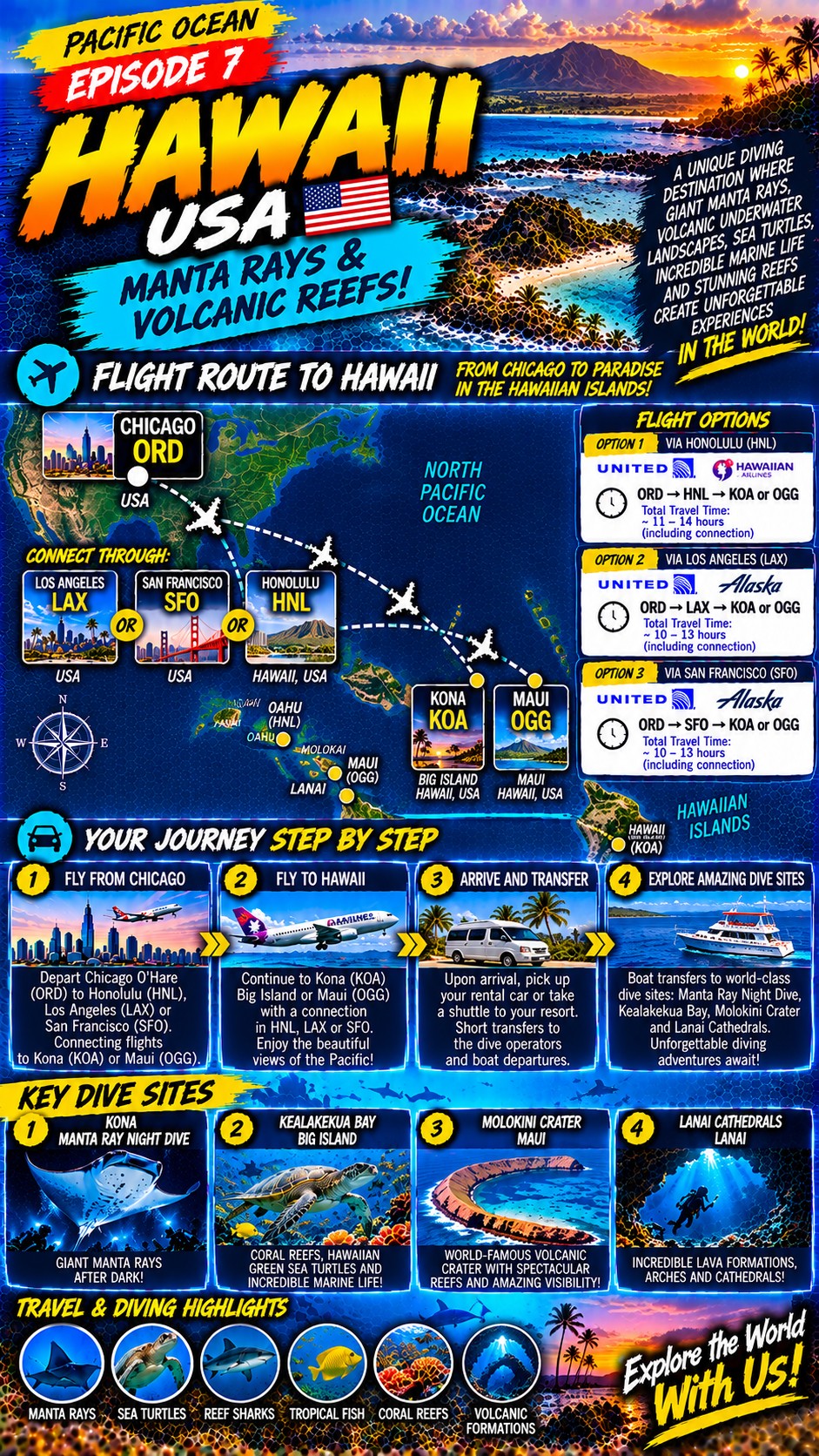
13. How Do You Get to Hawaii from Chicago?
Hawaii is one of the more accessible Pacific diving destinations for travelers departing from the United States.
Main Airports
Kona International Airport — KOA
Best for exploring the Kona Coast and manta ray night diving.
Kahului Airport — OGG
Best for visiting Maui and arranging trips to Molokini Crater.
Daniel K. Inouye International Airport — HNL
Located in Honolulu, Oahu, and an important connection point for inter-island flights.
Flight Option 1 — Chicago to Kona
Chicago O'Hare (ORD) → Kona (KOA)
Depending on current airline schedules, travelers may find nonstop or connecting services.
Flight Option 2 — Chicago to Kona via Honolulu
ORD → Honolulu (HNL) → Kona (KOA)
Flight Option 3 — Chicago to Maui
ORD → Kahului (OGG)
Nonstop or connecting options depend on travel dates and airline schedules.
Flight Option 4 — Chicago to Maui via the West Coast
ORD → Los Angeles (LAX) or San Francisco (SFO) → Kahului (OGG)
These are illustrative travel routes rather than confirmed itineraries.
Ground Transportation
After arriving in Hawaii, travelers can use rental cars, shuttles, or arranged transfers to reach their accommodations and dive operators.
Travel Planning Tips
We recommend:
-
Arriving before your first scheduled dive.
-
Confirming scuba equipment baggage allowances.
-
Reserving manta ray night dives in advance.
-
Checking seasonal ocean conditions.
-
Confirming marine park regulations.
-
Purchasing appropriate dive and travel insurance.
-
Planning adequate no-fly intervals after diving.
From Chicago to the Hawaiian Islands, an extraordinary Pacific diving adventure is waiting for you!
14. Marine Conservation — Protecting Hawaii's Underwater Paradise
Hawaii's marine ecosystems are among the most important natural treasures of the central Pacific.
Coral reefs, manta rays, sea turtles, and other marine species depend on healthy ocean habitats.
Conservation Challenges
Threats include:
-
Coral bleaching.
-
Ocean warming.
-
Marine pollution.
-
Coastal development.
-
Habitat disturbance.
-
Unsustainable fishing.
-
Human disturbance of marine wildlife.
Responsible Diving Practices
At Loves Park Scuba, we encourage divers to:
-
Maintain excellent buoyancy.
-
Never touch manta rays.
-
Never disturb sea turtles.
-
Avoid contact with coral.
-
Follow marine protected area regulations.
-
Respect wildlife observation guidelines.
-
Support responsible local dive operators.
-
Reduce single-use plastic.
Why Conservation Matters
Protecting Hawaii's marine ecosystems helps preserve extraordinary wildlife encounters for future generations.
Every responsible diver can make a difference in protecting the Pacific Ocean.
15. Why Hawaii Belongs on Your Diving Bucket List
Imagine watching giant manta rays glide above you during a spectacular night dive.
Exploring ancient volcanic lava formations illuminated by sunlight.
Swimming near Hawaiian green sea turtles.
Discovering colorful reef fish found nowhere else on Earth.
Diving along dramatic underwater walls.
And ending the day watching a magnificent Pacific sunset from a tropical island.
Few destinations combine such extraordinary marine biodiversity, volcanic geology, and natural beauty.
Hawaii is one of the most spectacular and diverse scuba diving destinations in the Pacific Ocean!
Whether you're a newly certified diver or an experienced underwater explorer, Hawaii offers unforgettable opportunities for adventure.
16. Your Hawaii Adventure Starts at Loves Park Scuba!
At Loves Park Scuba, we believe extraordinary diving adventures begin with proper training, reliable equipment, and a passion for ocean exploration.
Whether you dream of swimming beneath giant manta rays, exploring volcanic underwater formations, or photographing Hawaiian green sea turtles, our team can help you prepare.
We offer opportunities to develop your skills through:
-
Open Water Diver certification.
-
Advanced diving education.
-
Enriched Air Nitrox training.
-
Rescue Diver courses.
-
Buoyancy improvement.
-
Equipment selection.
-
Dive travel preparation.
Are you ready to discover Hawaii — Manta Rays & Volcanic Reefs?
Visit Loves Park Scuba and begin preparing for your next extraordinary Pacific Ocean adventure!
LOVES PARK SCUBA
DIVE INTO ADVENTURE — EXPLORE THE WORLD WITH US!
COMING NEXT IN OUR PACIFIC OCEAN DIVING SERIES
EPISODE 8 — MIKOMOTO ISLAND, JAPAN: THE HAMMERHEAD SHARK CAPITAL OF JAPAN!
Our next adventure takes us to the Pacific coast of Japan.
Imagine descending into the powerful currents of the Kuroshio Current and watching schools of hammerhead sharks emerge from the blue.
Discover volcanic underwater formations, dramatic rocky reefs, and one of Asia's most extraordinary shark-diving experiences.
MIKOMOTO ISLAND — THE HAMMERHEAD SHARK CAPITAL OF JAPAN!
10 ICONIC PACIFIC DESTINATIONS. ONE PASSION FOR DIVING!
