
HOW THE OTS SPECTRUM WORKS
Martin Gomez Aug 12, 2026
HOW THE OTS SPECTRUM WORKS
Regulator Integration • Equalization • Communications • ABV • Emergency Skills
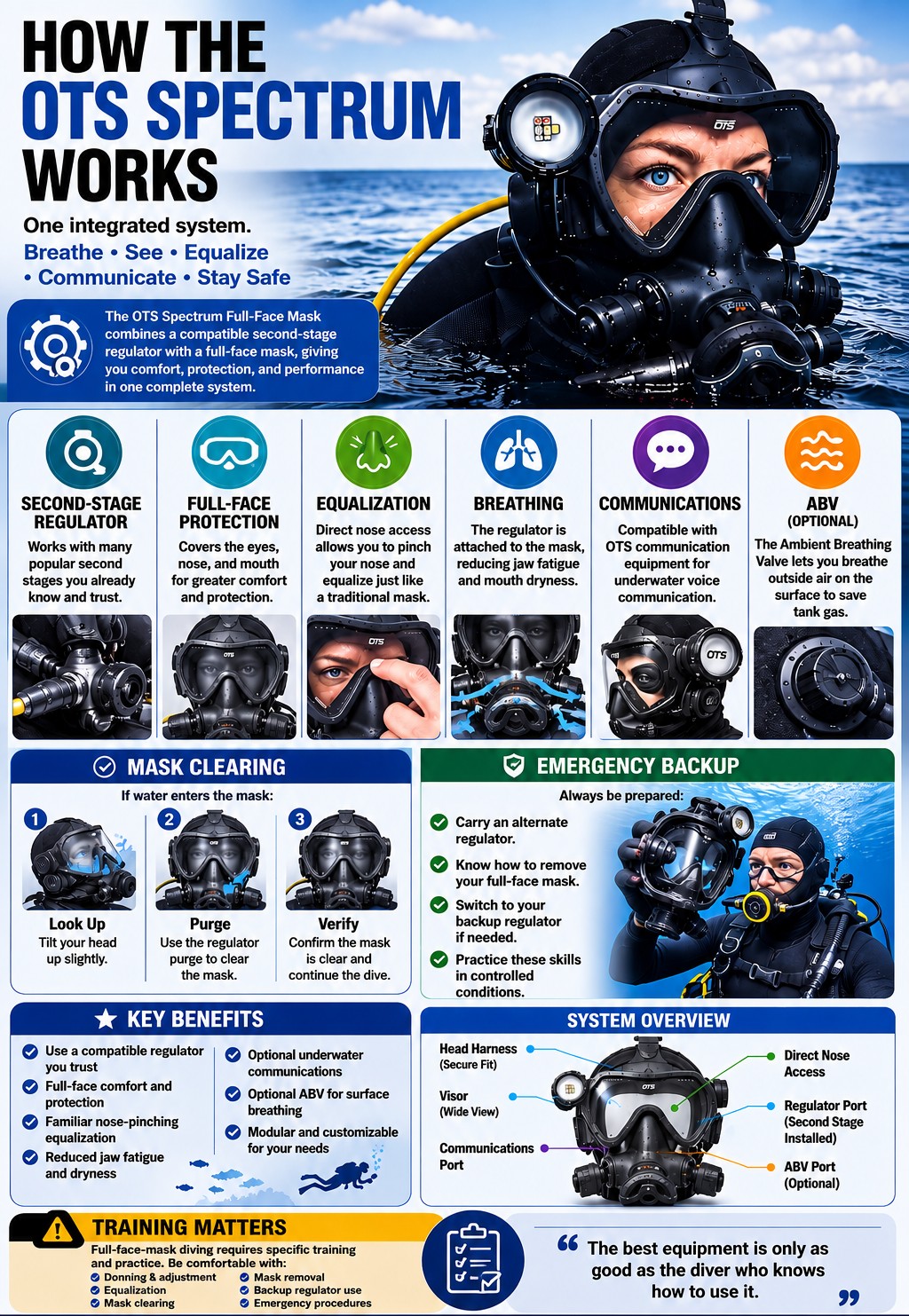
The OTS Spectrum Full-Face Mask combines a traditional second-stage regulator with a full-face mask, allowing the diver to breathe, see, equalize, and potentially communicate underwater through one integrated system. OTS designed it to accept most modern standard second-stage regulators, rather than requiring a proprietary second stage.
1. Second-Stage Installation
One of the Spectrum’s defining features is that you can install a compatible regulator you already own.
For the U.S./non-CE version, OTS instructs the user to remove the conventional bite mouthpiece, insert the regulator’s mouthpiece tube through the Spectrum’s regulator port, and secure it with the specified attachment method. The CE version uses a different clamp/mouthpiece arrangement, so installation procedures depend on the exact mask version.
The Spectrum does not normally include the second stage itself. OTS publishes regulator-port dimensions and recommends confirming compatibility before configuring the mask.
Key idea:
Your regulator becomes part of the mask rather than remaining in your mouth as a conventional bite-down second stage.
2. Mask Components
The basic Spectrum system includes several important elements working together:
Tempered-glass or coated visor — provides the diver’s field of view.
Double facial seal — designed to provide a secure fit across a range of face shapes.
Five-point head harness — holds the mask firmly and distributes tension around the head.
Oral-nasal section — surrounds the nose and mouth area.
Regulator port — allows installation of the compatible second stage.
Communications port — accepts compatible OTS communication equipment.
The Spectrum can also be expanded with accessories such as an Ambient Breathing Valve, lights, cameras, brackets, and communications systems.
3. Equalization
Equalizing with the Spectrum is deliberately familiar.
Unlike some full-face masks that use an internal nose-block system, the Spectrum allows you to physically pinch your nose through the mask, much like you would with a conventional scuba mask.
That can make the transition to FFM diving easier for divers who already use a standard Valsalva-style technique.
The procedure is conceptually simple:
Descend slowly → pinch the nose → equalize early and often → continue descending only if comfortable.
A full-face mask does not change the basic rule:
Never force an equalization.
4. Breathing
With the mask properly fitted, the diver breathes normally through the installed second stage.
Because the regulator is secured to the mask, there is no conventional mouthpiece that must constantly be held between the teeth.
That can reduce:
Jaw fatigue
Dry-mouth discomfort
and the possibility of accidentally losing the regulator from the mouth during normal operation.
OTS specifically promotes reduced jaw fatigue and improved comfort as key Spectrum benefits.
However, breathing performance still depends heavily on the specific second stage installed, including its condition, adjustment, and suitability for the intended environment.
5. Communications
This is where a full-face mask becomes much more than a comfort accessory.
The Spectrum includes a communications port compatible with OTS equipment such as Buddy Phone or appropriate ear/microphone assemblies. OTS also offers both wireless through-water and hard-wire communication systems.
With the proper system installed, divers can potentially communicate using speech underwater.
That can be especially useful for:
Instructor ↔ Student
Public Safety Teams
Scientific Divers
Commercial Divers
Search & Recovery Teams
Surface ↔ Diver Operations
The communication equipment doesn't replace good dive procedures or hand signals, but it can add an important layer of coordination.
6. Ambient Breathing Valve — ABV
The Ambient Breathing Valve is an optional accessory for the Spectrum; it is not included automatically.
Its purpose is simple:
Save cylinder gas while you're on the surface.
Without an ABV, a diver wearing a sealed full-face mask normally breathes through the scuba regulator, consuming cylinder gas.
With an appropriately configured ABV open at the surface, the diver can breathe ambient air instead.
Before descending, the system must be placed into its correct diving configuration according to the manufacturer’s procedures.
Think of it as:
Surface → breathe surrounding air
Underwater → breathe from the scuba system
This can be especially useful when waiting at the surface before descent.
7. Clearing a Flooded Spectrum
Full-face-mask divers must know how to respond if water enters the mask.
OTS describes a straightforward clearing technique: if the mask floods, the diver looks upward and activates the regulator purge, allowing incoming gas to displace the water. The diver then verifies that the mask is clear before resuming normal breathing.
But this skill should be practiced in controlled conditions, not first attempted during an actual emergency.
FFM diving introduces skills that aren't identical to conventional mask clearing.
8. What If the Mask Has to Come Off?
This is one of the most important differences between traditional scuba and full-face-mask diving.
With conventional equipment:
Mask and regulator are separate.
With a Spectrum:
The primary regulator is attached to the mask.
If the full-face mask must be removed underwater, the diver needs a practiced way to:
Maintain breathing gas
Switch to an alternate second stage
Control buoyancy
Maintain orientation
and, if appropriate,
replace or manage the full-face mask.
The exact emergency procedures should follow the diver's training, equipment configuration, and OTS instructions. OTS explicitly instructs users to review the manual and emergency procedures before diving the equipment.
9. Why Carry an Alternate Second Stage?
Because your primary second stage is incorporated into the full-face mask, an independent alternate breathing source becomes particularly important.
If you ever have to remove the Spectrum underwater, you need a regulator available without depending on the mask itself.
That is why full-face-mask training normally places strong emphasis on:
alternate-air-source access
mask removal
mask replacement
and
emergency breathing procedures.
10. Communications Failure Is Not a Diving Emergency
This distinction is important.
If underwater voice communications stop functioning, the diver should still be able to conduct the dive using normal:
Hand signals
Buddy procedures
Dive planning
and
Emergency protocols.
Communications are a tool.
They should never be the only method by which two divers can safely coordinate.
11. Training Matters
The Spectrum may look intuitive, but diving a full-face mask requires skills that differ from conventional scuba.
Before using one in open water, a diver should be comfortable with:
Donning and adjustment
Regulator installation
Equalization
Mask clearing
Mask removal
Alternate regulator deployment
Mask replacement
ABV procedures
Communication procedures
and
Emergency ascent protocols
OTS warns users to read and understand the Spectrum manual and emergency procedures before diving the equipment.
A Simple Way to Remember the Spectrum System
REGULATOR → provides breathing gas
MASK → seals eyes, nose and mouth
HARNESS → secures the system
NOSE ACCESS → allows familiar equalization
COMM PORT → enables voice communication
ABV → conserves cylinder gas at the surface
ALTERNATE REGULATOR → provides backup breathing capability
THE OTS SPECTRUM
BREATHE • SEE • EQUALIZE • COMMUNICATE • STAY PREPARED
Next: OTS SPECTRUM EMERGENCY PROCEDURES
Flooded mask • Complete mask removal • Switching to backup regulator • Re-donning the FFM • Loss of communications • Out-of-gas procedures • Surface emergencies
