
How to Learn Butterfly
Martin Gomez Aug 20, 2026
How to Learn Butterfly
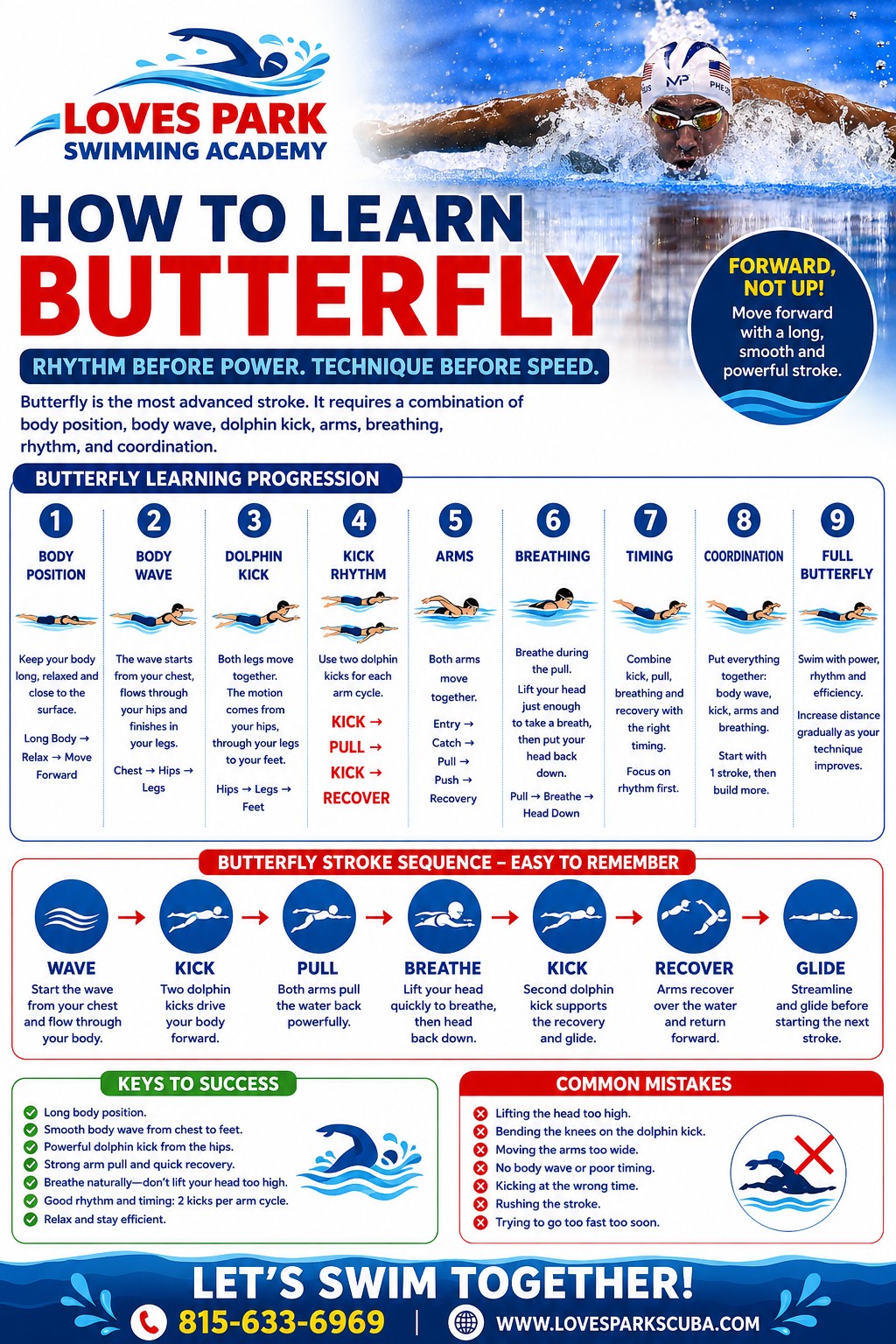
Butterfly is generally the most advanced of the four basic swimming strokes because it requires a combination of body position, body wave, dolphin kick, arm movement, breathing, rhythm, and coordination.
The key is not to start by trying to swim the complete stroke. Learn each movement separately and gradually put everything together.
1. Body Position
Keep the body long, relaxed, and close to the surface.
Butterfly includes an undulating movement, but the goal is to travel forward rather than move excessively up and down.
Long Body → Relax → Move Forward
2. Body Wave
Before adding the arms, learn the natural wave movement of butterfly.
The movement flows through the body:
CHEST → HIPS → LEGS
Think of the body as one continuous wave rather than separate movements.
3. Dolphin Kick
Both legs move together and simultaneously.
The movement begins mainly from the hips and travels through the legs to the feet.
Hips → Legs → Feet
A simple progression is:
Body Wave → Dolphin Kick → Streamline Dolphin Kick
4. Kick Rhythm
In full butterfly, swimmers typically use two dolphin kicks for each arm cycle.
For beginners, a simple rhythm is:
Kick → Pull → Kick → Recover
Develop the rhythm first, then refine the timing of each kick.
5. Arm Movement
Both arms move simultaneously.
The arm cycle is:
Entry → Catch → Pull → Push → Recovery
Start with:
One Butterfly Pull → Glide
Then gradually progress to continuous strokes.
6. Breathing
Breathing should work naturally with the stroke.
As the arms finish the pull, lift the head only enough to take a breath. Return the head to the water as the arms recover forward.
Pull → Breathe → Head Down → Recover
Avoid lifting the head too high because this can cause the hips to drop and increase resistance.
7. Coordination
Now combine the skills:
Body Wave + Dolphin Kick + Arms + Breathing
Start gradually:
1 Stroke → 2 Strokes → 3 Strokes → Short Distance
A swimmer does not need to swim an entire pool when first learning butterfly.
8. Move Forward, Not Up
One of the most important concepts in butterfly is:
FORWARD, NOT UP.
Trying to lift the body too high wastes energy. The stroke should feel long, smooth, rhythmic, and directed forward.
9. Build Distance Gradually
Once the swimmer develops good coordination:
1 Stroke → 3 Strokes → 5 Strokes → Short Distance → Half Pool → Full Length
Technique and rhythm come first. Endurance and speed come later.
Butterfly Learning Progression
BODY POSITION → BODY WAVE → DOLPHIN KICK → KICK RHYTHM → ARMS → BREATHING → TIMING → COORDINATION → FULL BUTTERFLY
Easy Way to Remember
WAVE → KICK → PULL → BREATHE → KICK → RECOVER → GLIDE
Rhythm before power. Technique before speed.
In butterfly, using more strength does not always produce better swimming. When the body, kicks, arms, and breathing work together with the correct rhythm, butterfly becomes smoother, more efficient, and less exhausting.
