
MAGDALENA BAY & PUNTA EUGENIA, MEXICO — THE WILD PACIFIC COAST OF BAJA CALIFORNIA! TOP 10 ICONIC SCUBA DIVING DESTINATIONS IN THE PACIFIC OCEAN — EPISODE 10: THE GRAND FINALE!
Martin Gomez Oct 30, 2026
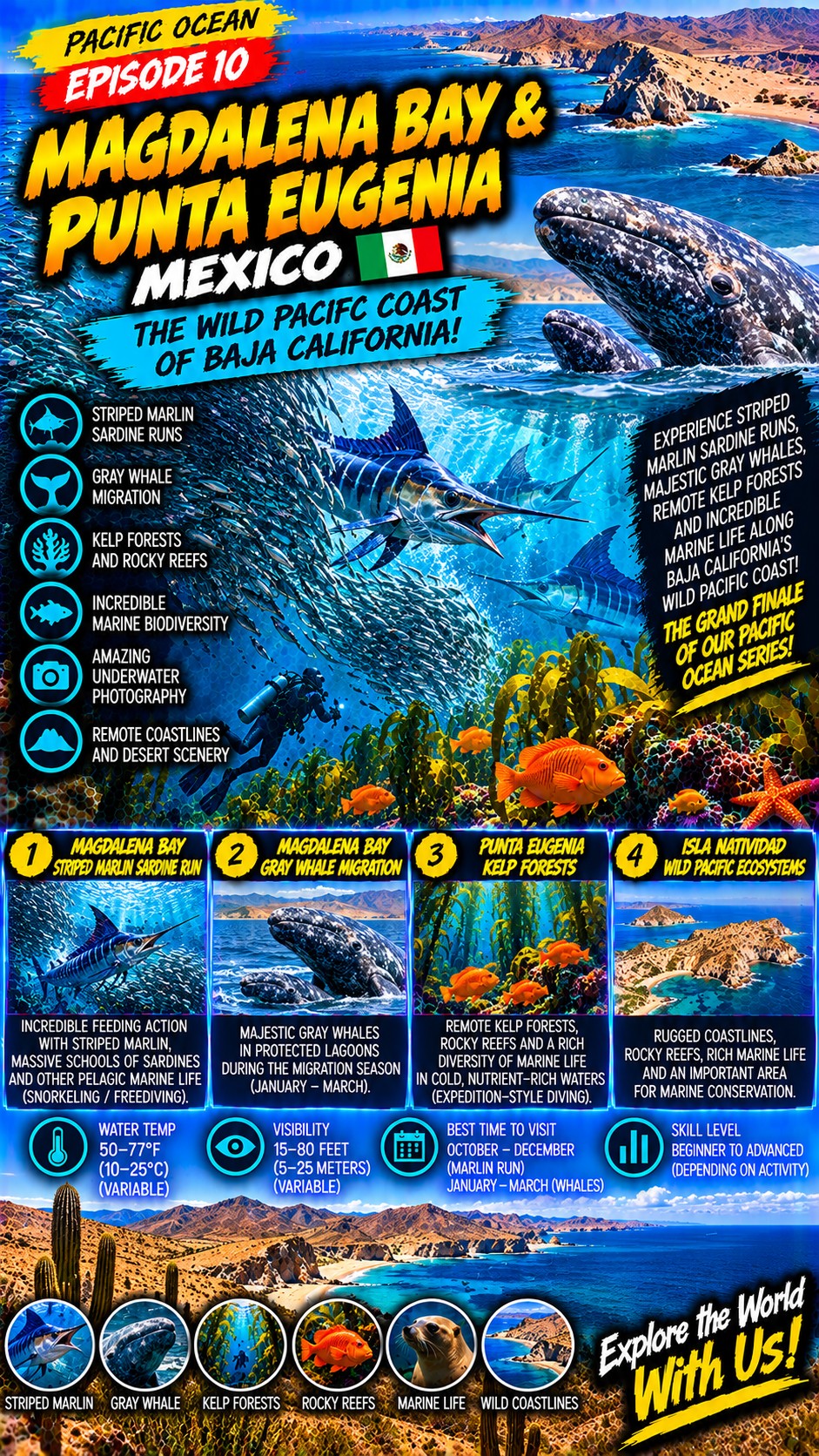
MAGDALENA BAY & PUNTA EUGENIA, MEXICO — THE WILD PACIFIC COAST OF BAJA CALIFORNIA!
TOP 10 ICONIC SCUBA DIVING DESTINATIONS IN THE PACIFIC OCEAN — EPISODE 10: THE GRAND FINALE!
Discover the Striped Marlin Sardine Run, Encounter Migrating Gray Whales, Explore Remote Kelp Forests, and Experience the Extraordinary Marine Wilderness of Baja California's Pacific Coast!
Welcome to Wild Baja — Where the Desert Meets the Pacific Ocean!
Imagine traveling along the rugged Pacific coast of Mexico's Baja California Peninsula.
To one side, the desert stretches toward distant mountains.
To the other, the vast Pacific Ocean extends beyond the horizon.
The coastline is dramatic, remote, and beautiful.
But beneath the surface, something extraordinary is happening.
Thousands of sardines gather into a dense, shimmering school.
Suddenly, the water erupts with movement.
Striped marlin charge through the bait ball at incredible speed.
Sea lions and seabirds may join the feeding spectacle.
The entire ocean seems alive.
Farther along the coast, gray whales migrate toward protected lagoons where they give birth and care for their calves.
And to the north, around Punta Eugenia, cold Pacific waters support spectacular rocky reefs, kelp forests, and rich marine ecosystems.
This is not simply another tropical diving destination.
This is a journey into the wild heart of the Pacific Ocean.
Welcome to Magdalena Bay & Punta Eugenia — The Wild Pacific Coast of Baja California!
At Loves Park Scuba, we are excited to present the grand finale of our journey through ten extraordinary Pacific Ocean destinations.
1. Where Are Magdalena Bay and Punta Eugenia?
Both destinations are located along the Pacific coast of Mexico's Baja California Peninsula, but they are separated by a considerable distance.
Magdalena Bay — Baja California Sur
Magdalena Bay, also known as Bahía Magdalena, is a large coastal lagoon system along the Pacific coast of Baja California Sur.
It is internationally recognized for gray whale watching, rich marine ecosystems, and access to offshore pelagic wildlife encounters.
The communities of Puerto San Carlos and Puerto Adolfo López Mateos serve as important gateways to the lagoon system.
Punta Eugenia — Northern Pacific Baja California Sur
Punta Eugenia is located near the northern end of Baja California Sur, close to the boundary with Baja California state.
The area lies near Isla Natividad and the productive waters surrounding the Vizcaíno Peninsula.
This remote coastline is known for its rocky reefs, kelp habitats, marine mammals, seabirds, and fishing communities.
What Makes This Region Special?
-
Extraordinary striped marlin feeding events.
-
Massive schools of sardines.
-
Seasonal gray whale migrations.
-
Remote Pacific coastlines.
-
Productive kelp forests.
-
Rocky underwater reefs.
-
Sea lions and other marine mammals.
-
Exceptional marine wildlife photography.
-
Authentic Baja California coastal culture.
Baja California's Pacific coast is one of North America's most spectacular marine wildlife regions!
2. Magdalena Bay — The Spectacular Striped Marlin Sardine Run!
One of the most extraordinary wildlife experiences in the Pacific Ocean takes place in the offshore waters accessible from the Magdalena Bay region.
During favorable seasonal conditions, striped marlin gather to hunt large schools of sardines and other small baitfish.
Imagine the Experience!
You enter the blue Pacific Ocean with your guide.
In the distance, seabirds gather above the surface.
The water begins to shimmer.
Thousands of sardines move together in a massive, silver-colored bait ball.
Suddenly, a striped marlin appears.
Then another.
Within seconds, several marlin begin hunting through the school.
The sardines tighten into a dense ball as the predators circle.
Marlin flash through the water with incredible speed and precision.
It is one of the most dramatic feeding spectacles in the ocean.
Why Is the Sardine Run So Special?
The experience may involve:
-
Striped marlin.
-
Massive schools of sardines.
-
Sea lions.
-
Seabirds.
-
Other pelagic predators.
-
Extraordinary underwater photography opportunities.
Important: Snorkeling, Freediving, or Scuba?
The striped marlin bait-ball experience is most commonly offered as a surface-based snorkeling or freediving expedition.
Many operators do not use scuba equipment for these fast-moving encounters.
The animals and bait balls may move rapidly, requiring boats to relocate throughout the day.
Best Time
The main season is generally October through December, although timing and sightings vary with ocean conditions.
The Magdalena Bay striped marlin experience is one of the most exciting marine wildlife encounters in the world!
3. Magdalena Bay — The Gray Whale Migration!
Every year, eastern North Pacific gray whales undertake one of the most remarkable migrations in the animal kingdom.
They travel between northern feeding grounds and the warmer lagoons of Baja California.
Magdalena Bay is one of the important regions where visitors can observe these magnificent marine mammals.
Imagine Meeting a Gray Whale!
You board a small authorized whale-watching boat.
The lagoon is calm.
Suddenly, a massive gray whale surfaces nearby.
Its powerful back breaks the water.
A cloud of mist rises as the whale exhales.
Moments later, a calf appears beside its mother.
The experience is unforgettable.
Why Do Gray Whales Visit Baja California?
The protected coastal lagoons provide important habitat for:
-
Calving.
-
Nursing.
-
Resting.
-
Social behavior.
Best Time for Gray Whale Watching
The primary season is generally January through March, with timing varying by location and year.
Important Wildlife Protection
Gray whale encounters are conducted through regulated boat-based whale-watching activities.
Visitors should use authorized operators and follow Mexican wildlife protection rules.
Swimming with or touching whales should not be assumed to be permitted.
Observing gray whales in the lagoons of Baja California is one of the greatest wildlife experiences in the Pacific Ocean!
4. Punta Eugenia — Remote Kelp Forest Adventures!
Farther north along the Pacific coast, Punta Eugenia offers a completely different marine environment.
Here, cooler waters and rocky underwater habitats support productive ecosystems.
The region is influenced by the California Current system and coastal upwelling.
What Makes Punta Eugenia Special?
-
Rocky underwater reefs.
-
Kelp forest habitats.
-
Marine mammals.
-
Rich fish populations.
-
Colorful invertebrates.
-
Remote coastal scenery.
-
Fascinating marine biodiversity.
Imagine Exploring the Underwater Landscape!
You descend into cool Pacific water.
Below you, large rocky formations create an extraordinary underwater environment.
Long strands of kelp move gently with the surge.
Fish gather around the rocks.
Sea stars and colorful invertebrates decorate the reef.
In the distance, a sea lion moves through the water.
The experience is wild, remote, and beautiful.
Is Scuba Diving Available?
The Punta Eugenia and Isla Natividad region has remarkable underwater habitats, but it is not a conventional, widely developed recreational scuba tourism destination.
Diving access may require specialized local arrangements, appropriate permissions, suitable weather, and experienced operators.
Visitors should confirm that a legitimate recreational dive operation is available before planning a scuba trip.
Punta Eugenia represents the adventurous, less-explored side of Baja California's Pacific coast.
5. Isla Natividad — Kelp Forests and Marine Conservation!
Near Punta Eugenia lies Isla Natividad, a small island known for its productive marine ecosystems and fishing community.
The surrounding waters support important rocky reef and kelp forest habitats.
What Makes Isla Natividad Special?
-
Kelp forests.
-
Rocky reef ecosystems.
-
Abundant marine invertebrates.
-
Fish populations.
-
Marine conservation research.
-
Community-based fisheries management.
Marine Life
Depending on habitat and season, the surrounding region supports:
-
Rockfish.
-
Kelp-associated fish.
-
Lobsters.
-
Abalone.
-
Sea urchins.
-
Sea stars.
-
Marine mammals.
Why Is Isla Natividad Important?
The island has been associated with research into kelp ecosystems, fisheries, and the effects of changing ocean conditions.
The region provides valuable insights into the conservation of temperate marine ecosystems.
Responsible Exploration
Because Isla Natividad is a small fishing community rather than a mainstream dive resort, visitors should respect local access requirements, community activities, and environmental protections.
Isla Natividad demonstrates the extraordinary ecological importance of Baja California's Pacific kelp forests!
6. Bahía Asunción — Another Wild Pacific Coastal Experience!
North of Punta Eugenia, Bahía Asunción offers another beautiful example of Baja California's rugged Pacific coastline.
The area is known for its fishing traditions, rocky shores, and productive marine ecosystems.
What Can Visitors Discover?
-
Dramatic coastal scenery.
-
Marine birds.
-
Rocky reefs.
-
Sea lions in the wider region.
-
Fishing communities.
-
Remote Pacific beaches.
-
Beautiful sunsets.
Is It a Scuba Destination?
Commercial recreational scuba options may be limited.
The region is better approached as an expedition-style coastal destination unless a qualified local operator confirms suitable diving arrangements.
Why Include Bahía Asunción?
It helps travelers understand the extraordinary diversity of Baja California's remote Pacific coastline.
Bahía Asunción is an excellent example of Baja California's wild coastal character!
7. The California Current — The Lifeline of Wild Baja!
One of the most important oceanographic features affecting the region is the California Current.
This large ocean current generally transports cooler water southward along the western coast of North America.
Coastal upwelling can bring cold, nutrient-rich water toward the surface.
Why Is This Important?
These nutrients support microscopic marine organisms that form the foundation of productive food webs.
In turn, these ecosystems support:
-
Sardines and other baitfish.
-
Pelagic predators.
-
Seabirds.
-
Marine mammals.
-
Rocky reef communities.
-
Kelp forests.
Why Does Baja California Have So Much Marine Life?
The combination of currents, seasonal productivity, coastal habitats, and marine migration routes creates extraordinary conditions for wildlife.
What Does This Mean for Divers?
Water temperatures and visibility can change significantly.
Some areas may have:
-
Cold water.
-
Strong surge.
-
Currents.
-
Reduced visibility.
-
Remote access.
-
Rapidly changing weather.
Understanding the California Current helps explain why Baja California's Pacific coast is such an extraordinary marine wildlife destination.
8. The Incredible Marine Life of Baja California's Pacific Coast
Striped Marlin
Fast, powerful predators famous for spectacular bait-ball hunting events.
Gray Whales
Magnificent marine mammals that migrate to Baja California's protected lagoons.
California Sea Lions
Agile marine mammals found along portions of the Baja California coast.
Sardines
Small schooling fish that play an essential role in the region's food webs.
Dolphins
Several dolphin species may be encountered in offshore waters.
Sea Turtles
Some sea turtle species use the coastal and offshore waters of Baja California.
Sharks
Different shark species occur throughout the region, depending on habitat and season.
Seabirds
Pelicans, gulls, cormorants, and other seabirds gather around productive marine habitats.
Kelp Forest Species
Rockfish, invertebrates, and numerous other animals inhabit cooler coastal habitats.
Few destinations offer such an extraordinary combination of large marine animals and productive underwater ecosystems!
9. Best Time to Visit Magdalena Bay and Punta Eugenia
Because these destinations offer different wildlife experiences, the ideal travel season depends on what visitors want to see.
October–December: Striped Marlin Sardine Run
This is generally the main period for offshore striped marlin and bait-ball expeditions.
January–March: Gray Whale Season
The winter breeding and calving season offers opportunities for authorized whale watching in the lagoons.
Spring–Fall: Coastal Exploration
Weather and ocean conditions may allow coastal excursions and other marine activities.
Punta Eugenia and Isla Natividad
Conditions vary throughout the year, and there is no universally established recreational scuba tourism season.
Local operator availability and weather are especially important.
General Conditions
| Category | Magdalena Bay offshore | Punta Eugenia region |
|---|---|---|
| Main attraction | Striped marlin and bait balls | Kelp forests and rocky reefs |
| Wildlife season | October–December for marlin | Varies by species and conditions |
| Water temperature | Variable; often roughly 64–77°F (18–25°C) during marlin season | Cooler and highly variable |
| Visibility | Variable, sometimes excellent offshore | Variable, often affected by coastal productivity |
| Typical activity | Snorkeling / freediving | Expedition-style marine exploration |
| Scuba availability | Not standard for marlin encounters | Limited; requires verification |
| Experience level | Strong swimming skills and operator requirements | Experienced cold-water divers if diving is arranged |
These are broad planning guidelines, not guaranteed conditions.
The best time to visit depends on whether your priority is striped marlin, gray whales, or remote coastal exploration.
10. Is This Destination Suitable for Beginner Divers?
The answer depends on the activity.
Gray Whale Watching
Authorized boat-based whale watching can be suitable for many travelers, including nondivers.
Striped Marlin Snorkeling
Offshore snorkeling with moving bait balls can be physically demanding.
Participants may need to enter and exit boats repeatedly, swim in open water, and manage variable sea conditions.
Strong swimming ability, comfort in open water, and operator guidance are essential.
Punta Eugenia Scuba Diving
Any organized scuba expedition in this region should be approached conservatively.
Cold water, remote access, currents, surge, and limited emergency infrastructure may make conditions demanding.
Recommended Preparation at Loves Park Scuba
Open Water Diver
Build a foundation in scuba diving.
Advanced Adventure / Advanced Open Water
Develop skills for more demanding underwater environments.
Dry Suit Diving
Prepare for cooler water.
Perfect Buoyancy
Improve underwater control and reduce environmental impact.
Rescue Diver
Develop emergency awareness and response skills.
Snorkeling and Freediving Preparation
Practice safe surface swimming and appropriate breath-hold techniques under qualified supervision.
Marine Wildlife Awareness
Learn to observe animals without disturbing their natural behavior.
Good preparation is essential for enjoying Baja California's wild marine environments responsibly.
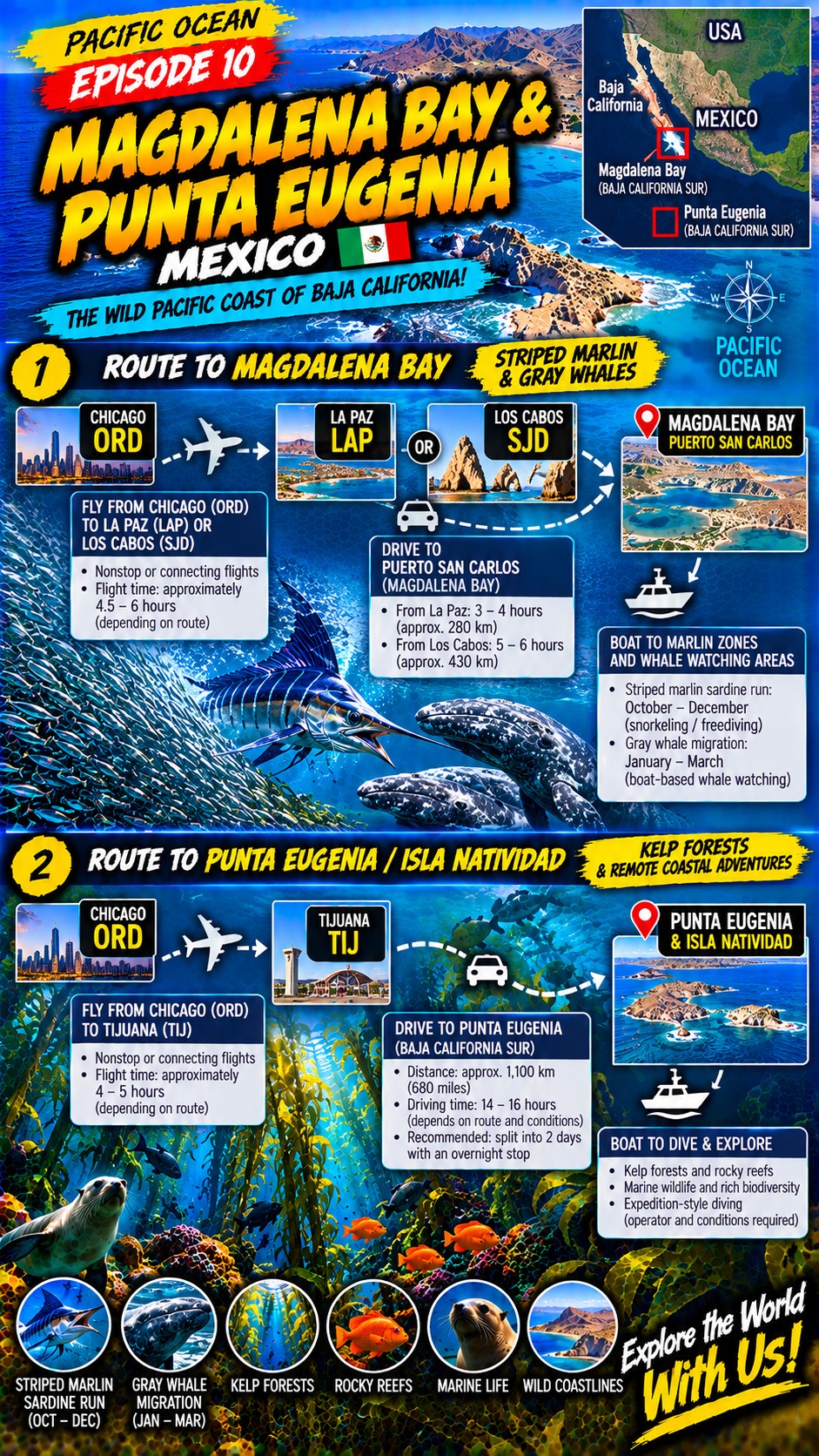
11. How Do You Reach Magdalena Bay from Chicago?
For travelers departing from the Chicago area, the journey begins at Chicago O'Hare International Airport (ORD).
Step 1 — Fly to Baja California Sur
A practical gateway for Magdalena Bay is La Paz International Airport (LAP).
Possible flight itineraries may involve connections through major Mexican airports.
Another option is Los Cabos International Airport (SJD), although this requires a longer overland transfer.
Possible Route 1
Chicago ORD → Mexico City MEX → La Paz LAP
Flight availability and schedules vary.
Possible Route 2
Chicago ORD → Los Cabos SJD
Nonstop or connecting services depend on travel dates and airline schedules.
Step 2 — Travel to Puerto San Carlos
From La Paz, travelers can arrange ground transportation to Puerto San Carlos.
The journey commonly takes approximately 3–4 hours, depending on road conditions and the departure point.
From Los Cabos, the drive is considerably longer.
Step 3 — Join the Marine Wildlife Expedition
The departure port and boat itinerary depend on the operator.
For striped marlin encounters, boats may travel offshore to locate feeding activity.
For gray whale watching, boats operate within authorized lagoon areas.
Recommended Travel Planning
-
Confirm the exact wildlife activity.
-
Select an experienced, licensed operator.
-
Check seasonal availability.
-
Allow flexibility for weather.
-
Confirm whether snorkeling equipment is included.
-
Bring appropriate exposure protection.
-
Purchase travel insurance.
-
Understand the physical requirements of offshore snorkeling.
Magdalena Bay is an extraordinary destination for travelers seeking some of the Pacific Ocean's greatest marine wildlife spectacles!
12. How Do You Reach Punta Eugenia from Chicago?
Punta Eugenia is much more remote than Magdalena Bay.
Step 1 — Fly to Baja California
Travelers may consider Tijuana International Airport (TIJ) or another suitable gateway, depending on the expedition arrangements.
Step 2 — Travel South Through Baja California
Punta Eugenia is accessible by a long overland journey through remote parts of the peninsula.
The route may involve extensive driving and smaller roads.
Step 3 — Reach the Coastal Community
The final approach depends on the specific destination, accommodations, and local arrangements.
Step 4 — Arrange Marine Activities
Boat access and marine exploration should be organized with appropriate local providers.
Important Travel Considerations
Punta Eugenia is not a conventional resort destination.
Travelers should carefully plan:
-
Transportation.
-
Fuel availability.
-
Accommodation.
-
Communication.
-
Emergency services.
-
Medical access.
-
Boat availability.
-
Weather conditions.
-
Appropriate permits.
Important Note
Magdalena Bay and Punta Eugenia are not nearby destinations.
Combining them in a single trip requires significant travel time and careful logistical planning.
For most travelers, Magdalena Bay is the more accessible choice for a marine wildlife vacation, while Punta Eugenia is better suited to specialized expedition planning.
13. Beyond the Ocean — Discover the Wild Beauty of Baja California!
The Pacific coast of Baja California offers extraordinary scenery and cultural experiences.
Desert Landscapes
Explore dramatic desert environments where mountains meet the sea.
Remote Beaches
Discover beautiful stretches of coastline far from major tourist centers.
Fishing Communities
Experience the traditions of Baja California's coastal communities.
Seafood
Enjoy fresh local seafood and regional Mexican cuisine.
Wildlife Photography
Capture dramatic coastal landscapes, seabirds, marine mammals, and unforgettable sunsets.
Coastal Road Trips
Travel through remote regions of the Baja California Peninsula and discover spectacular scenery.
Stargazing
Remote areas with limited artificial lighting can offer impressive night skies.
Baja California combines extraordinary marine wildlife with one of North America's most beautiful desert-coastal landscapes!
14. Marine Conservation — Protecting the Wild Pacific!
Baja California's Pacific ecosystems are extraordinary, but they face serious environmental challenges.
Major Threats
-
Overfishing.
-
Bycatch of marine wildlife.
-
Marine pollution.
-
Climate change.
-
Habitat degradation.
-
Disturbance of marine mammals.
-
Changes in ocean productivity.
Why Are These Ecosystems Important?
Baja California supports important feeding, breeding, and migration habitats for numerous marine species.
The region also supports coastal communities whose livelihoods depend on healthy marine ecosystems.
Responsible Wildlife Tourism
At Loves Park Scuba, we encourage travelers to:
-
Select responsible operators.
-
Never chase or touch marine animals.
-
Respect minimum approach distances.
-
Avoid interfering with feeding behavior.
-
Follow Mexican wildlife regulations.
-
Never enter the water with whales unless specifically authorized under applicable regulations.
-
Avoid collecting marine organisms.
-
Support local conservation initiatives.
-
Respect fishing communities and protected areas.
Responsible Striped Marlin Encounters
Participants should follow operator instructions, avoid obstructing predators or bait balls, and maintain appropriate distances from fast-moving wildlife.
Protecting Baja California's marine ecosystems helps preserve some of the most spectacular wildlife experiences in the Pacific Ocean!
15. Why Magdalena Bay and Punta Eugenia Belong on Your Bucket List
Imagine floating in the blue Pacific Ocean as thousands of sardines form a massive bait ball.
Striped marlin suddenly charge through the school.
The water becomes a spectacular display of speed and survival.
Months later, gray whales arrive in protected coastal lagoons.
A mother and calf surface beside a small whale-watching boat.
Farther north, the rocky reefs and kelp forests of Punta Eugenia support an entirely different underwater world.
Above the surface, the desert stretches toward the horizon.
The coastline remains wild and dramatic.
Few regions offer such an extraordinary combination of marine wildlife, ocean productivity, and natural beauty.
Magdalena Bay & Punta Eugenia represent the wild spirit of the Pacific Ocean!
16. Your Baja California Adventure Starts at Loves Park Scuba!
At Loves Park Scuba, we believe every great ocean adventure begins with knowledge, preparation, and respect for marine life.
Whether you dream of witnessing the striped marlin sardine run, observing gray whales, exploring kelp forests, or improving your diving skills, our team can help you prepare.
We offer opportunities to develop your knowledge and abilities through:
-
Open Water Diver certification.
-
Advanced diving education.
-
Dry Suit Diving.
-
Buoyancy training.
-
Rescue Diver courses.
-
Equipment selection.
-
Dive travel preparation.
Are you ready to discover the wild Pacific coast of Baja California?
Visit Loves Park Scuba and begin preparing for your next extraordinary marine adventure!
LOVES PARK SCUBA
DIVE INTO ADVENTURE — EXPLORE THE WORLD WITH US!
THE GRAND FINALE — OUR PACIFIC OCEAN SERIES IS COMPLETE!
We have traveled across the Pacific Ocean, exploring ten extraordinary destinations.
From the enormous schools of hammerhead sharks in the Galápagos Islands to the giant oceanic manta rays of Socorro.
From the remote shark-filled waters of Cocos Island to the incredible marine biodiversity of the Sea of Cortez.
From the shark-filled passes of French Polynesia to the spectacular manta ray night dives of Hawaii.
From the powerful currents of Mikomoto Island to the magnificent kelp forests of California.
And finally, to the wild Pacific coast of Baja California.
OUR TOP 10 ICONIC PACIFIC OCEAN DESTINATIONS
-
Galápagos Islands, Ecuador — The Kingdom of Hammerhead Sharks
-
Socorro Islands, Mexico — The Kingdom of Giant Oceanic Mantas
-
Cocos Island, Costa Rica — The Hammerhead Shark Sanctuary
-
Sea of Cortez, Mexico — The Aquarium of the World
-
Fakarava, French Polynesia — The Wall of Sharks
-
Rangiroa, French Polynesia — Dolphins & Drift Diving
-
Hawaii, USA — Manta Rays & Volcanic Reefs
-
Mikomoto Island, Japan — The Hammerhead Shark Capital of Japan
-
California Channel Islands, USA — Kelp Forest Adventures
-
Magdalena Bay & Punta Eugenia, Mexico — The Wild Pacific Coast of Baja California
TEN DESTINATIONS. ONE EXTRAORDINARY OCEAN. ENDLESS ADVENTURES!
Thank you for exploring the Pacific Ocean with Loves Park Scuba!
THE WORLD IS FULL OF INCREDIBLE PLACES TO DIVE.
KEEP EXPLORING. KEEP LEARNING. KEEP DIVING.
LOVES PARK SCUBA — EXPLORE THE WORLD WITH US!
