
MIKOMOTO ISLAND, JAPAN — THE HAMMERHEAD SHARK CAPITAL OF JAPAN! TOP 10 ICONIC SCUBA DIVING DESTINATIONS IN THE PACIFIC OCEAN — EPISODE 8
Martin Gomez Oct 29, 2026
MIKOMOTO ISLAND, JAPAN — THE HAMMERHEAD SHARK CAPITAL OF JAPAN!
TOP 10 ICONIC SCUBA DIVING DESTINATIONS IN THE PACIFIC OCEAN — EPISODE 8
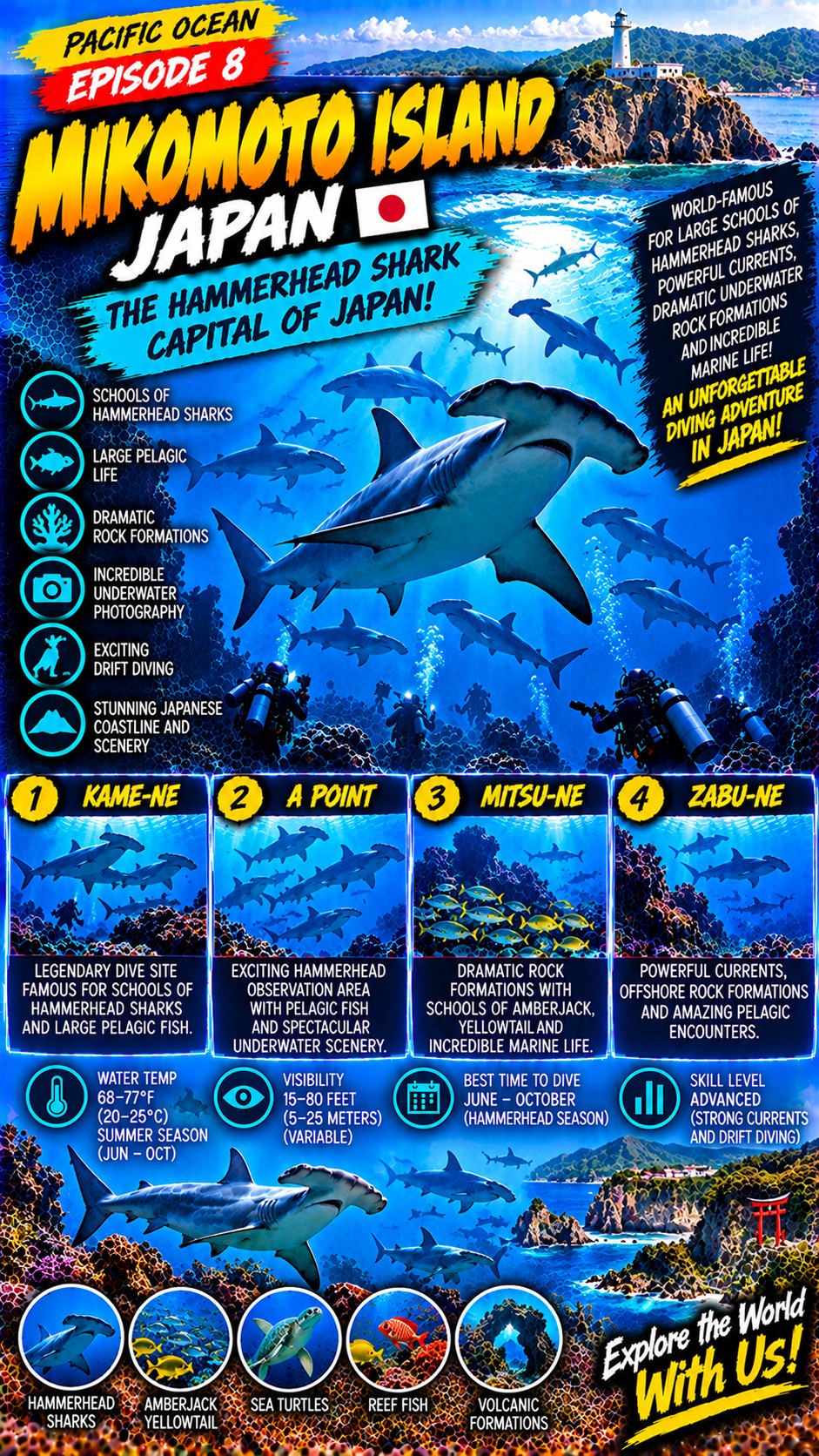
Discover Spectacular Schools of Hammerhead Sharks, Experience the Powerful Kuroshio Current, Explore Dramatic Underwater Rock Formations, and Dive into One of Japan's Greatest Ocean Adventures!
Welcome to Mikomoto — Where Hammerheads Rule the Pacific!
Imagine descending into the deep-blue waters of the Pacific Ocean, just off the southern coast of Japan.
The water is moving.
You can feel the power of the ocean as the current flows around massive underwater rock formations.
Your dive guide signals toward the open blue.
At first, you see only a few distant shadows.
Then the silhouettes become unmistakable.
Hammerhead sharks!
One appears, followed by another.
Suddenly, an enormous school of scalloped hammerhead sharks moves through the water.
Their distinctive heads create an unforgettable silhouette against the blue Pacific.
Dozens of sharks swim together, moving effortlessly through the current.
For a moment, the entire underwater landscape seems alive.
Above the surface, a rugged rocky island rises from the sea, crowned by a historic lighthouse.
In the distance, the beautiful mountains of Japan's Izu Peninsula stretch along the coastline.
Welcome to Mikomoto Island, Japan — The Hammerhead Shark Capital of Japan!
At Loves Park Scuba, we are excited to continue our journey through the world's most extraordinary Pacific Ocean diving destinations.
Our eighth adventure takes us to one of Asia's most exciting shark-diving locations, where powerful currents and spectacular marine wildlife create an unforgettable experience.
1. Where Is Mikomoto Island?
Mikomoto Island, also known as Mikomoto-jima, is a small rocky island located off the southern coast of Japan's Izu Peninsula.
It belongs to Shizuoka Prefecture and lies in the Pacific Ocean, southwest of Tokyo.
The island is uninhabited and is famous for its historic lighthouse and the extraordinary marine life found in the surrounding waters.
What Makes Mikomoto Special?
-
Large schools of scalloped hammerhead sharks.
-
Powerful ocean currents.
-
Spectacular drift diving.
-
Dramatic underwater rock formations.
-
Large schools of pelagic fish.
-
Excellent opportunities for shark photography.
-
A fascinating combination of Japanese culture and ocean adventure.
Unlike tropical coral destinations, Mikomoto is dominated by rocky underwater landscapes and nutrient-rich currents.
Mikomoto is one of the most exciting hammerhead shark diving destinations in the Pacific Ocean!
2. The Hammerhead Sharks of Mikomoto
The greatest attraction at Mikomoto Island is the opportunity to encounter schools of scalloped hammerhead sharks.
These magnificent predators are recognized by their distinctive hammer-shaped heads.
Imagine the Ultimate Hammerhead Encounter!
You descend with your group near a rocky underwater formation.
The current moves steadily around the reef.
Your guide signals toward the blue water.
A hammerhead shark appears.
Then another.
And another.
Soon, an extraordinary school moves past the reef.
The sharks swim in formation, their silhouettes creating a spectacular underwater scene.
Why Do Hammerheads Visit Mikomoto?
Mikomoto lies in a region influenced by the warm Kuroshio Current.
This major Pacific Ocean current transports warm water and contributes to the movement of marine life through the region.
Hammerhead sharks and other pelagic species use these productive offshore waters.
What Is the Famous Hammerhead River?
Divers sometimes use the expression “Hammerhead River” to describe the extraordinary sight of large schools of hammerhead sharks swimming together.
Under favorable conditions, the number of sharks can be remarkable.
However, sightings are never guaranteed.
Observing a school of hammerhead sharks in the wild is one of the greatest experiences an advanced diver can have!
3. Kame-ne — The Legendary Hammerhead Diving Area!
One of the most famous dive sites around Mikomoto Island is Kame-ne.
This underwater rocky formation is internationally recognized for encounters with hammerhead sharks and large pelagic fish.
What Makes Kame-ne Special?
The underwater terrain creates a dynamic environment where currents flow around rocky structures.
Divers may encounter:
-
Scalloped hammerhead sharks.
-
Large schools of amberjack.
-
Yellowtail.
-
Other pelagic fish.
-
Sea turtles.
-
Rays.
The Diving Experience
Divers descend with their guides and explore the rocky formations while monitoring current conditions.
The guide selects the appropriate route based on the direction and strength of the water movement.
Important Considerations
Kame-ne is not a casual beginner dive.
Strong currents and open-water conditions can make the site demanding.
Kame-ne is one of the most iconic hammerhead shark diving locations in Japan!
4. A Point — A Spectacular Hammerhead Observation Area!
Another recognized diving location around Mikomoto is A Point.
This area is particularly associated with hammerhead shark encounters during favorable early-summer conditions.
What Makes A Point Special?
The underwater structure may provide opportunities to observe sharks moving through nearby blue water.
Marine Life Highlights
-
Scalloped hammerhead sharks.
-
Schools of pelagic fish.
-
Reef fish.
-
Other passing marine species.
Underwater Photography
A Point can provide opportunities for wide-angle shark photography when conditions are suitable.
Important Safety Message
Even when divers can observe sharks from a rocky formation, the surrounding current may be strong.
Divers must remain within their training limits and follow the guide's instructions.
A Point offers another exciting opportunity to experience Mikomoto's legendary hammerhead sharks.
5. Mitsu-ne — Dramatic Rocks and Massive Schools of Fish!
Mitsu-ne is another fascinating dive site around Mikomoto Island.
The area features distinctive underwater rock formations that attract numerous marine species.
What Can Divers Encounter?
-
Large schools of yellowtail.
-
Amberjack.
-
Other pelagic fish.
-
Reef fish.
-
Occasional sharks.
-
Rays.
What Makes Mitsu-ne Special?
The underwater formations create an exciting landscape for exploring marine biodiversity.
Schools of fish may gather around the rocky structures.
The Experience
Imagine swimming along a dramatic volcanic-looking rock formation while hundreds of fish move through the current.
Sunlight filters through the water, illuminating the underwater landscape.
Mitsu-ne demonstrates that Mikomoto is much more than a shark-diving destination!
6. Zabu-ne — Powerful Currents and Pelagic Encounters!
Zabu-ne is another recognized diving area around Mikomoto Island.
Its exposed rocky terrain creates opportunities for encounters with large marine animals.
Marine Life Highlights
Depending on conditions:
-
Hammerhead sharks.
-
Pelagic fish.
-
Schools of amberjack.
-
Yellowtail.
-
Other offshore species.
Why Is Zabu-ne Exciting?
The exposed environment and complex underwater formations create dramatic diving scenery.
However, conditions may be demanding.
Dive guides must evaluate current strength, visibility, and weather before selecting the site.
Zabu-ne offers experienced divers another opportunity to discover the wild underwater world of Mikomoto.
7. The Kuroshio Current — The Ocean Highway of Japan!
One of the most important natural features influencing Mikomoto is the Kuroshio Current.
This powerful western boundary current flows northward through the western Pacific.
It transports warm tropical and subtropical water along parts of Japan's coastline.
Why Is the Kuroshio Important?
The current influences:
-
Water temperature.
-
Marine species distribution.
-
Ocean productivity.
-
Pelagic fish movements.
-
Shark encounters.
-
Diving conditions.
What Does This Mean for Divers?
When the Kuroshio flows near Mikomoto, divers may experience warmer, clearer water and exciting pelagic activity.
However, the current can also create demanding underwater conditions.
Drift Diving in Mikomoto
Most diving around Mikomoto involves drift-diving procedures.
Divers must be comfortable with:
-
Boat entries.
-
Descending without fixed lines.
-
Maintaining group positioning.
-
Monitoring depth and gas supply.
-
Deploying a surface marker buoy.
-
Controlled open-water ascents.
-
Boat pickup procedures.
Understanding the Kuroshio Current is essential to appreciating both the excitement and the challenges of diving at Mikomoto.
8. More Than Hammerheads — The Marine Life of Mikomoto
Although hammerhead sharks are the main attraction, Mikomoto supports a remarkable variety of marine animals.
Amberjack and Yellowtail
Large schools of these powerful swimming fish are common attractions.
Barracuda
These streamlined predators may appear around offshore rocky formations.
Sea Turtles
Sea turtles are occasionally observed in the region.
Eagle Rays
These beautiful rays may be encountered in suitable conditions.
Reef Fish
Numerous species inhabit the rocky underwater structures.
Other Sharks
Additional shark species may visit the region.
Ocean Sunfish
Occasional encounters with ocean sunfish are possible, although uncommon.
Dolphins
Dolphins may sometimes be observed in offshore waters.
Every dive around Mikomoto offers an opportunity to discover the extraordinary marine biodiversity of the Japanese Pacific.
9. Best Time to Dive Mikomoto Island
Mikomoto is particularly famous for hammerhead shark encounters during the warmer months.
June–October: The Main Hammerhead Season
This period is generally recommended for visiting Mikomoto.
The influence of the Kuroshio Current and seasonal ocean conditions can create favorable opportunities for observing schools of hammerhead sharks.
July–September: Popular Summer Diving
Water temperatures are typically warmer, and hammerhead encounters can be excellent.
However, weather and currents remain unpredictable.
October: Late-Season Opportunities
Hammerhead sharks may still be present, depending on ocean conditions.
Outside the Main Season
Diving may be possible at other times of the year, but winter winds and rough seas can limit boat operations.
Typical Diving Conditions
| Category | General Conditions |
|---|---|
| Water temperature, July–September | Approximately 68–77°F (20–25°C) |
| Water temperature, spring and late fall | Approximately 61–68°F (16–20°C) |
| Visibility | Highly variable, often around 15–80 ft (5–25 m) |
| Main hammerhead season | June–October |
| Diving style | Boat diving and drift diving |
| Recommended experience | Advanced, with substantial recent diving experience |
| Currents | Potentially strong and unpredictable |
Colder thermoclines may occur even during warmer months.
Recommended Exposure Protection
A 5 mm wetsuit is often a reasonable starting point for summer conditions.
Depending on water temperature and personal comfort, additional thermal protection may be necessary.
For divers seeking hammerhead sharks, June through October is generally the best period to consider Mikomoto.
10. Is Mikomoto Suitable for Beginner Divers?
No. Mikomoto is generally an advanced diving destination.
Unlike many recreational tropical dive sites, Mikomoto can involve strong currents, deep water, and demanding boat-diving procedures.
Some local operators require more than 50 logged dives, along with additional experience and medical requirements.
Requirements vary by operator and should always be confirmed before booking.
Why Is Mikomoto Challenging?
Divers may encounter:
-
Strong currents.
-
Rapidly changing water movement.
-
Deep underwater formations.
-
Open-water descents.
-
Blue-water ascents.
-
Limited visibility.
-
Boat pickup procedures.
-
Remote offshore conditions.
Recommended Training at Loves Park Scuba
Advanced Adventure / Advanced Open Water
Develop experience beyond basic recreational diving.
Drift Diving
Learn to plan and manage dives involving currents.
Deep Diving
Improve awareness and planning for deeper recreational diving.
Enriched Air Nitrox
Learn to use enriched-air mixtures within your training and certification limits.
Perfect Buoyancy
Improve underwater control in demanding environments.
Rescue Diver
Develop emergency awareness and response skills.
Additional Recommended Experience
Divers should be comfortable with:
-
Surface marker buoy deployment.
-
Controlled blue-water ascents.
-
Boat diving procedures.
-
Current management.
-
Conservative gas planning.
-
Maintaining buddy and group contact.
-
Following professional guide instructions.
Mikomoto rewards experience, preparation, and excellent diving judgment.
11. How Does a Typical Mikomoto Diving Day Work?
Most Mikomoto diving operations are based in the southern Izu Peninsula.
Divers generally travel to the island aboard specialized day boats.
Step 1 — Meet at the Dive Center
Divers arrive at the scheduled meeting point.
The operator checks certification, experience, medical requirements, and equipment.
Step 2 — Dive Briefing
The guide explains:
-
Current conditions.
-
Entry procedures.
-
Planned depth.
-
Maximum dive time.
-
Group positioning.
-
Emergency procedures.
-
Surface marker buoy use.
-
Boat pickup procedures.
Step 3 — Boat Transfer
The journey from nearby departure ports to Mikomoto Island commonly takes approximately 15–20 minutes, depending on the operator and conditions.
Step 4 — The Dive
Divers enter the water and follow the planned route.
Dives are generally conducted using drift-diving procedures.
Step 5 — Return to the Boat
After completing the dive, the group performs a controlled ascent and follows the operator's pickup procedures.
Step 6 — Additional Dives
Depending on the season, operator, and conditions, multiple dives may be available.
A diving day at Mikomoto is an exciting combination of careful preparation and extraordinary marine encounters.
12. Beyond Diving — Explore Japan's Beautiful Izu Peninsula!
A trip to Mikomoto offers an opportunity to explore one of Japan's beautiful coastal regions.
Shimoda
A charming coastal town famous for its beaches, harbor, and historical significance.
Shirahama Beach
A beautiful beach known for white sand and coastal scenery.
Perry Road
A historic street in Shimoda featuring traditional architecture and an interesting atmosphere.
Izu Peninsula
Explore rugged coastlines, scenic viewpoints, mountains, and charming towns.
Japanese Hot Springs
The Izu region is famous for its relaxing onsen experiences.
Mount Fuji
Depending on your itinerary, a visit to the wider Shizuoka region may offer opportunities to admire Japan's most famous mountain.
Japanese Cuisine
Enjoy fresh seafood, sushi, ramen, and traditional Japanese dishes.
Tokyo
Many international travelers combine their diving expedition with time exploring Japan's capital.
Mikomoto offers the perfect opportunity to combine advanced scuba diving with the extraordinary culture and natural beauty of Japan.
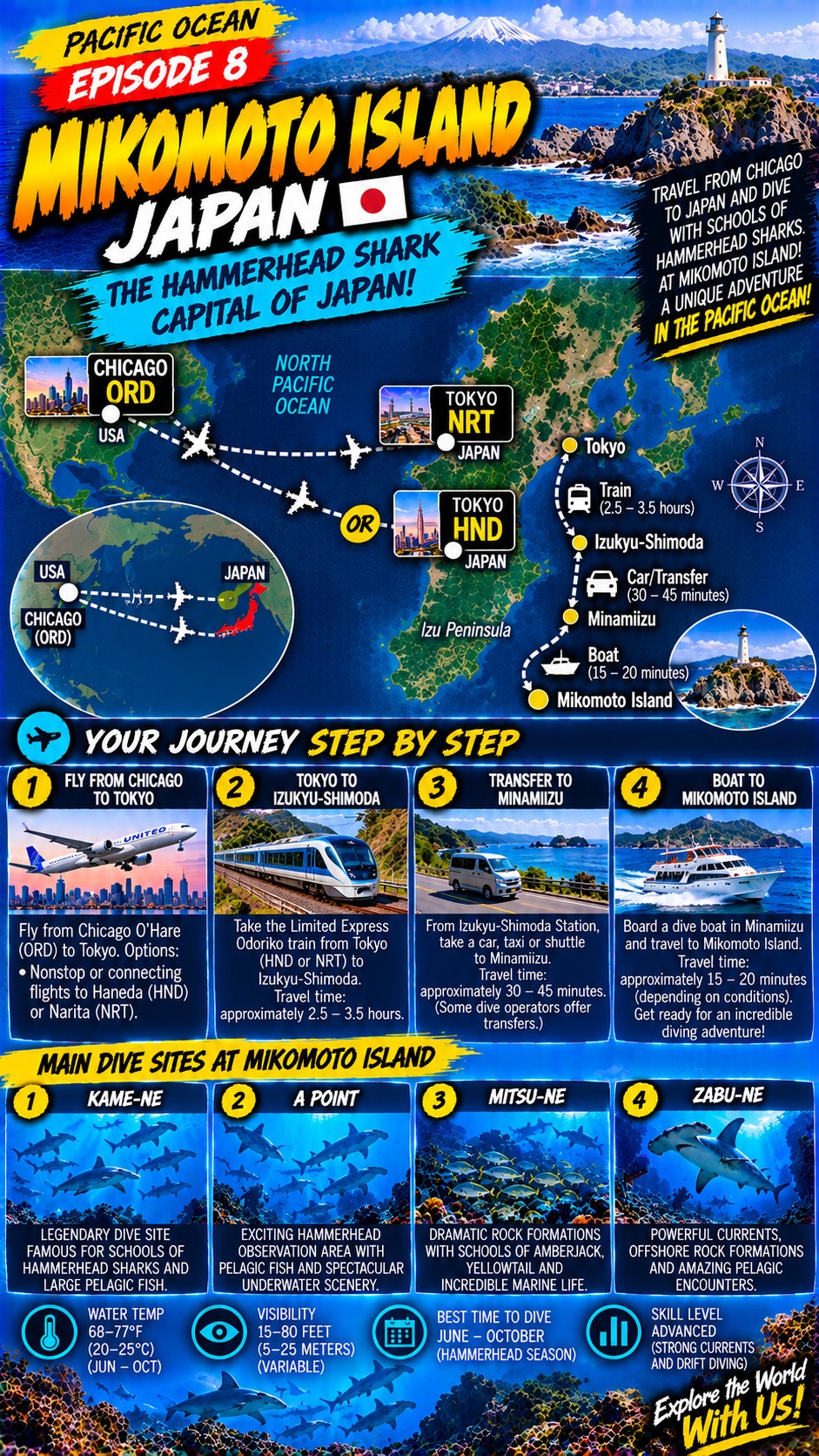
13. How Do You Get to Mikomoto Island from Chicago?
For travelers departing from Chicago, the journey begins with an international flight to Japan.
Step 1 — Fly from Chicago to Tokyo
The two principal international airports serving Tokyo are:
Tokyo Haneda Airport — HND
Tokyo Narita International Airport — NRT
Possible Flight Route 1
Chicago O'Hare (ORD) → Tokyo Haneda (HND)
Nonstop service may be available depending on current airline schedules.
Possible Flight Route 2
Chicago O'Hare (ORD) → Tokyo Narita (NRT)
Flight availability depends on airline schedules and travel dates.
Possible Flight Route 3
Chicago O'Hare (ORD) → Another U.S. Gateway → Tokyo (HND or NRT)
Connecting options may be available through other airports.
These are illustrative routes rather than confirmed itineraries.
Step 2 — Travel from Tokyo to Shimoda
From Tokyo, travelers can take the train toward the southern Izu Peninsula.
One convenient option is the Limited Express Odoriko, which connects the Tokyo area with Izukyu-Shimoda Station on applicable schedules.
Alternatively, travelers can use rail connections through Atami.
Approximate Train Travel Time
Tokyo to Izukyu-Shimoda generally takes around 2.5–3.5 hours, depending on the service and departure station.
Airport transfers require additional time.
Step 3 — Transfer to the Dive Operator
From Izukyu-Shimoda Station, travelers continue to their selected dive center in the southern Izu region.
Some operators provide shuttle transportation by prior arrangement.
Step 4 — Boat to Mikomoto Island
The final stage is a short boat ride from the designated departure port to Mikomoto Island.
Recommended Travel Planning
We recommend:
-
Arriving in Japan at least one day before planned diving.
-
Allowing sufficient time for airport and rail connections.
-
Reserving accommodation near the dive operator.
-
Confirming minimum experience requirements.
-
Bringing documentation of logged dives.
-
Checking medical clearance requirements.
-
Confirming equipment rental availability.
-
Planning extra days for weather-related cancellations.
-
Purchasing suitable travel and dive insurance.
-
Allowing an appropriate no-fly interval after diving.
From Chicago to Tokyo, across the Izu Peninsula, and into the Pacific Ocean, reaching Mikomoto is an extraordinary diving adventure!
14. Marine Conservation — Protecting Japan's Hammerhead Sharks
Hammerhead sharks are among the ocean's most remarkable predators.
However, many hammerhead populations face serious conservation threats.
Major Challenges
-
Overfishing.
-
Shark fin trade.
-
Accidental capture in fishing gear.
-
Marine pollution.
-
Climate change.
-
Habitat degradation.
Why Are Hammerheads Important?
Sharks play important roles in marine food webs.
Their conservation contributes to the health and balance of ocean ecosystems.
Responsible Shark Diving
At Loves Park Scuba, we encourage divers to:
-
Never chase sharks.
-
Never attempt to touch them.
-
Avoid interfering with their natural behavior.
-
Maintain excellent buoyancy.
-
Follow professional dive guides.
-
Respect local marine regulations.
-
Support responsible shark tourism.
Protecting hammerhead sharks helps preserve one of the Pacific Ocean's most extraordinary wildlife spectacles.
15. Why Mikomoto Belongs on Your Diving Bucket List
Imagine descending into the powerful waters of the Japanese Pacific.
The Kuroshio Current moves around enormous underwater rocks.
Schools of amberjack swim through the blue.
Your guide signals toward the open ocean.
Suddenly, an extraordinary school of hammerhead sharks appears.
Dozens of sharks move together, creating an unforgettable underwater spectacle.
Above the surface, the historic Mikomoto lighthouse rises from a rugged island.
Beyond the ocean, the beautiful coastline of Japan's Izu Peninsula stretches into the distance.
Few destinations combine challenging diving, spectacular marine wildlife, and fascinating cultural experiences.
Mikomoto Island is one of Japan's greatest scuba diving adventures!
For experienced divers who dream of encountering large schools of hammerhead sharks, Mikomoto deserves a place on the bucket list.
16. Your Mikomoto Adventure Starts at Loves Park Scuba!
At Loves Park Scuba, we believe extraordinary diving adventures begin with proper training, reliable equipment, and a passion for ocean exploration.
Whether you dream of photographing schools of hammerhead sharks, improving your drift-diving skills, or exploring the extraordinary underwater environments of Japan, our team can help you prepare.
We offer opportunities to develop your diving skills through:
-
Advanced diving education.
-
Enriched Air Nitrox training.
-
Rescue Diver courses.
-
Buoyancy improvement.
-
Equipment selection.
-
Dive travel preparation.
Are you ready to discover Mikomoto Island — The Hammerhead Shark Capital of Japan?
Visit Loves Park Scuba and begin preparing for your next extraordinary Pacific Ocean adventure!
LOVES PARK SCUBA
DIVE INTO ADVENTURE — EXPLORE THE WORLD WITH US!
COMING NEXT IN OUR PACIFIC OCEAN DIVING SERIES
EPISODE 9 — CALIFORNIA CHANNEL ISLANDS, USA: KELP FOREST ADVENTURES!
Our next adventure takes us to the spectacular coast of California.
Imagine descending into a magnificent underwater forest where giant kelp rises toward the surface.
Sunlight filters through the golden-green canopy.
Garibaldi fish swim among rocky reefs.
Sea lions move gracefully between towering kelp fronds.
Discover why California's Channel Islands offer one of the most extraordinary temperate-water diving experiences in the Pacific Ocean.
CALIFORNIA CHANNEL ISLANDS — KELP FOREST ADVENTURES!
10 ICONIC PACIFIC DESTINATIONS. ONE PASSION FOR DIVING!
