
NORTH CAROLINA, USA: THE GRAVEYARD OF THE ATLANTIC! Top 10 Iconic Scuba Diving Destinations in the Atlantic Ocean — Episode 2
Martin Gomez Oct 29, 2026
NORTH CAROLINA, USA: THE GRAVEYARD OF THE ATLANTIC!
Top 10 Iconic Scuba Diving Destinations in the Atlantic Ocean — Episode 2
Explore Legendary World War II Shipwrecks, Encounter Sand Tiger Sharks, and Discover the Extraordinary Underwater History of America's Atlantic Coast!
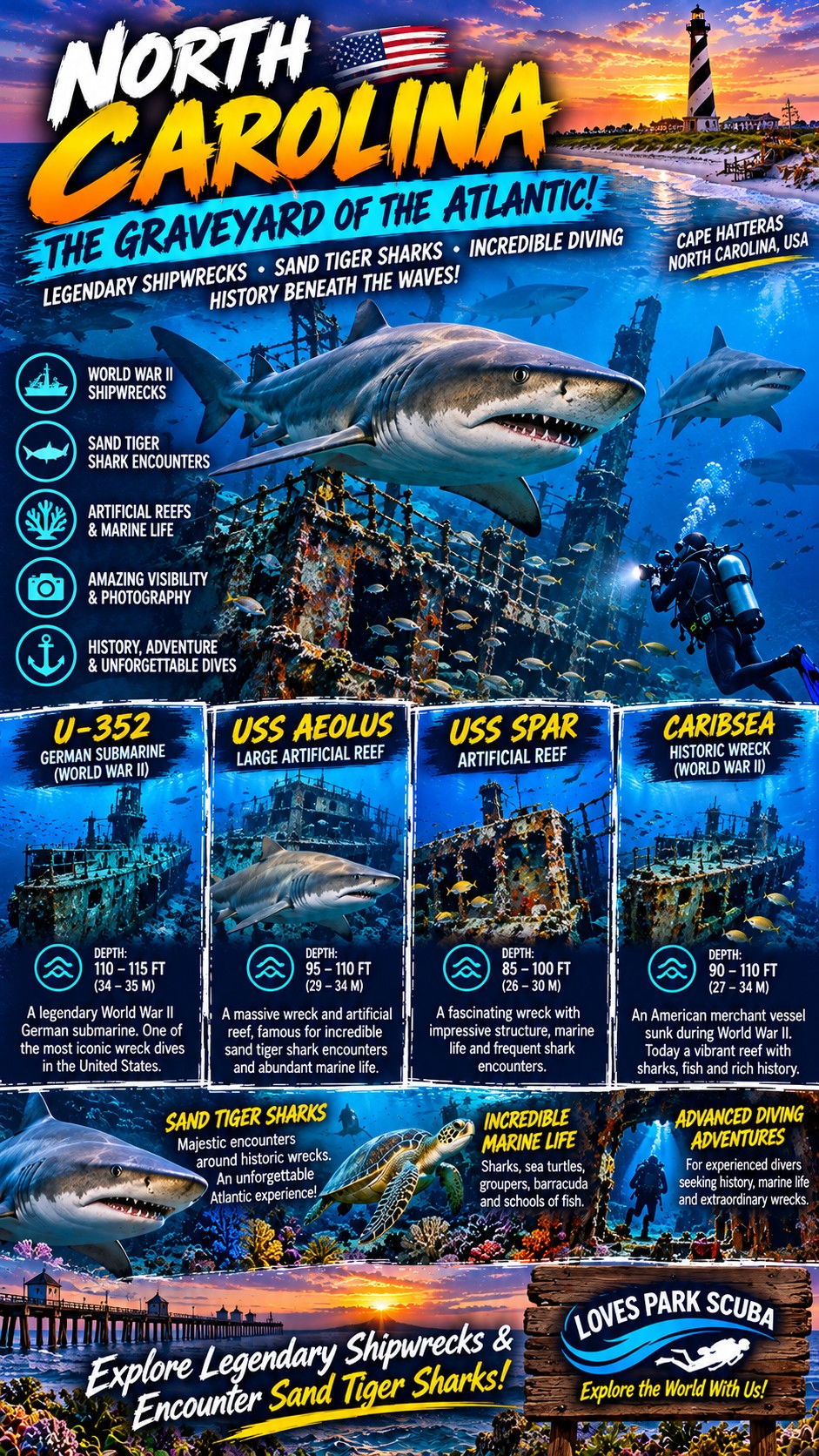
Welcome to North Carolina: Where History Sleeps Beneath the Atlantic!
Imagine descending into the deep blue waters of the Atlantic Ocean.
As you approach the ocean floor, the silhouette of a historic shipwreck slowly appears through the water.
Its massive steel structure is covered with marine growth, while schools of fish move through the remains of a vessel that once crossed these waters.
Suddenly, a large sand tiger shark glides silently above the wreck.
Another shark appears nearby, moving effortlessly through the blue water.
You are not simply exploring a shipwreck.
You are discovering a piece of maritime history that has become part of an extraordinary underwater ecosystem.
Welcome to North Carolina — The Graveyard of the Atlantic!
Located along the eastern coast of the United States, North Carolina is internationally recognized for its remarkable concentration of shipwrecks, fascinating maritime history, and incredible marine-life encounters.
From historic sailing vessels to World War II submarines and modern artificial reefs, the waters off North Carolina offer some of the most extraordinary wreck-diving experiences in the Atlantic Ocean.
At Loves Park Scuba, we're excited to introduce North Carolina as the second destination in our series exploring the Top 10 Iconic Scuba Diving Destinations in the Atlantic Ocean.
1. Why Is North Carolina Called the Graveyard of the Atlantic?
For centuries, the waters off North Carolina have been dangerous for ships navigating the Atlantic coastline.
The region's shifting sandbars, strong currents, storms, and complex coastal geography contributed to numerous maritime accidents.
The Outer Banks, a chain of barrier islands extending along the coast, became particularly notorious for shipwrecks.
Cape Hatteras is especially famous because of its location near the meeting of major ocean currents.
During World War II, German submarines also operated along the American East Coast, sinking merchant vessels and creating another chapter in the region's maritime history.
Today, thousands of shipwrecks are documented along the North Carolina coastline, although only a portion are practical recreational dive sites.
Many have become artificial reefs supporting abundant marine life.
North Carolina is more than a diving destination. It's an underwater museum of maritime history!
2. U-352: A Legendary German Submarine
One of North Carolina's most famous dive sites is the U-352, a German Type VIIC submarine from World War II.
The submarine was sunk on May 9, 1942, after an engagement with the United States Coast Guard cutter Icarus.
Today, the U-352 rests offshore near Morehead City at a depth of approximately 110–115 feet (34–35 meters).
The submarine's remains offer a fascinating opportunity to observe a piece of World War II history beneath the Atlantic.
What Makes U-352 So Special?
-
An authentic German World War II submarine.
-
Fascinating maritime and military history.
-
An impressive underwater wreck environment.
-
Marine life living around the historic structure.
-
Excellent underwater photography opportunities.
Because of its depth and offshore location, U-352 is best suited to experienced divers with appropriate deep-diving training.
Currents, visibility, sea conditions, and boat access can vary significantly.
Diving U-352 is an extraordinary experience that combines underwater exploration with an important chapter of American maritime history.
As with all historic wrecks, divers should respect the site and avoid disturbing or removing artifacts.
3. Top Dive Sites in North Carolina
U-352 — The Historic German Submarine
One of the most iconic wreck dives in the United States.
Explore the remains of a World War II submarine and discover the marine life surrounding its structure.
Highlights: Historic submarine, deep wreck diving, and underwater photography.
USS Aeolus — A Massive Artificial Reef
The USS Aeolus was a former United States Navy vessel intentionally sunk off North Carolina in 1988.
Today, it provides a large artificial reef habitat.
The wreck is particularly well known for encounters with sand tiger sharks.
Highlights: Large shipwreck, sand tiger sharks, and artificial reef marine life.
USS Spar — A Fascinating Wreck Adventure
The USCGC Spar was a former United States Coast Guard vessel intentionally sunk as an artificial reef.
Its structure attracts fish and other marine life, making it an interesting destination for wreck-diving enthusiasts.
Highlights: Artificial reef, wreck exploration, and marine biodiversity.
Papoose — A Historic Offshore Wreck
The wreck commonly known as Papoose is associated with World War II-era ship losses off the North Carolina coast.
It is a popular advanced wreck dive known for its marine life and historic character.
Highlights: Historic wreck, offshore diving, and sand tiger shark encounters.
Caribsea — History and Marine Life
The Caribsea was an American merchant vessel sunk by a German submarine in 1942.
Today, its remains provide habitat for marine life and an opportunity to explore the history of wartime shipping along the Atlantic coast.
Highlights: World War II maritime history, wreck exploration, and marine life.
4. Sand Tiger Sharks: The Stars of North Carolina Wreck Diving
One of the most exciting attractions of North Carolina diving is the opportunity to encounter sand tiger sharks (Carcharias taurus).
These impressive sharks are recognized by their robust bodies and distinctive, visible teeth.
Despite their intimidating appearance, sand tiger sharks are generally slow-moving and are often observed calmly swimming around wreck structures.
They may gather around certain offshore wrecks, creating extraordinary underwater photography opportunities.
Why Are Sand Tiger Sharks Associated With Shipwrecks?
Shipwrecks create artificial reef habitats that attract schools of fish and other marine organisms.
These structures provide areas where sharks can find prey and move through the surrounding environment.
Divers may observe sand tiger sharks swimming around wrecks such as the Aeolus and Spar.
Watching these magnificent animals glide through historic shipwrecks is one of the most unforgettable experiences in Atlantic wreck diving!
Shark sightings are never guaranteed, and divers must maintain respectful distances.
5. Marine Life: What Can You Encounter?
North Carolina's offshore waters support a remarkable variety of marine species.
Sand Tiger Sharks
Among the most iconic animals associated with North Carolina wreck diving.
Barracuda
Large barracuda may be observed around wrecks and artificial reefs.
Amberjack
Schools of amberjack frequently gather around offshore structures.
Groupers
Several grouper species inhabit rocky reefs and wreck environments.
Sea Turtles
Loggerhead and other sea turtles may occasionally be encountered.
Tropical and Temperate Fish
Because North Carolina lies in a transitional marine region influenced by the Gulf Stream, divers may encounter a mixture of warm-water and temperate species.
Rays
Different ray species may be observed around sandy areas and wreck habitats.
Every dive offers another opportunity to discover the extraordinary biodiversity of the Atlantic Ocean!
6. When Is the Best Time to Dive North Carolina?
Offshore diving in North Carolina is strongly influenced by seasonal weather, ocean currents, and sea conditions.
The most popular recreational wreck-diving season generally extends from late spring through early fall.
| Season | Diving Experience |
|---|---|
| January – March | Cold conditions and limited offshore diving opportunities |
| April – May | Improving temperatures, with variable weather |
| June – August | Popular wreck-diving season with warmer water |
| September – October | Potentially excellent conditions, depending on tropical weather |
| November – December | Cooling temperatures and more variable offshore conditions |
Summer water temperatures at offshore sites may range from approximately 70°F to 82°F (21–28°C), depending on depth and water masses.
Thermoclines can produce considerably colder conditions below the surface.
Visibility may range from approximately 30 to more than 100 feet, depending on currents, plankton, weather, and location.
North Carolina's offshore dive trips are particularly sensitive to wind and wave conditions.
Boat trips may be canceled when weather makes offshore operations unsafe.
For many recreational wreck divers, June through September offers an attractive planning window, while always accounting for hurricane-season risks.
7. Is North Carolina Suitable for Beginner Divers?
North Carolina offers some shallower coastal and artificial reef diving opportunities, but many of its most famous offshore wrecks are better suited to experienced divers.
Sites such as U-352 can approach the maximum depth limit for recreational scuba diving.
Strong currents, variable visibility, offshore boat travel, and deep profiles require careful preparation.
At Loves Park Scuba, we recommend considering:
Open Water Diver
Build the fundamental knowledge and skills required for recreational diving.
Advanced Adventure / Advanced Open Water
Develop experience in different underwater environments, including deeper dives.
Deep Diving
Learn appropriate planning, gas management, and safety procedures for deeper recreational diving.
Wreck Diving
Develop skills for responsible wreck exploration and understanding wreck-related hazards.
Enriched Air Nitrox
Learn to plan enriched-air dives while respecting oxygen exposure limits and appropriate maximum operating depths.
Perfect Buoyancy
Improve underwater control around fragile wreck structures and marine habitats.
Underwater Photography
Capture remarkable images of historic wrecks and sand tiger sharks.
For more demanding dives, additional technical diving training may be appropriate.
Proper training, equipment, experience, and dive planning are essential for safe North Carolina wreck diving.
8. Wreck Diving: Exploring History Beneath the Surface
Wreck diving is one of the most fascinating forms of underwater exploration.
Every sunken vessel tells a story.
Some were lost during storms or navigational accidents.
Others were sunk during wartime.
Still others were intentionally placed underwater to create artificial reefs.
Over time, these structures become important marine habitats.
Fish gather around their hulls, sponges grow across steel surfaces, and larger predators patrol the surrounding waters.
However, wreck diving also introduces additional hazards.
Divers must consider:
-
Depth and gas management.
-
Possible entanglement hazards.
-
Sharp or unstable structures.
-
Current and visibility conditions.
-
Overhead environments.
-
Navigation and emergency procedures.
-
Respect for historic wrecks and protected sites.
Wreck penetration should never be attempted without specialized training, equipment, and an appropriate dive plan.
At Loves Park Scuba, we believe responsible exploration begins with education and preparation.
9. Beyond Diving: Explore North Carolina's Atlantic Coast
North Carolina offers many exciting experiences above the surface.
Cape Hatteras Lighthouse
One of America's most famous coastal landmarks, associated with the maritime history of the Outer Banks.
Outer Banks
A spectacular chain of barrier islands known for beautiful beaches, coastal scenery, and maritime heritage.
North Carolina Maritime Museum
Located in Beaufort, this museum offers fascinating exhibits about the region's maritime history, archaeology, and shipwrecks.
Beaufort Waterfront
A charming coastal community with restaurants, shops, and beautiful harbor views.
Morehead City
An important departure point for offshore wreck-diving operations.
Fort Macon State Park
A historic coastal fort offering opportunities to explore local history and enjoy Atlantic coastal scenery.
North Carolina combines extraordinary underwater adventures with rich history, beautiful coastal landscapes, and welcoming seaside communities.
10. Responsible Diving: Protecting Historic Wrecks and Marine Life
North Carolina's underwater wrecks are valuable historical and ecological resources.
Many provide important habitats for marine life, while others represent significant chapters in maritime history.
At Loves Park Scuba, we encourage responsible diving practices:
-
Never remove artifacts from historic wrecks.
-
Respect protected shipwreck sites.
-
Maintain excellent buoyancy.
-
Avoid touching fragile structures.
-
Never chase or harass sharks.
-
Secure gauges and other equipment.
-
Follow local regulations and dive operator instructions.
-
Support responsible marine conservation practices.
Protecting these underwater treasures helps preserve their history and marine ecosystems for future generations.
Why North Carolina Belongs on Your Diving Bucket List
There are many spectacular scuba diving destinations throughout the Atlantic Ocean, but North Carolina offers something truly special.
Legendary World War II shipwrecks.
Historic German submarines.
Massive artificial reefs.
Extraordinary sand tiger shark encounters.
Fascinating maritime history.
And unforgettable offshore diving adventures.
North Carolina is not simply another wreck-diving destination. It's an underwater journey through history!
Your North Carolina Adventure Starts at Loves Park Scuba!
At Loves Park Scuba, we believe scuba diving is about exploring new destinations, developing our skills, protecting marine ecosystems, and creating unforgettable memories.
Whether you're interested in historic shipwrecks, advanced diving, underwater photography, or encounters with magnificent sand tiger sharks, our team is here to help you prepare.
From scuba certification and advanced training to equipment selection and dive travel opportunities, we're ready to help.
Are you ready to discover North Carolina — The Graveyard of the Atlantic?
Visit Loves Park Scuba and let us help you prepare for your next extraordinary Atlantic diving adventure!
LOVES PARK SCUBA
Dive Into Adventure — Explore the World With Us!
COMING NEXT IN OUR ATLANTIC DIVING SERIES
Episode 3 — Jupiter & Palm Beach, Florida: Sharks, Drift Diving & Goliath Groupers!
Discover exciting Gulf Stream drift diving, extraordinary shark encounters, and the giants of Florida's Atlantic reefs.
10 Iconic Atlantic Destinations. One Passion for Diving!
