
Progression From Floating to Swimming
Martin Gomez Aug 20, 2026
Progression From Floating to Swimming
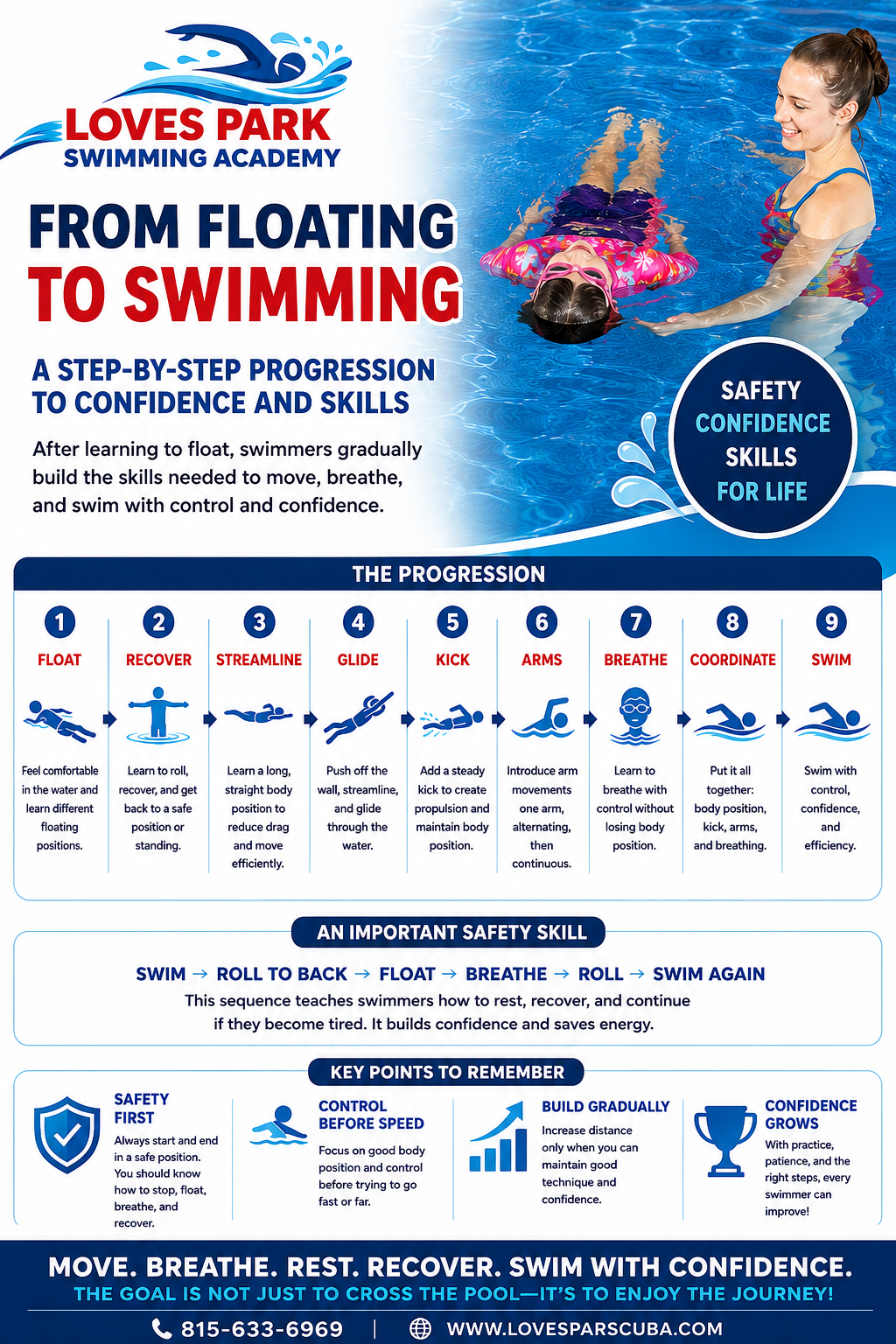
After learning how to float and recover safely, the next step is teaching swimmers how to turn flotation into controlled and efficient movement through the water.
A simple progression is:
FLOAT → BODY POSITION → PUSH & GLIDE → STREAMLINE → KICK → ARMS → BREATHING → COORDINATION → SWIM
1. Body Control & Recovery
Before moving forward, swimmers should be comfortable with:
Front Float → Back Float → Roll Over → Recover to Standing
This gives swimmers confidence because they know how to stop, float, breathe, and regain control.
2. Push & Glide
The swimmer learns that the body can travel through the water without constantly moving.
Push → Streamline → Glide → Stand
Start with short distances while focusing on a relaxed, long, and balanced body position.
3. Streamline
Teach swimmers to make their bodies long, narrow, and aligned to reduce resistance.
Good body position = easier movement.
The goal is not to fight the water or use more force. It is to learn how to move efficiently through it.
4. Add the Kick
Once the glide is comfortable, introduce the flutter kick:
Push → Glide → Kick → Stand
Then progress to:
Push → Streamline → Kick → Float → Recover
Practice kicking in both front and back positions.
5. Front & Back Movement
Develop movement in both directions:
Front Glide + Kick
Back Glide + Kick
Learning both positions gives swimmers more control and allows them to roll onto their back when they need to breathe or rest.
6. Add the Arms
Once body position and kicking are established, introduce arm movements gradually:
One Arm → Alternating Arms → Continuous Arms
The swimmer begins to understand how the arms create propulsion and move the body forward.
7. Add Breathing
Introduce breathing without losing body position:
Face In → Blow Bubbles → Turn/Lift → Breathe → Face In
As skills improve, progress toward controlled side breathing for freestyle.
8. Coordination
Now we combine everything:
Body Position + Kick + Arms + Breathing = Swimming
Start with short distances and focus on control and technique before increasing distance.
9. Swim, Roll & Rest
This is an important water-safety progression:
Swim → Roll to Back → Float → Breathe → Roll → Swim Again
Swimmers learn that if they become tired, they can stop, float, breathe, recover, and continue instead of fighting the water.
10. Build Distance & Endurance
Once the swimmer demonstrates control, gradually increase the distance:
5 ft → 10 ft → 15 ft → Half Pool → Full Length
Distance should increase because the swimmer demonstrates control and confidence, not simply because they can reach the other side.
The Complete Progression
COMFORT → BREATHING → FLOAT → RECOVER → STREAMLINE → GLIDE → KICK → ARMS → BREATHE → COORDINATE → SWIM → ROLL & REST → SWIM AGAIN
Safety and control first. Movement second. Technique and distance next.
The goal is not simply to teach someone to swim across the pool. The goal is to develop a swimmer who can move, breathe, stop, float, rest, recover, and continue swimming with confidence and independence.
