
RANGIROA, FRENCH POLYNESIA — DOLPHINS & DRIFT DIVING! TOP 10 ICONIC SCUBA DIVING DESTINATIONS IN THE PACIFIC OCEAN — EPISODE 6
Martin Gomez Oct 29, 2026
RANGIROA, FRENCH POLYNESIA — DOLPHINS & DRIFT DIVING!
TOP 10 ICONIC SCUBA DIVING DESTINATIONS IN THE PACIFIC OCEAN — EPISODE 6
Swim Near Wild Dolphins, Drift Through Legendary Ocean Passes, Encounter Sharks and Manta Rays, and Explore One of the World's Largest Coral Atolls!
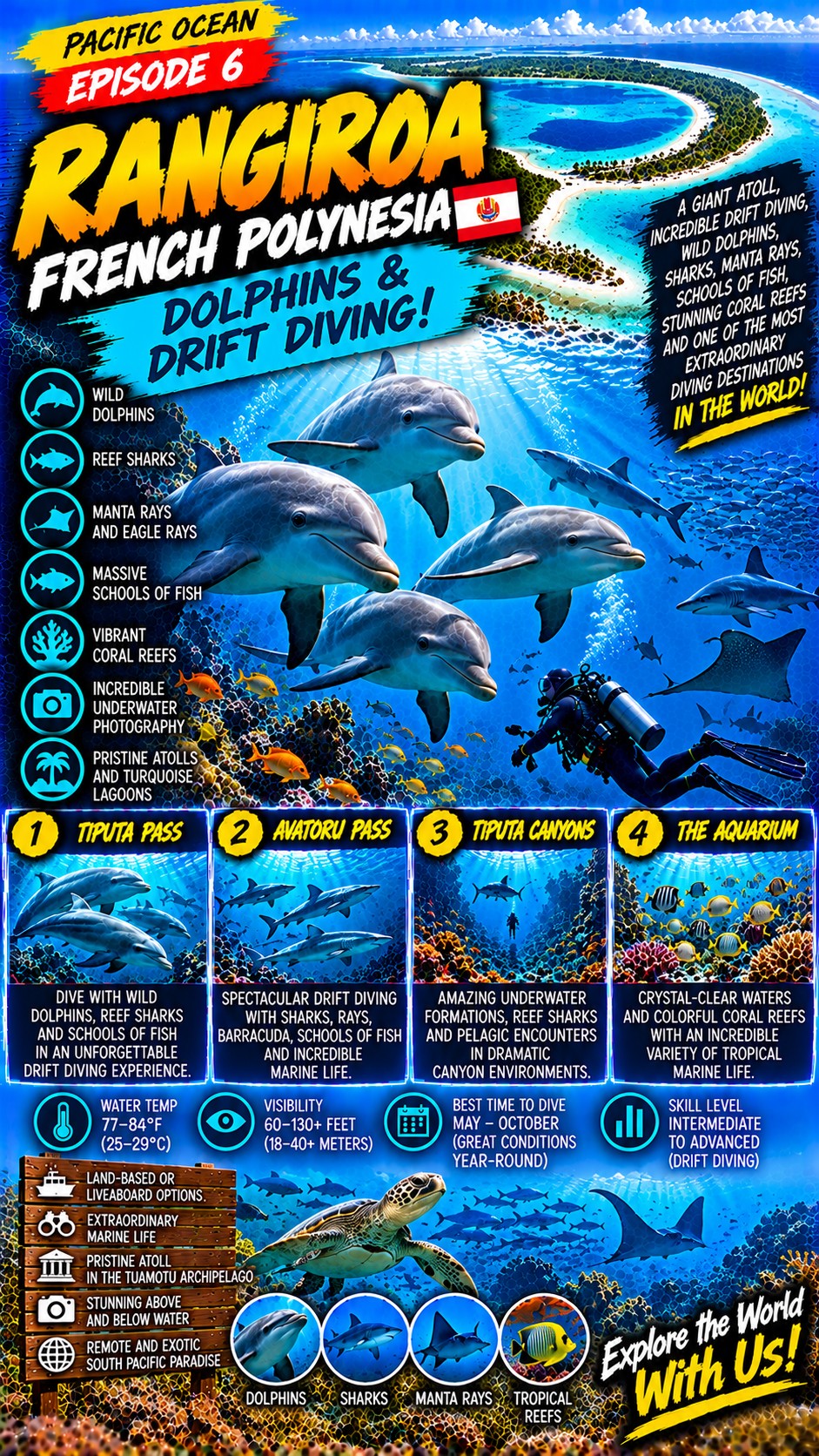
Welcome to Rangiroa — Where Dolphins Rule the Blue!
Imagine descending into the warm, crystal-clear waters of the South Pacific Ocean.
Below you, the coral reef slopes gently toward the deep blue.
Schools of tropical fish move effortlessly through the current.
Your dive guide signals toward the open ocean.
Suddenly, several shadows appear.
At first, you think they might be sharks.
But as they approach, you recognize their distinctive silhouettes.
Dolphins!
A group of wild bottlenose dolphins swims gracefully through the water.
One turns toward your group.
Another passes above the reef.
For a few unforgettable moments, you watch these intelligent marine mammals move freely through their natural environment.
Then the current carries you toward a spectacular underwater passage.
Sharks patrol the reef.
Barracudas move in formation.
The deep blue ocean stretches endlessly ahead.
Welcome to Rangiroa, French Polynesia — Dolphins & Drift Diving!
At Loves Park Scuba, we're excited to continue our journey through the world's most extraordinary Pacific Ocean diving destinations.
Our sixth adventure takes us to a legendary coral atoll where wild dolphins, powerful currents, spectacular reefs, and extraordinary marine biodiversity create unforgettable underwater experiences.
1. Where Is Rangiroa?
Rangiroa is located in the Tuamotu Archipelago of French Polynesia, approximately 220 miles (350 kilometers) northeast of Tahiti.
It is one of the largest coral atolls in the world.
Its name is commonly translated as “Vast Sky” in the Tuamotuan language.
Unlike mountainous volcanic islands, Rangiroa is a ring-shaped coral atoll surrounding an enormous lagoon.
The lagoon is so large that, from some locations, the opposite side cannot be seen.
What Makes Rangiroa Special?
Rangiroa is famous for:
-
Wild bottlenose dolphin encounters.
-
Spectacular drift diving.
-
Strong tidal currents.
-
Sharks and large pelagic fish.
-
Healthy coral reef habitats.
-
Manta rays and eagle rays.
-
Large schools of barracuda and jacks.
-
Extraordinary underwater photography.
-
Beautiful turquoise lagoons.
-
Remote South Pacific scenery.
Two ocean passages are particularly important to the diving experience:
Tiputa Pass — The legendary dolphin and drift-diving destination.
Avatoru Pass — Another spectacular channel connecting the lagoon with the open Pacific.
Rangiroa is one of the most exciting drift-diving destinations in French Polynesia!
2. Tiputa Pass — The Legendary Dolphin Encounter!
The most famous diving area in Rangiroa is Tiputa Pass.
This channel connects the vast lagoon with the surrounding Pacific Ocean.
It is internationally recognized for its currents, shark encounters, and the possibility of observing wild bottlenose dolphins underwater.
Imagine Meeting Wild Dolphins!
You descend along the reef while your guide carefully monitors the current.
The water is clear, and the coral formations are covered with marine life.
A school of fish passes nearby.
Suddenly, your guide points toward the blue.
A dolphin approaches.
It moves gracefully through the water, effortlessly changing direction.
Another dolphin appears behind it.
For a few moments, you have the extraordinary opportunity to observe these animals in their natural habitat.
What Makes Tiputa Special?
-
Resident and visiting bottlenose dolphins.
-
Grey reef sharks.
-
Whitetip reef sharks.
-
Blacktip reef sharks.
-
Schools of barracuda.
-
Jacks and tuna.
-
Eagle rays.
-
Occasional manta rays.
-
Beautiful coral reef formations.
Responsible Dolphin Encounters
The dolphins of Rangiroa are wild animals.
Encounters are never guaranteed.
Divers should never chase, grab, feed, or deliberately touch dolphins.
Some dolphins may approach people voluntarily, but responsible diving means allowing the animals to control the interaction.
Watching wild dolphins underwater at Tiputa Pass can be one of the most memorable experiences of a diver's life!
3. Avatoru Pass — Sharks, Rays, and Spectacular Currents!
At the northern side of Rangiroa's main inhabited area lies Avatoru Pass.
Like Tiputa, Avatoru connects the lagoon with the open Pacific Ocean.
The movement of water through the channel creates an environment rich in marine life.
What Can Divers Encounter?
Depending on conditions:
-
Reef sharks.
-
Schools of fish.
-
Barracuda.
-
Jacks.
-
Tuna.
-
Eagle rays.
-
Other pelagic species.
What Makes Avatoru Special?
The pass offers impressive underwater scenery and opportunities to observe marine life moving through the current.
The experience depends on the tidal cycle and the direction of water flow.
The Drift-Diving Experience
During suitable conditions, divers may enter the water near the ocean side of the pass and drift along the reef.
The current carries the group while the dive guide manages navigation and positioning.
Avatoru Pass offers another extraordinary opportunity to experience the dynamic underwater world of Rangiroa.
4. The Canyons of Tiputa — An Underwater Adventure!
One of the most fascinating features of Tiputa Pass is its underwater topography.
Rocky formations, channels, and reef structures create dramatic scenery.
What Are the Canyons?
The area includes underwater depressions and formations where divers may observe marine life moving through the passage.
Marine Life Highlights
-
Grey reef sharks.
-
Schools of fish.
-
Barracuda.
-
Dolphins, when present.
-
Reef fish.
-
Other pelagic visitors.
Why Are the Canyons Special?
The rocky formations provide an interesting perspective on the marine environment.
However, these sites can involve strong currents and demanding diving conditions.
Divers must follow their guides and remain within their training and experience limits.
The Canyons demonstrate why Rangiroa is famous for adventurous drift diving and spectacular underwater landscapes.
5. The Aquarium — A Colorful Underwater Paradise!
Not every underwater experience in Rangiroa involves powerful currents and large marine predators.
Near Tiputa Pass, an area commonly known as The Aquarium offers opportunities to observe colorful tropical fish in relatively sheltered water.
It is particularly popular for snorkeling, although the activities available depend on the operator.
What Can Visitors See?
-
Schools of tropical fish.
-
Coral formations.
-
Colorful reef species.
-
Clear lagoon water.
-
Fascinating shallow-water marine life.
Why Visit The Aquarium?
It provides a wonderful contrast to the more demanding pass dives.
Visitors can appreciate the beauty of Rangiroa's coral reef ecosystem in a different environment.
Rangiroa offers both exciting blue-water adventures and peaceful tropical reef experiences.
6. The Dolphins of Rangiroa — Intelligent Ocean Ambassadors
The dolphins of Tiputa Pass are among the most famous marine animals in French Polynesia.
Bottlenose dolphins are highly intelligent and social mammals.
They use sophisticated communication and echolocation to navigate their environment.
Why Do Dolphins Visit Tiputa?
The channel connects the lagoon with the open ocean.
Dolphins use the surrounding waters for movement, social activity, and feeding.
The area's currents and marine productivity contribute to a dynamic environment.
What Makes an Encounter Special?
Unlike controlled wildlife attractions, these dolphins are completely wild.
They choose whether to approach divers.
Some encounters are brief.
Others may involve dolphins swimming nearby for longer periods.
Important Conservation Message
A close encounter does not mean the dolphin wants to be touched.
Divers should remain calm, avoid sudden movements, and follow the operator's wildlife interaction guidelines.
The greatest dolphin encounter is one in which the animal remains completely free to choose its behavior.
7. Sharks and Pelagic Marine Life of Rangiroa
Although dolphins are the most famous attraction, Rangiroa is also home to impressive shark and pelagic fish populations.
Grey Reef Sharks
Commonly associated with the channels and outer reefs.
Whitetip Reef Sharks
Often observed near reef formations.
Blacktip Reef Sharks
Frequently found around reef and lagoon habitats.
Silvertip Sharks
Occasional visitors to deeper or more exposed areas.
Hammerhead Sharks
Seasonal encounters may occur, but sightings are not guaranteed.
Manta Rays
These magnificent rays may visit the region.
Eagle Rays
Graceful rays that can be observed around reef slopes and channels.
Barracuda
Large schools may gather around the passes.
Tuna and Jacks
Fast-moving pelagic fish that use the productive waters of the atoll.
Sea Turtles
Several species occur throughout French Polynesian waters.
Every dive in Rangiroa offers the possibility of discovering something extraordinary.
8. Drift Diving — The Signature Experience of Rangiroa
One of the reasons Rangiroa is internationally famous is its extraordinary drift diving.
The ocean passages experience tidal currents as water moves between the lagoon and the open Pacific.
What Is Drift Diving?
Drift diving involves allowing a current to carry divers along a planned route.
Rather than swimming continuously against the water, divers move with the flow while maintaining control of their buoyancy and position.
Why Is Rangiroa So Exciting?
The currents can bring:
-
Nutrient-rich water.
-
Large schools of fish.
-
Sharks.
-
Rays.
-
Dolphins.
-
Other pelagic species.
Important Safety Considerations
Drift diving requires careful planning.
Divers should understand:
-
Current direction and strength.
-
Entry and exit procedures.
-
Group positioning.
-
Surface marker buoy deployment.
-
Blue-water ascents.
-
Boat pickup procedures.
-
Gas management.
-
Emergency communication.
Why Dive with Experienced Local Guides?
Conditions in the passes can change significantly with the tides.
Experienced local professionals understand the appropriate entry points, current windows, and operational procedures.
Rangiroa is an extraordinary destination for divers who enjoy the excitement of moving with the ocean.
9. Best Time to Dive Rangiroa
Rangiroa offers scuba diving throughout the year.
However, conditions vary with weather patterns, currents, and seasonal water temperatures.
May–October: Generally Drier Season
This period often provides favorable conditions for visiting French Polynesia.
Water temperatures are usually slightly cooler.
November–April: Warmer, Wetter Season
Water temperatures are generally warmer, although rainfall and tropical weather can be more frequent.
Typical Diving Conditions
| Category | General Conditions |
|---|---|
| Water temperature | Approximately 77–84°F (25–29°C) |
| Visibility | Often 60–130 ft (18–40 m), but variable |
| Diving season | Year-round |
| Popular travel period | May–October |
| Main diving style | Drift diving, sharks, dolphins, coral reefs |
| Recommended experience | Intermediate to advanced for exposed pass dives |
When Is the Best Time for Dolphins?
Wild dolphins may be encountered throughout the year.
However, sightings are never guaranteed.
The probability of encounters depends on natural animal behavior, environmental conditions, and dive location.
Recommended Exposure Protection
A 3 mm wetsuit may be sufficient for many divers.
Some prefer a 5 mm wetsuit for repeated dives or cooler conditions.
Rangiroa is a spectacular year-round diving destination, with every season offering a different experience.
10. Is Rangiroa Suitable for Beginner Divers?
Rangiroa offers some relatively sheltered snorkeling and diving environments.
However, its most famous dives are generally recommended for experienced divers.
The ocean passes can involve:
-
Strong currents.
-
Rapid changes in water movement.
-
Deeper reef formations.
-
Open-water ascents.
-
Drift diving.
-
Boat pickup procedures.
-
Large marine animal encounters.
Recommended Training at Loves Park Scuba
Advanced Adventure / Advanced Open Water
Develop confidence in different diving environments.
Drift Diving
Learn how to plan and manage dives involving currents.
Deep Diving
Improve your knowledge of deeper recreational dive planning.
Enriched Air Nitrox
Learn enriched-air diving procedures and appropriate dive planning.
Perfect Buoyancy
Improve control while diving near sensitive reef habitats.
Rescue Diver
Develop emergency awareness and response skills.
Underwater Photography
Capture extraordinary marine encounters while respecting wildlife.
Additional Recommended Skills
-
Surface marker buoy deployment.
-
Controlled ascents.
-
Boat diving procedures.
-
Current awareness.
-
Conservative gas management.
-
Following guide instructions.
The right training and experience will help you enjoy Rangiroa's spectacular diving safely and responsibly.
11. Land-Based Diving or Liveaboard?
Rangiroa offers several options for exploring its underwater environments.
Option 1 — Land-Based Diving
Visitors can stay in hotels, resorts, or guesthouses on the atoll.
Local dive operators provide access to nearby dive sites.
Advantages include:
-
Comfortable accommodation.
-
Easy access to restaurants.
-
Flexible daily diving schedules.
-
Opportunities for non-diving activities.
-
Relaxed island atmosphere.
Option 2 — Tuamotu Liveaboard
Some liveaboard expeditions explore multiple atolls in the Tuamotu Archipelago.
Depending on the itinerary, a trip may include Rangiroa, Fakarava, and other destinations.
Availability varies by operator and season.
Which Option Is Better?
Land-based diving is excellent for travelers who want to explore Rangiroa while enjoying the island's relaxed atmosphere.
Liveaboards may appeal to divers seeking a broader Tuamotu adventure.
Both options can provide extraordinary experiences in the South Pacific.
12. Beyond Diving — Discover the Beauty of Rangiroa!
Rangiroa is not only famous for its underwater adventures.
Above the surface, the atoll offers beautiful lagoons, tropical scenery, and authentic Polynesian culture.
The Blue Lagoon
A spectacular lagoon-within-a-lagoon surrounded by small tropical islets.
Its turquoise water creates breathtaking scenery.
Reef Island
A fascinating area featuring unusual coral and geological formations.
Pink Sand Beaches
Some excursions visit beaches with beautiful pinkish sand.
Polynesian Villages
Experience local island culture and hospitality.
Pearl Farms
French Polynesia is famous for its beautiful black pearls.
Lagoon Excursions
Enjoy boat trips, snorkeling, and tropical island scenery.
Local Cuisine
Discover fresh fish, tropical fruits, and traditional Polynesian dishes.
Spectacular Sunsets
Watch the sun disappear over the vast Pacific Ocean.
Rangiroa combines world-class diving with the peaceful beauty of a remote tropical paradise.
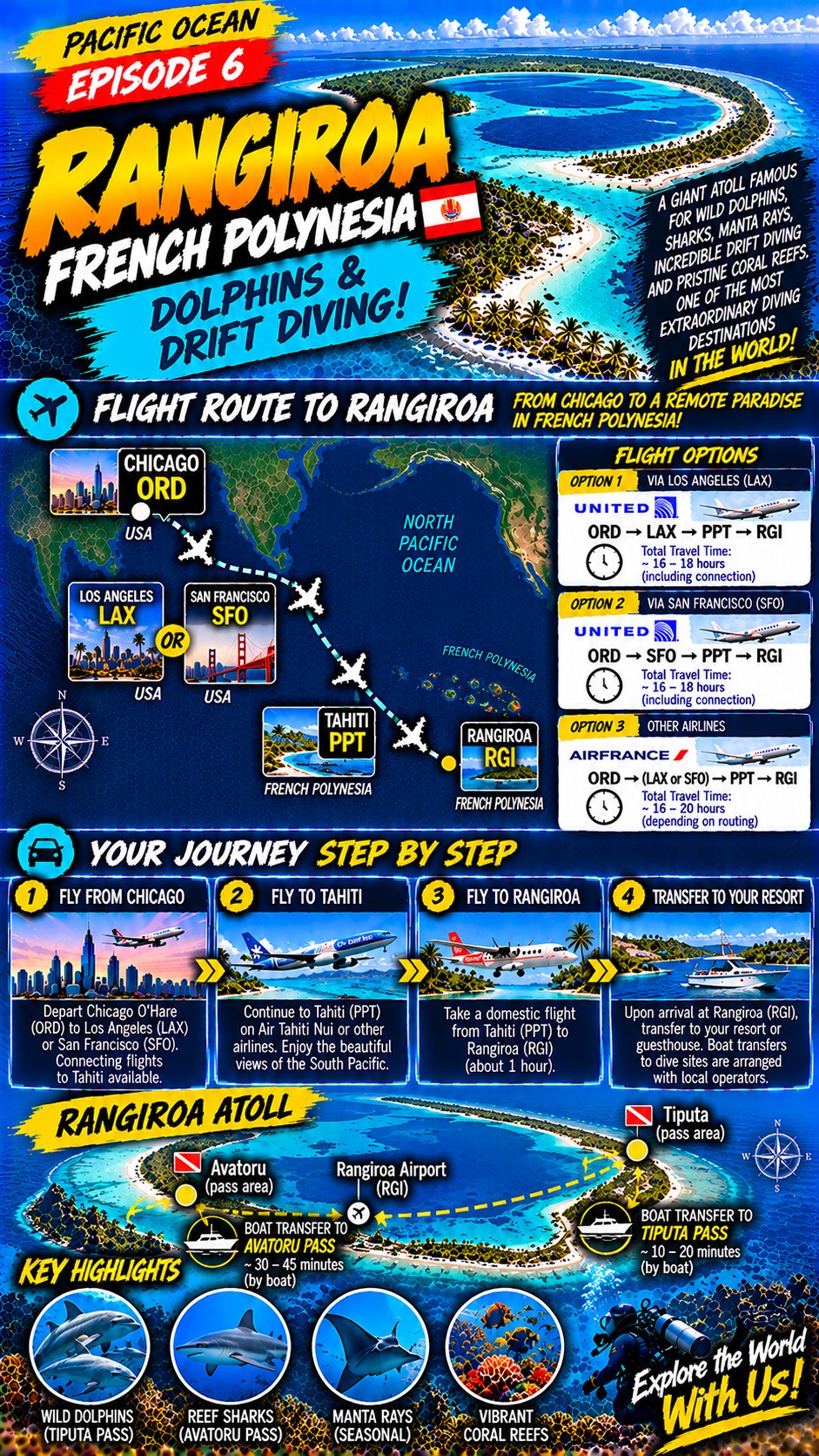
13. How Do You Get to Rangiroa from Chicago?
Traveling to Rangiroa begins with an international flight to Tahiti.
Step 1 — Fly from Chicago to Tahiti
The main international airport is:
Faa'a International Airport — PPT
Located near Papeete, Tahiti.
Possible Flight Route 1
Chicago O'Hare (ORD) → Los Angeles (LAX) → Tahiti (PPT)
Possible Flight Route 2
Chicago O'Hare (ORD) → San Francisco (SFO) → Tahiti (PPT)
Other connections may be available depending on schedules.
These routes are illustrative and should be verified for the intended travel dates.
Step 2 — Domestic Flight to Rangiroa
From Tahiti, travelers take a domestic flight to:
Rangiroa Airport — RGI
PPT → RGI
The flight typically takes approximately one hour, depending on the service.
Step 3 — Transfer to Your Accommodation
After arriving at Rangiroa Airport, travelers continue to their resort, hotel, or guesthouse.
Many accommodations are located around the main inhabited area near Avatoru and Tiputa.
Important Travel Considerations
We recommend:
-
Allowing sufficient time for international and domestic connections.
-
Confirming scuba equipment baggage allowances.
-
Checking domestic flight schedules.
-
Reviewing dive operator experience requirements.
-
Purchasing appropriate travel and dive insurance.
-
Confirming transportation arrangements.
-
Planning an appropriate no-fly interval after your final dive.
From Chicago to Tahiti and onward to Rangiroa, the journey is part of an unforgettable South Pacific adventure!
14. Marine Conservation — Protecting Rangiroa's Extraordinary Wildlife
Rangiroa's marine ecosystems are part of the extraordinary biodiversity of French Polynesia.
Coral reefs, sharks, dolphins, and other marine species depend on healthy ocean habitats.
Conservation Challenges
Threats include:
-
Climate change.
-
Coral bleaching.
-
Marine pollution.
-
Unsustainable fishing.
-
Disturbance of marine wildlife.
-
Changes in ocean temperatures.
Responsible Dolphin Diving
At Loves Park Scuba, we encourage divers to:
-
Never chase dolphins.
-
Never deliberately touch or feed marine mammals.
-
Maintain appropriate distances.
-
Avoid disturbing natural behavior.
-
Follow local wildlife interaction rules.
-
Respect marine habitats.
Responsible Reef Diving
Divers should also:
-
Maintain excellent buoyancy.
-
Avoid contact with coral.
-
Secure dangling equipment.
-
Respect marine protected areas.
-
Support responsible local operators.
Protecting Rangiroa ensures that future generations can continue to experience its extraordinary marine biodiversity.
15. Why Rangiroa Belongs on Your Diving Bucket List
Imagine drifting through a spectacular ocean passage.
Wild dolphins swim through the blue water.
Grey reef sharks patrol the reef.
Barracudas gather in large schools.
Eagle rays move gracefully through the current.
Colorful coral formations stretch across the underwater landscape.
Above the surface, turquoise lagoons and palm-covered islands create an extraordinary tropical paradise.
Few destinations combine these experiences in such a spectacular setting.
Rangiroa is one of the world's most extraordinary destinations for dolphin encounters and drift diving!
For divers who dream of experiencing the power and beauty of the South Pacific Ocean, Rangiroa deserves a place on the bucket list.
16. Your Rangiroa Adventure Starts at Loves Park Scuba!
At Loves Park Scuba, we believe extraordinary diving adventures begin with proper training, reliable equipment, and a passion for ocean exploration.
Whether you dream of observing wild dolphins, drifting through spectacular ocean passes, or photographing sharks and rays, our team can help you prepare.
We offer opportunities to develop your diving skills through:
-
Open Water Diver certification.
-
Advanced diving education.
-
Enriched Air Nitrox training.
-
Rescue Diver courses.
-
Buoyancy improvement.
-
Equipment selection.
-
Dive travel preparation.
Are you ready to discover Rangiroa — Dolphins & Drift Diving?
Visit Loves Park Scuba and begin preparing for your next extraordinary Pacific Ocean adventure!
LOVES PARK SCUBA
DIVE INTO ADVENTURE — EXPLORE THE WORLD WITH US!
COMING NEXT IN OUR PACIFIC OCEAN DIVING SERIES
EPISODE 7 — HAWAII, USA: MANTA RAYS & VOLCANIC REEFS!
Our next adventure takes us to the spectacular Hawaiian Islands.
Imagine diving at night as magnificent manta rays glide gracefully through illuminated water.
Explore volcanic underwater landscapes, lava tubes, coral reefs, and extraordinary Pacific marine biodiversity.
Discover why Hawaii is one of the world's most iconic diving destinations.
HAWAII — MANTA RAYS & VOLCANIC REEFS!
10 ICONIC PACIFIC DESTINATIONS. ONE PASSION FOR DIVING!
