
SCAPA FLOW, SCOTLAND: HISTORIC WORLD WAR I SHIPWRECKS! Top 10 Iconic Scuba Diving Destinations in the Atlantic Ocean — Episode 7
Martin Gomez Oct 29, 2026
SCAPA FLOW, SCOTLAND: HISTORIC WORLD WAR I SHIPWRECKS!
Top 10 Iconic Scuba Diving Destinations in the Atlantic Ocean — Episode 7
Explore Legendary German Battleships, Historic World War I Wrecks, and One of the Most Extraordinary Underwater Museums in the World!
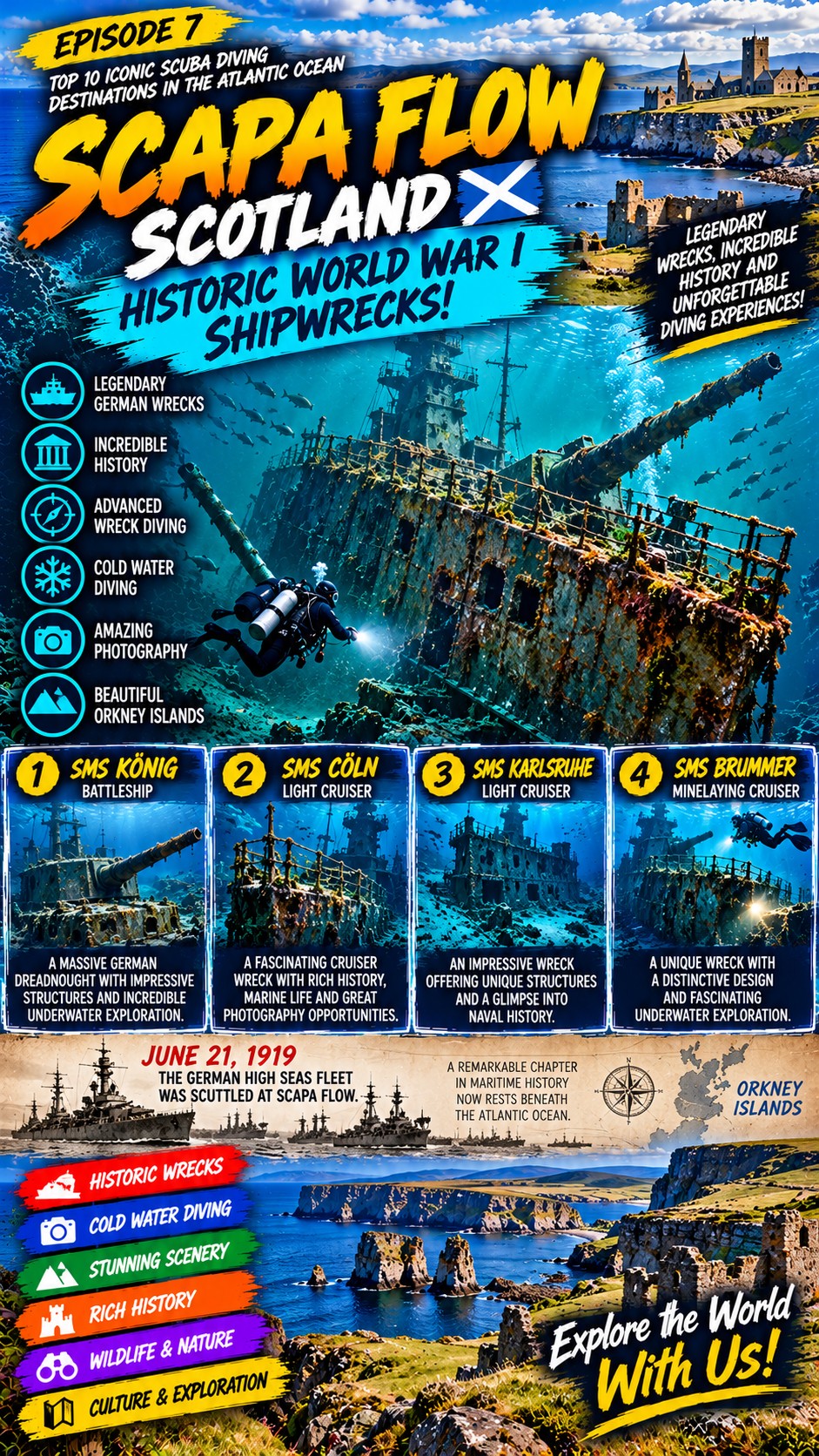
Welcome to Scapa Flow: Where Naval History Rests Beneath the Sea!
Imagine descending into the cold, mysterious waters of Scotland's Orkney Islands.
As you move deeper, a massive steel structure slowly emerges from the green-blue water.
Enormous armor plates, gun turrets, and the remains of a powerful warship reveal themselves in the dim underwater light.
You are exploring a vessel that once belonged to one of the most formidable naval fleets in the world.
More than a century ago, these ships sailed across European waters during the First World War.
Today, they rest beneath the surface of Scapa Flow, surrounded by marine life and carrying the stories of an extraordinary chapter in maritime history.
Welcome to Scapa Flow, Scotland, one of the world's most celebrated historic wreck-diving destinations!
Located in the Orkney Islands, north of mainland Scotland, Scapa Flow is a large natural harbor with a remarkable naval heritage.
At Loves Park Scuba, we're excited to introduce Scapa Flow as the seventh destination in our series exploring the Top 10 Iconic Scuba Diving Destinations in the Atlantic Ocean.
1. Why Is Scapa Flow So Famous?
Scapa Flow became internationally important during World War I because it served as a major anchorage for the British Royal Navy's Grand Fleet.
Following the Armistice of November 1918, the German High Seas Fleet was interned at Scapa Flow while the victorious Allied powers negotiated the terms of peace.
On June 21, 1919, German Rear Admiral Ludwig von Reuter ordered the interned German fleet to be scuttled.
More than 50 German vessels sank that day.
Many were subsequently salvaged, but several major warships remain on the seabed.
Today, Scapa Flow is internationally recognized for its historic wrecks and extraordinary diving opportunities.
Scapa Flow is not simply a collection of shipwrecks. It is an underwater monument to one of the most significant naval events of the twentieth century!
2. The German High Seas Fleet: Giants of the Deep
Among Scapa Flow's most famous remaining German warships are three battleships and four light cruisers.
These vessels offer a fascinating opportunity to explore early twentieth-century naval engineering.
SMS König — A Legendary German Battleship
SMS König was a powerful German dreadnought battleship.
Today, its enormous wreck lies at depths generally ranging from approximately 20 to 38 meters (65–125 feet).
Divers can observe impressive structural remains, armored sections, and features associated with the ship's massive construction.
Highlights: Historic battleship, enormous steel structures, and advanced wreck diving.
SMS Kronprinz Wilhelm — An Impressive Naval Giant
SMS Kronprinz Wilhelm was another German battleship scuttled in 1919.
Its wreck offers fascinating opportunities to examine the remains of a large early twentieth-century warship.
Highlights: Battleship architecture, historic naval engineering, and underwater photography.
SMS Markgraf — A Deep Historic Battleship
SMS Markgraf is one of the three surviving German battleships at Scapa Flow.
Its depth and enormous size make it especially interesting to experienced wreck divers.
Highlights: Massive battleship remains, deep diving, and World War I history.
These wrecks require careful dive planning, appropriate training, and an understanding of cold-water conditions.
3. The Famous German Light Cruisers
In addition to the battleships, four German light cruisers remain at Scapa Flow.
SMS Dresden
An impressive light cruiser wreck with fascinating structural details and marine growth.
SMS Cöln
A popular historic wreck offering opportunities to observe cruiser structures and naval equipment.
SMS Karlsruhe
A fascinating wreck with accessible structural features at suitable depths for appropriately trained divers.
SMS Brummer
A former German minelaying cruiser with a distinctive design and fascinating wartime history.
The cruisers generally lie shallower than the deepest sections of the battleships, although dive profiles and conditions vary significantly.
Exploring these ships is like swimming through the history of Europe's great naval fleets!
4. Top Dive Sites in Scapa Flow
SMS König — The Battleship Experience
Explore the remains of a massive German dreadnought.
Highlights: Heavy naval construction, historic structures, and deep wreck diving.
SMS Cöln — A Historic Cruiser
One of the best-known German cruiser wrecks in Scapa Flow.
Highlights: Cruiser architecture, marine growth, and underwater photography.
SMS Karlsruhe — Fascinating Wreck Exploration
A historic light cruiser with interesting structural remains.
Highlights: Wreck features, marine life, and naval history.
SMS Brummer — The Minelaying Cruiser
A distinctive German warship with an important wartime role.
Highlights: Unique vessel design, historic equipment, and wreck exploration.
Blockships at Churchill Barriers
Scapa Flow also contains wrecks of vessels intentionally sunk to obstruct navigable channels and help defend the harbor.
Some blockship sites offer different diving experiences from the deeper German fleet wrecks.
Highlights: Historic harbor defenses, shallower wreck environments, and maritime history.
Important: Site access, diving restrictions, depths, currents, and weather conditions must be confirmed with qualified local operators.
5. Marine Life Among the Historic Wrecks
Although Scapa Flow is best known for maritime history, its wrecks also support marine ecosystems.
Over the decades, steel surfaces have become habitats for a variety of marine organisms.
Divers may encounter:
Anemones
Colorful marine invertebrates attached to wreck structures.
Sponges
Marine organisms covering portions of the historic vessels.
Crabs
Crustaceans sheltering among the wreckage.
Wrasse
Fish commonly associated with rocky habitats and underwater structures.
Pollack
Fish that may gather around wrecks and reef-like environments.
Starfish
Echinoderms found on and around submerged structures.
The contrast between massive steel warships and delicate marine life creates extraordinary underwater photography opportunities.
Scapa Flow demonstrates how historic wrecks can become important habitats for marine organisms over time.
6. Cold-Water Diving: A Different Kind of Adventure
Scapa Flow is a cold-water diving destination.
Unlike the tropical environments of the Caribbean, the Orkney Islands require divers to prepare for lower temperatures and potentially challenging conditions.
Typical water temperatures range approximately from:
-
Winter: 43–46°F (6–8°C).
-
Spring: 45–50°F (7–10°C).
-
Summer: 50–57°F (10–14°C).
-
Autumn: 48–54°F (9–12°C).
Actual temperatures vary with season, location, and depth.
Visibility can range from a few meters to more than 15 meters (50 feet) under favorable conditions.
Divers should be prepared for changing visibility, reduced light, and cold-water exposure.
Recommended Equipment
-
Properly fitted drysuit.
-
Appropriate thermal undergarments.
-
Cold-water-rated regulator system.
-
Hood and gloves.
-
Reliable dive computer.
-
Surface marker buoy.
-
Appropriate lighting.
-
Redundant equipment where required by the dive plan.
-
Suitable exposure protection for surface intervals.
Cold-water diving requires preparation, proper equipment, and experience.
At Loves Park Scuba, we encourage divers interested in destinations like Scapa Flow to develop their drysuit and advanced diving skills before traveling.
7. When Is the Best Time to Dive Scapa Flow?
Scapa Flow can be dived during different parts of the year, but seasonal conditions strongly influence operations.
| Season | Diving Experience |
|---|---|
| December – February | Cold water, short daylight hours, challenging weather |
| March – May | Improving daylight and spring diving opportunities |
| June – August | Longer daylight hours and relatively warmer water |
| September – October | Popular wreck-diving period with variable weather |
| November | Cooling temperatures and shorter days |
For many visiting recreational and technical divers, May through September is an attractive planning period.
However, Orkney weather can change quickly, and boat departures depend on local sea conditions.
8. Is Scapa Flow Suitable for Beginner Divers?
Scapa Flow is primarily known as a destination for experienced wreck divers.
Some shallower sites may be suitable for divers with less experience under appropriate supervision.
However, the famous German battleships and cruisers often require additional skills and experience.
At Loves Park Scuba, we recommend considering:
Advanced Adventure / Advanced Open Water
Develop experience with deeper dives, navigation, and different underwater environments.
Dry Suit Diving
Learn proper drysuit buoyancy control, emergency procedures, and cold-water techniques.
Deep Diving
Develop appropriate planning skills for deeper recreational profiles.
Wreck Diving
Understand the hazards associated with shipwreck structures and responsible wreck exploration.
Enriched Air Nitrox
Learn enriched-air planning and oxygen exposure management.
Perfect Buoyancy
Improve control around historic structures and sensitive marine habitats.
Technical Diving
For deeper, longer, or more complex wreck dives, specialized technical training may be necessary.
Important: Penetrating shipwrecks requires specialized training, appropriate equipment, and a suitable dive plan.
Some historic sites may also have restrictions on access or disturbance.
9. Responsible Diving: Preserving Maritime History
Scapa Flow is an important historical and archaeological environment.
The wrecks are valuable cultural resources that deserve protection.
Responsible diving practices include:
-
Never remove artifacts.
-
Respect protected wreck sites.
-
Avoid disturbing historic structures.
-
Maintain excellent buoyancy.
-
Secure hoses, gauges, and equipment.
-
Follow local maritime and archaeological regulations.
-
Avoid entering unstable wreck structures.
-
Respect any sites associated with loss of life.
-
Follow instructions from qualified local dive operators.
Preserving these underwater monuments ensures that future generations can continue learning from their history.
10. Beyond Diving: Discover Scotland's Orkney Islands
The Orkney Islands offer fascinating attractions above the surface.
Skara Brae
Explore one of Europe's most remarkable prehistoric settlements.
Ring of Brodgar
Visit an extraordinary Neolithic stone circle.
Italian Chapel
Discover a beautiful chapel built by Italian prisoners of war during World War II.
Churchill Barriers
Explore the historic causeways constructed to strengthen Scapa Flow's naval defenses.
Stromness
A charming harbor town and an important base for local diving operations.
Kirkwall
Orkney's largest town, known for its historic architecture and cultural attractions.
Highland and Island Scenery
Enjoy dramatic coastlines, wildlife, and the distinctive landscapes of northern Scotland.
Scapa Flow combines extraordinary underwater history with fascinating archaeological and cultural experiences.
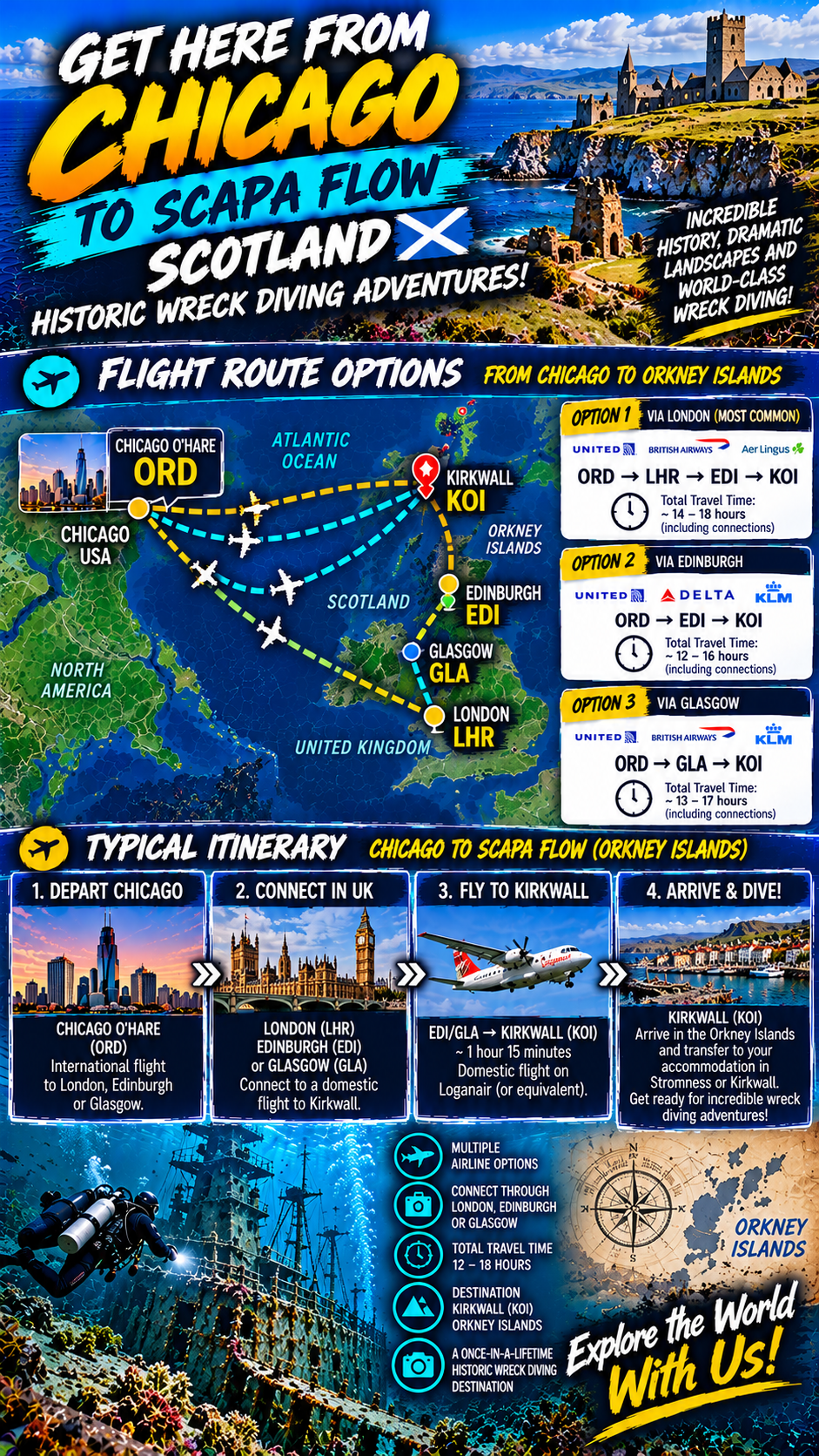
11. How Do You Get to Scapa Flow from Chicago?
For travelers departing from Chicago, reaching Scapa Flow generally involves international and domestic travel connections.
A possible itinerary is:
Chicago O'Hare (ORD) → London Heathrow (LHR) → Edinburgh (EDI) → Kirkwall (KOI)
Other routes may connect through Glasgow or Aberdeen, depending on airline schedules.
After arriving at Kirkwall Airport, travelers continue by road to their accommodations or dive operator, often in Stromness.
Important Travel Considerations
-
International and domestic flight connections.
-
Airline baggage allowances for scuba equipment.
-
Additional charges for heavy diving gear.
-
Weather-related travel delays.
-
Accommodation near the dive departure point.
-
Cold-water equipment rental availability.
-
UK entry and electronic travel authorization requirements, where applicable.
For a dedicated wreck-diving expedition, we recommend allowing sufficient time for travel, equipment preparation, and weather contingencies.
Why Scapa Flow Belongs on Your Diving Bucket List
There are many extraordinary scuba diving destinations throughout the Atlantic Ocean, but Scapa Flow offers something truly unique.
Legendary World War I battleships.
Historic German light cruisers.
Extraordinary naval engineering.
Cold-water wreck diving.
Fascinating marine life.
And more than a century of maritime history beneath the waves.
Scapa Flow is not simply another wreck-diving destination. It is an underwater journey into world history!
Your Scapa Flow Adventure Starts at Loves Park Scuba!
At Loves Park Scuba, we believe scuba diving is about exploring the world, developing our skills, protecting marine ecosystems, and creating unforgettable memories.
Whether you dream of exploring historic battleships, developing advanced wreck-diving skills, or experiencing the extraordinary underwater history of Scotland, our team is here to help you prepare.
From drysuit training and advanced diving to equipment selection and dive travel planning, we're ready to help.
Are you ready to discover Scapa Flow — Historic World War I Shipwrecks?
Visit Loves Park Scuba and let us help you prepare for your next extraordinary Atlantic diving adventure!
LOVES PARK SCUBA
Dive Into Adventure — Explore the World With Us!
COMING NEXT IN OUR ATLANTIC DIVING SERIES
Episode 8 — Silfra, Iceland: Diving Between Two Continents!
Discover crystal-clear glacial water, spectacular underwater rock formations, and the extraordinary experience of diving between the North American and Eurasian tectonic plates.
10 Iconic Atlantic Destinations. One Passion for Diving!
