
SOCORRO ISLANDS, MEXICO — THE KINGDOM OF GIANT OCEANIC MANTAS! Top 10 Iconic Scuba Diving Destinations in the Pacific Ocean — Episode 2
Martin Gomez Oct 29, 2026
SOCORRO ISLANDS, MEXICO — THE KINGDOM OF GIANT OCEANIC MANTAS!
Top 10 Iconic Scuba Diving Destinations in the Pacific Ocean — Episode 2
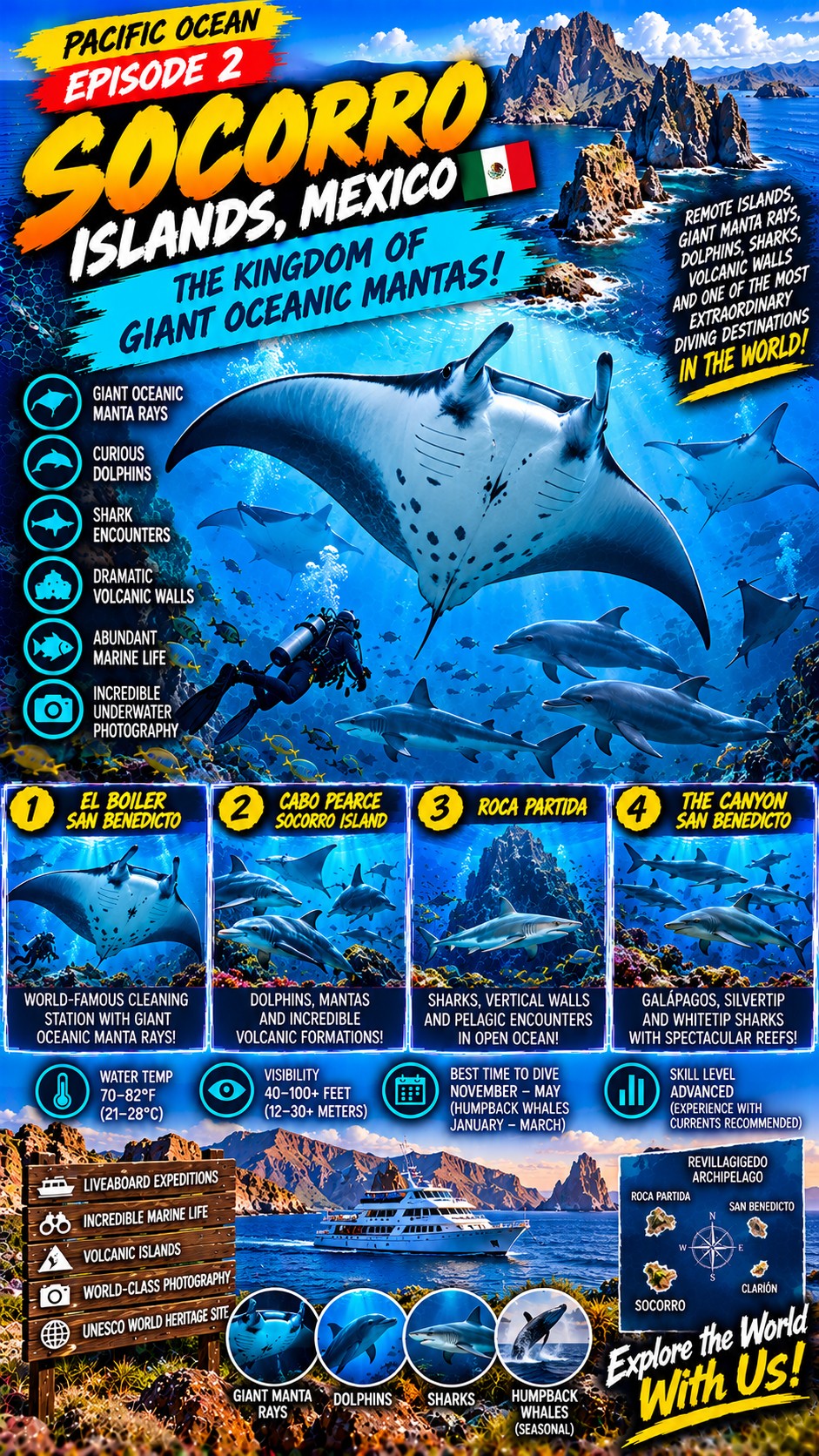
Discover Giant Oceanic Manta Rays, Curious Dolphins, Powerful Sharks, and Spectacular Volcanic Underwater Landscapes!
Welcome to Socorro: Where Giants Rule the Pacific!
Imagine descending into the deep blue waters of the Pacific Ocean.
Below you, a massive volcanic formation disappears into the depths.
Schools of fish move along the rocky walls while powerful ocean currents carry nutrients through the surrounding waters.
Suddenly, an enormous shadow appears in the distance.
As it approaches, you realize that it is not a shark.
It is a giant oceanic manta ray.
With a wingspan that can exceed 20 feet, this magnificent animal moves effortlessly through the water.
Then something extraordinary happens.
Instead of swimming away, the manta approaches your group.
It circles gracefully, passing above the divers as if it were studying these unusual visitors to its underwater world.
Moments later, another manta appears.
And then another.
Welcome to Socorro Islands, Mexico — The Kingdom of Giant Oceanic Mantas!
Located in the remote eastern Pacific Ocean, the Revillagigedo Archipelago is one of the world's most extraordinary destinations for encounters with large marine animals.
At Loves Park Scuba, we're excited to continue our new series:
TOP 10 ICONIC SCUBA DIVING DESTINATIONS IN THE PACIFIC OCEAN!
Our second adventure takes us to a place where giant manta rays, dolphins, sharks, and dramatic volcanic formations create unforgettable underwater experiences.
1. Where Are the Socorro Islands?
The Socorro Islands are part of the Revillagigedo Archipelago, a remote group of volcanic islands belonging to Mexico.
The archipelago lies in the Pacific Ocean, southwest of the Baja California Peninsula.
It includes four principal islands:
-
Socorro Island
-
San Benedicto Island
-
Roca Partida
-
Clarión Island
The first three are the best-known destinations on recreational diving liveaboard itineraries.
The archipelago is approximately 250 miles (400 kilometers) or more from Cabo San Lucas, depending on the destination and route.
Because of its remote location, scuba diving expeditions generally depart from Cabo San Lucas aboard specialized liveaboard vessels.
Why Is This Region So Special?
The islands rise dramatically from the deep ocean floor.
Their underwater formations interact with ocean currents, attracting an impressive variety of marine life.
The surrounding waters support:
-
Giant oceanic manta rays.
-
Bottlenose dolphins.
-
Galápagos sharks.
-
Silky sharks.
-
Whitetip reef sharks.
-
Silvertip sharks.
-
Seasonal humpback whales.
-
Large schools of fish.
-
Tuna and other pelagic species.
-
Occasional whale sharks and other ocean visitors.
Socorro is not a traditional tropical reef destination. It is an extraordinary open-ocean adventure focused on encounters with marine giants!
2. Giant Oceanic Manta Rays: The Stars of Socorro
The undisputed stars of Socorro are the giant oceanic manta rays.
These extraordinary animals belong to the species Mobula birostris.
They are among the largest rays in the world, with exceptionally large individuals reaching wingspans of more than 20 feet (6 meters).
Despite their impressive size, manta rays are gentle filter feeders.
They consume zooplankton and other tiny organisms suspended in the water.
Why Are Socorro's Mantas So Famous?
One of the most remarkable characteristics of the region is the behavior of some resident manta rays around scuba divers.
In certain locations, mantas have been observed repeatedly approaching divers and circling nearby.
These encounters can last several minutes and sometimes longer.
Imagine a giant manta swimming directly above your head, its enormous wings moving slowly through the water.
For many divers, this becomes one of the most emotional experiences of their diving lives.
Manta Ray Cleaning Stations
Manta rays frequently visit areas where smaller fish remove parasites and dead tissue from their bodies.
These locations are known as cleaning stations.
Divers may observe mantas approaching these sites and remaining nearby while cleaner fish perform their work.
Responsible Manta Encounters
At Loves Park Scuba, we encourage responsible wildlife interactions.
Divers should:
-
Never chase manta rays.
-
Never touch or grab their bodies.
-
Avoid blocking their swimming paths.
-
Maintain excellent buoyancy.
-
Follow the dive guide's instructions.
-
Allow the animals to choose whether to approach.
The most extraordinary manta encounters happen when we respect the animals and allow them to behave naturally.
3. San Benedicto Island: The Home of the Giant Mantas
San Benedicto Island is one of the most famous diving destinations in the Revillagigedo Archipelago.
This remote volcanic island offers dramatic underwater formations and exceptional opportunities to observe giant manta rays.
One of its most celebrated dive sites is El Boiler.
El Boiler — The Legendary Manta Cleaning Station
El Boiler is an underwater pinnacle that rises from the surrounding depths.
The site is internationally famous for encounters with giant oceanic manta rays.
The rocky formation attracts cleaner fish, which in turn attract mantas.
Divers may position themselves near the pinnacle and watch these magnificent animals move gracefully through the water.
What Can Divers Encounter at El Boiler?
-
Giant oceanic manta rays.
-
Bottlenose dolphins.
-
Galápagos sharks.
-
Other pelagic fish.
-
Spectacular underwater volcanic formations.
El Boiler is one of the most iconic manta ray diving sites on the planet!
The Canyon — Sharks and Pelagic Encounters
Another famous site at San Benedicto is The Canyon.
This location is known for its underwater rocky formations and opportunities to observe different shark species.
Depending on conditions, divers may encounter:
-
Galápagos sharks.
-
Silvertip sharks.
-
Whitetip reef sharks.
-
Manta rays.
-
Large schools of fish.
The Canyon offers a different experience from El Boiler, combining volcanic terrain with exciting encounters with marine predators.
4. Socorro Island: Dolphins, Mantas, and Volcanic Wonders
Socorro Island is the largest island in the archipelago.
Its dramatic volcanic landscape continues beneath the surface, creating fascinating underwater environments.
One of the best-known diving areas is Cabo Pearce.
Cabo Pearce — The Dolphin Encounter
Cabo Pearce is internationally recognized for encounters with giant manta rays and bottlenose dolphins.
Some dolphins in this region are known to approach scuba divers.
Imagine a group of dolphins swimming nearby, observing your movements and occasionally passing within view of your underwater camera.
These interactions are unpredictable and depend entirely on the animals.
What Makes Cabo Pearce Extraordinary?
-
Giant oceanic manta rays.
-
Curious bottlenose dolphins.
-
Galápagos sharks.
-
Underwater volcanic ridges.
-
Large schools of fish.
-
Dramatic blue-water environments.
Few places offer the possibility of observing giant mantas and wild dolphins during the same diving expedition.
Punta Tosca
Punta Tosca is another well-known diving area around Socorro Island.
Its rocky underwater environment may provide opportunities to encounter manta rays, sharks, and other pelagic marine life.
Conditions and site access vary, and the dive operator determines the safest locations for each excursion.
5. Roca Partida: A Tower Rising from the Deep Pacific
Roca Partida is one of the most dramatic diving destinations in the eastern Pacific Ocean.
This isolated volcanic rock rises directly from deep ocean waters.
Above the surface, it appears as a small rocky formation surrounded by an immense expanse of blue water.
Below the surface, its steep walls disappear into the depths.
What Makes Roca Partida So Special?
The island's underwater walls attract a remarkable variety of marine life.
Divers may encounter:
-
Whitetip reef sharks resting along rocky ledges.
-
Galápagos sharks.
-
Silky sharks.
-
Large schools of jacks.
-
Tuna.
-
Manta rays.
-
Other pelagic visitors.
The Famous Whitetip Reef Sharks
One of the most memorable sights at Roca Partida is the presence of whitetip reef sharks resting along underwater ledges.
Multiple sharks may occupy the same sheltered areas.
Watching these animals resting together creates fascinating photography opportunities.
Diving Along the Walls
Roca Partida is exposed to open-ocean conditions.
Currents, swell, and surface conditions can be challenging.
Divers must remain attentive to their depth, buoyancy, gas supply, and the instructions of their dive guides.
Roca Partida represents the wild, adventurous spirit of Pacific Ocean diving!
6. The Sharks of Socorro
Although manta rays are the archipelago's most famous attraction, Socorro also offers remarkable shark encounters.
Galápagos Sharks
These large sharks are frequently associated with offshore islands and rocky underwater formations.
Silky Sharks
Silky sharks are powerful open-water predators that may be encountered in the surrounding waters.
Silvertip Sharks
Recognizable by the pale tips of their fins, silvertip sharks are among the species that divers may observe.
Whitetip Reef Sharks
These sharks are often seen resting near rocky ledges and sheltered underwater formations.
Hammerhead Sharks
Hammerhead sharks may occasionally be encountered in the region, although Socorro is generally more famous for manta rays than for massive hammerhead schools.
Whale Sharks
Whale sharks are occasional visitors rather than a guaranteed attraction.
Socorro offers the opportunity to observe several impressive shark species in their natural ocean environment.
As with all wildlife diving, sightings vary according to location, season, and environmental conditions.
7. Dolphins: An Unexpected Underwater Encounter
One of the most extraordinary experiences in Socorro is the possibility of encountering bottlenose dolphins underwater.
Dolphins are intelligent, highly social marine mammals.
Some individuals around Socorro have shown curiosity toward divers.
During certain encounters, dolphins may swim close to a group and remain nearby for several moments.
These experiences can be unforgettable.
However, it is important to remember that dolphins are wild animals.
Divers should never chase, touch, restrain, or attempt to feed them.
Observing a dolphin voluntarily approach you underwater is a privilege that deserves respect.
8. Humpback Whales: The Giants Above the Reef
During the winter and spring season, humpback whales migrate through the waters surrounding the Revillagigedo Archipelago.
These magnificent marine mammals travel to warmer waters for breeding and calving activities.
From a liveaboard vessel, travelers may have opportunities to observe whales at the surface.
On some dives, underwater whale vocalizations can be heard.
Imagine descending along a volcanic wall while the distant songs of humpback whales travel through the ocean.
It is an extraordinary reminder that the Pacific Ocean is alive with creatures far beyond our field of vision.
Whale sightings are seasonal, and in-water encounters are not guaranteed or part of a standard scuba diving activity.
All whale observations must follow applicable wildlife regulations.
9. When Is the Best Time to Dive Socorro?
The primary recreational liveaboard diving season generally runs from November through May, although individual operators may use somewhat different schedules.
Conditions vary throughout the season.
| Period | General Conditions | Marine Life Highlights |
|---|---|---|
| November – December | Generally warmer water early in the season | Giant mantas, sharks, dolphins |
| January – March | Cooler water and winter conditions | Mantas, sharks, dolphins, seasonal humpback whales |
| April – May | Gradually warming conditions | Mantas, sharks, dolphins, other pelagic life |
Water Temperature
Typical temperatures range approximately from:
70–82°F (21–28°C)
Colder conditions can occur during winter months.
Visibility
Visibility often ranges approximately from:
40–100 feet (12–30 meters)
Actual visibility varies considerably with currents, weather, plankton, and location.
Exposure Protection
A 5 mm or 7 mm wetsuit may be appropriate depending on the season and the diver's thermal comfort.
A hood can be useful during cooler months.
Best Time for Humpback Whales
The winter and early spring months generally offer better opportunities for seasonal humpback whale observations.
Best Time for Giant Manta Rays
Giant manta rays may be encountered throughout much of the normal diving season.
Socorro is a wildlife destination, so the best experience depends on ocean conditions and the natural movements of marine animals.
10. Is Socorro Suitable for Beginner Divers?
Socorro is generally considered a destination for experienced divers.
Many dive sites are remote, exposed, and subject to changing ocean conditions.
Divers may encounter:
-
Strong currents.
-
Open-ocean swell.
-
Deep water surrounding volcanic formations.
-
Blue-water ascents.
-
Challenging boat entries and exits.
-
Variable visibility.
-
Multiple dives over consecutive days.
-
Long distances from advanced medical facilities.
Because of these conditions, liveaboard operators commonly require advanced certification and a minimum number of logged dives.
Exact requirements vary by operator.
Recommended Training at Loves Park Scuba
Advanced Adventure / Advanced Open Water
Develop confidence in different underwater environments.
Deep Diving
Improve understanding of depth-related planning and gas management.
Drift Diving
Practice techniques for diving safely in currents.
Enriched Air Nitrox
Learn how to plan enriched-air dives and manage oxygen exposure.
Perfect Buoyancy
Improve stability, control, and underwater positioning.
Rescue Diver
Develop greater awareness and emergency-response skills.
Underwater Photography
Learn techniques for capturing marine wildlife while maintaining safe diving practices.
Additional Skills
Divers should also be comfortable with:
-
Deploying a surface marker buoy.
-
Performing controlled blue-water ascents.
-
Managing gas supplies conservatively.
-
Following liveaboard procedures.
-
Diving from inflatable tenders.
-
Handling current and surge.
-
Maintaining appropriate separation and buddy procedures.
The more prepared you are, the more confidently you can enjoy the extraordinary marine life of Socorro!
11. Liveaboard Diving: The Only Practical Way to Explore Socorro
Unlike destinations with nearby dive resorts and daily shore-diving opportunities, Socorro is a remote offshore expedition destination.
The normal way to explore its famous dive sites is aboard a specialized liveaboard vessel.
What Is a Liveaboard?
A liveaboard is a vessel designed to accommodate scuba divers for several days.
Guests sleep, eat, relax, and prepare their diving equipment aboard the boat.
What Does a Typical Socorro Expedition Include?
Depending on the operator and itinerary:
-
Multiple nights aboard the vessel.
-
Meals and accommodation.
-
Diving around San Benedicto, Socorro, and Roca Partida.
-
Guided dives.
-
Tanks and weights.
-
Dive briefings and marine life presentations.
-
Opportunities for underwater photography.
-
Long ocean crossings between Cabo San Lucas and the islands.
Many itineraries last approximately 8–10 days, although duration varies.
What About the Ocean Crossing?
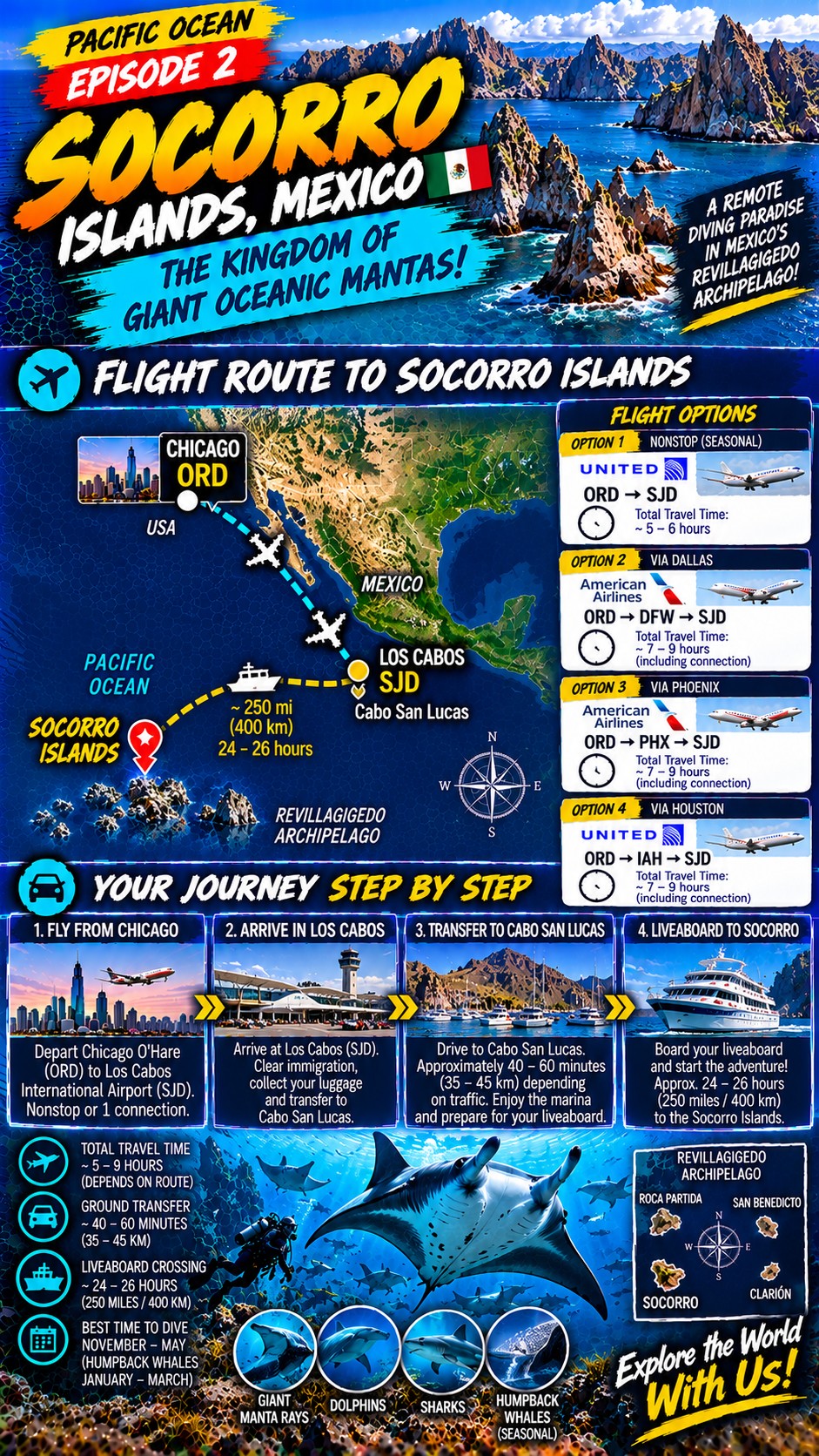
The crossing from Cabo San Lucas to the archipelago often takes approximately 24 hours or longer, depending on the vessel, weather, and destination.
Travelers should be prepared for open-ocean conditions.
Seasickness prevention and appropriate medication should be discussed with a healthcare professional before departure if needed.
Important Considerations
Liveaboard travelers should verify:
-
Operator safety standards.
-
Certification requirements.
-
Required logged dive experience.
-
Equipment rental availability.
-
Nitrox availability and fees.
-
Marine park charges.
-
Travel insurance.
-
Diving accident and evacuation coverage.
-
Medical requirements.
-
Weather cancellation policies.
A Socorro liveaboard is not simply a diving vacation. It is a true Pacific Ocean expedition!
12. Marine Conservation: Protecting the Giants of Socorro
The Revillagigedo Archipelago is internationally recognized for its exceptional marine biodiversity.
In 2016, the archipelago was designated a UNESCO World Heritage Site.
Mexico subsequently established the Revillagigedo National Park, providing extensive marine protection.
The region supports important habitats and migratory routes for numerous species.
Why Is Conservation Important?
Giant manta rays, sharks, and other pelagic animals face threats including:
-
Accidental capture in fishing gear.
-
Illegal fishing.
-
Marine pollution.
-
Climate change.
-
Disturbance from irresponsible wildlife interactions.
-
Changes in ocean ecosystems.
Responsible Diving Practices
At Loves Park Scuba, we encourage every diver to:
-
Maintain excellent buoyancy.
-
Never touch manta rays or sharks.
-
Never chase dolphins.
-
Avoid disturbing cleaning stations.
-
Secure all equipment.
-
Respect protected areas.
-
Follow park regulations.
-
Choose authorized dive operators.
-
Support marine conservation.
Protecting Socorro means protecting one of the most extraordinary gatherings of marine giants on Earth.
13. Beyond Diving: Discover Cabo San Lucas
Most Socorro expeditions begin in Cabo San Lucas, located at the southern tip of Mexico's Baja California Peninsula.
Before or after a liveaboard trip, visitors can explore this famous coastal destination.
El Arco de Cabo San Lucas
One of the most iconic natural rock formations in Mexico.
Marina Cabo San Lucas
A lively waterfront with restaurants, shops, and spectacular views of visiting vessels.
Whale Watching
Seasonal opportunities to observe humpback whales and other marine mammals.
Baja California Desert Landscapes
Discover the dramatic contrast between desert mountains and the deep blue Pacific Ocean.
Local Cuisine
Enjoy seafood and regional Mexican dishes.
Beaches and Coastal Views
Relax and explore the spectacular scenery around the southern Baja California Peninsula.
Cabo San Lucas is the perfect gateway to an unforgettable Socorro diving expedition!
14. How Do You Get to Socorro from Chicago?
For travelers departing from Chicago, the journey begins with a flight to Los Cabos International Airport.
Main Airport
Los Cabos International Airport — SJD
The airport serves the Los Cabos region of Baja California Sur, Mexico.
Possible Flight Route 1
Chicago O'Hare (ORD) → Los Cabos (SJD)
Nonstop flights may be available depending on airline schedules and travel dates.
Possible Flight Route 2
Chicago O'Hare (ORD) → Dallas/Fort Worth (DFW) → Los Cabos (SJD)
Possible Flight Route 3
Chicago O'Hare (ORD) → Phoenix (PHX) → Los Cabos (SJD)
Possible Flight Route 4
Chicago O'Hare (ORD) → Houston (IAH) → Los Cabos (SJD)
These are illustrative routing possibilities, not confirmed schedules for specific dates.
Ground Transportation
After arriving at SJD, travelers transfer to Cabo San Lucas.
The journey typically takes approximately 40–60 minutes, depending on traffic and the departure marina.
Liveaboard Departure
Most Socorro liveaboards depart from Cabo San Lucas.
Travelers board their vessel and begin the long ocean crossing toward the Revillagigedo Archipelago.
Recommended Travel Planning
Because of the distance involved, it is wise to arrive in Los Cabos at least one day before the scheduled liveaboard departure.
This allows time for:
-
Flight delays.
-
Baggage collection.
-
Equipment preparation.
-
Hotel accommodation.
-
Transfer arrangements.
-
Liveaboard check-in.
Important Flight Considerations for Divers
When returning home, always allow an appropriate no-fly interval after the final scuba dive.
Follow current diving medical guidance and the liveaboard operator's recommendations.
From Chicago to the remote waters of Socorro, the journey is part of the adventure!
15. Why Socorro Belongs on Every Advanced Diver's Bucket List
There are many extraordinary scuba diving destinations in the Pacific Ocean.
But few offer the combination of wildlife encounters found around Socorro.
Imagine:
A giant oceanic manta ray swimming directly above your head.
A curious dolphin approaching your dive group.
A school of sharks moving along a volcanic wall.
Whitetip reef sharks resting together on rocky ledges.
The distant sounds of humpback whales traveling through the water.
And the endless blue of the Pacific Ocean surrounding a remote volcanic island.
Socorro offers one of the most extraordinary big-animal diving experiences on Earth!
For experienced divers who dream of encounters with giant marine animals, the Revillagigedo Archipelago is an unforgettable destination.
16. Your Socorro Adventure Starts at Loves Park Scuba!
At Loves Park Scuba, we believe the greatest diving adventures begin with proper training, reliable equipment, and a passion for exploring the underwater world.
Whether your dream is to encounter a giant manta ray, photograph sharks, explore volcanic underwater landscapes, or experience a remote liveaboard expedition, our team can help you prepare.
We offer opportunities to develop your diving skills through:
-
Open Water certification.
-
Advanced diving education.
-
Enriched Air Nitrox training.
-
Rescue Diver courses.
-
Buoyancy improvement.
-
Equipment selection and preparation.
-
Dive travel guidance.
Are you ready to dive with the giants of Socorro?
Visit Loves Park Scuba and begin preparing for your next extraordinary Pacific Ocean adventure!
LOVES PARK SCUBA
DIVE INTO ADVENTURE — EXPLORE THE WORLD WITH US!
COMING NEXT IN OUR PACIFIC DIVING SERIES
EPISODE 3 — COCOS ISLAND, COSTA RICA: THE HAMMERHEAD SHARK SANCTUARY!
Our next adventure takes us to one of the most remote and legendary diving destinations in the eastern Pacific Ocean.
Imagine massive schools of hammerhead sharks moving around underwater pinnacles, powerful ocean currents, and a tropical island surrounded by deep blue water.
Discover the extraordinary marine wilderness of Cocos Island, Costa Rica!
10 ICONIC PACIFIC DESTINATIONS. ONE PASSION FOR DIVING!
