
The Four Basic Swimming Strokes
Martin Gomez Aug 20, 2026
The Four Basic Swimming Strokes
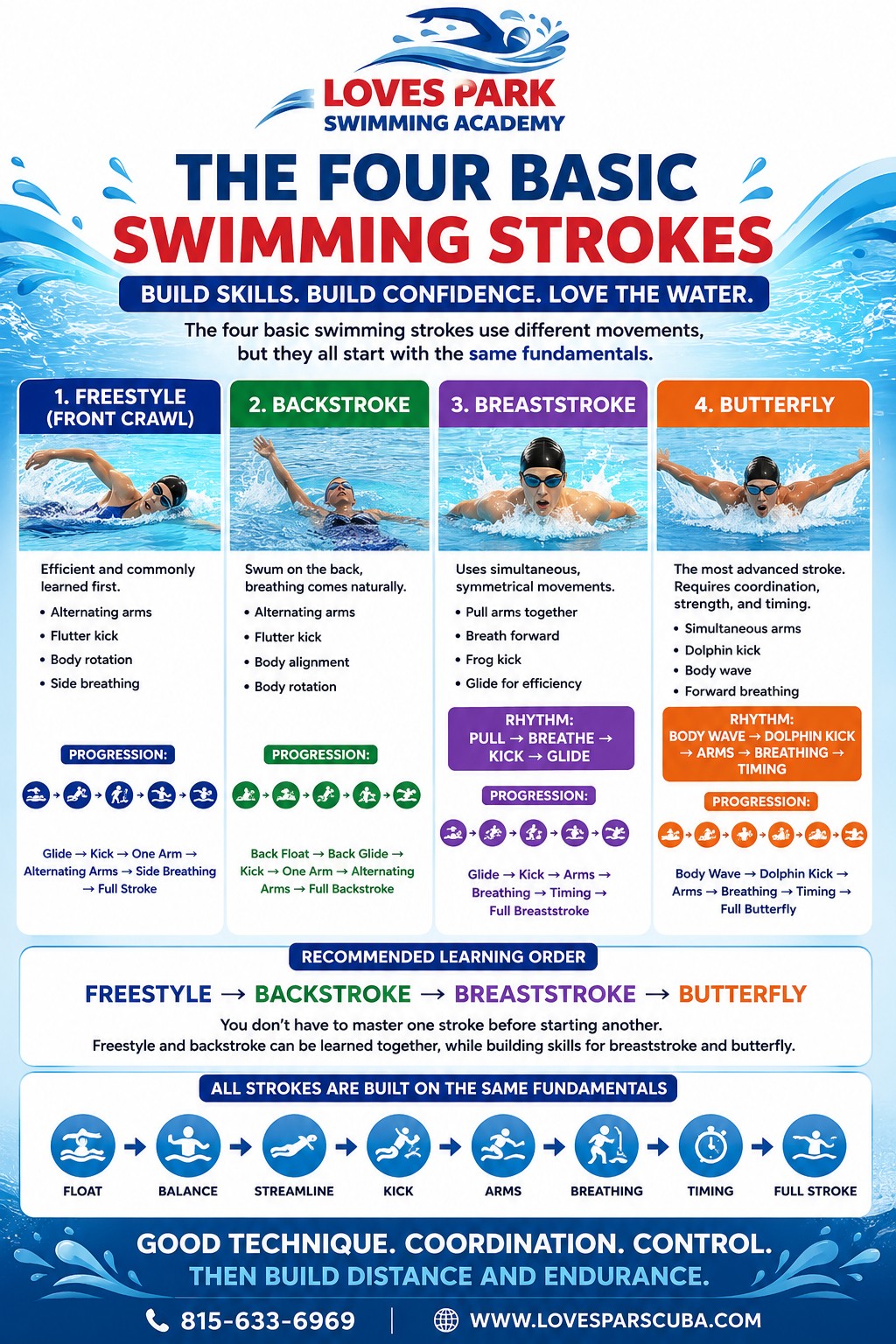
After learning floating, breathing, body position, and movement through the water, swimmers can begin developing the four basic swimming strokes: Freestyle, Backstroke, Breaststroke, and Butterfly.
Each stroke uses a different combination of body position, kicking, arm movement, breathing, and coordination.
1. Freestyle — Front Crawl
Freestyle is usually one of the first strokes swimmers learn for continuous and efficient movement through the water.
The body stays horizontal and streamlined, with the face looking down. The arms move alternately while the legs perform a continuous flutter kick. To breathe, the swimmer rotates the body slightly and turns the head to the side.
Main skills: Body position, flutter kick, alternating arms, body rotation, and side breathing.
Progression:
Glide → Kick → One Arm → Alternating Arms → Side Breathing → Full Stroke
2. Backstroke
Backstroke has many similarities to freestyle, but it is performed on the back. Because the face remains above the water, swimmers can breathe naturally.
The swimmer keeps the body aligned and the hips near the surface. The legs perform a flutter kick while the arms move continuously and alternately. A controlled body rotation helps create an efficient stroke.
Main skills: Back float, body alignment, flutter kick, alternating arms, and body rotation.
Progression:
Back Float → Back Glide → Kick → One Arm → Alternating Arms → Full Backstroke
3. Breaststroke
Breaststroke is different because the arms and legs move simultaneously and symmetrically.
The arms pull outward and then return forward while the legs perform a breaststroke kick, sometimes called a frog kick. After each cycle, the swimmer uses a glide to move efficiently through the water.
A simple way to teach the rhythm is:
PULL → BREATHE → KICK → GLIDE
Timing and coordination are especially important in breaststroke.
Progression:
Glide → Kick → Arms → Breathing → Timing → Full Breaststroke
4. Butterfly
Butterfly is generally the most advanced of the four strokes because it requires coordination, rhythm, strength, and good body position.
Both arms move simultaneously while the legs perform a dolphin kick. Butterfly should not depend only on arm strength. The swimmer learns to connect the movement of the entire body in a smooth, coordinated rhythm.
A simple progression is:
BODY WAVE → DOLPHIN KICK → ARMS → BREATHING → TIMING → FULL BUTTERFLY
Technique and rhythm should be developed before increasing distance.
Recommended Learning Progression
For many swimmers, a practical order is:
FREESTYLE → BACKSTROKE → BREASTSTROKE → BUTTERFLY
However, swimmers do not always need to completely master one stroke before beginning another. For example, freestyle and backstroke can develop together while basic breaststroke and dolphin kick skills are gradually introduced.
All four strokes are built on the same swimming fundamentals:
FLOAT → BALANCE → STREAMLINE → KICK → ARMS → BREATHING → TIMING → FULL STROKE
Learn the position. Learn the movement. Add breathing. Develop coordination. Then build distance and endurance.
The goal is not simply to memorize four different ways to move the arms and legs. It is to teach swimmers how to control their bodies and move efficiently, confidently, and safely through the water.
