
The Main Decompression Models Used in Dive Computers Today
Martin Gomez Aug 11, 2026
Understanding Your Dive Computer
The Main Decompression Models Used in Dive Computers Today
1. Bühlmann ZHL-16C
One of the most widely used and documented decompression models today. It models inert gas uptake and elimination using 16 theoretical tissue compartments with different half-times.
Many modern dive computers allow divers to adjust conservatism using Gradient Factors (GF).
Example: GF 40/85
2. RGBM — Reduced Gradient Bubble Model
RGBM belongs to a family of decompression models designed to consider not only dissolved inert gas but also aspects of bubble formation and behavior.
Different versions include:
-
Suunto RGBM
-
Technical RGBM
-
Fused RGBM
-
Fused RGBM 2
Some modern Suunto computers allow divers to choose between Fused RGBM 2 and Bühlmann 16 GF.
3. Proprietary or Modified Bühlmann-Based Algorithms
Some manufacturers use algorithms based on Bühlmann concepts but incorporate their own modifications and conservatism systems.
Examples include:
-
ZH-L16 ADT
-
ZH-L16 ADT MB
-
Predictive Multi-Gas
-
Manufacturer-specific Bühlmann implementations
Important: Two computers that both use “Bühlmann” will not necessarily display exactly the same NDL or decompression profile.
Settings, Gradient Factors, implementation, and conservatism can affect the results.
4. DSAT / Pelagic Z+ and Other Models
Some recreational dive computers use algorithms such as:
-
DSAT
-
Pelagic Z+ (PZ+)
-
Other manufacturer-specific algorithms
This is another reason why two divers following essentially the same dive profile may see different NDLs on their computers.
The Most Important Concept
Your dive computer does not know exactly what is happening inside your body.
It measures and records information such as:
Depth • Time • Breathing Gas • Ascent Profile • Surface Interval • Previous Dives
It then applies that information to a mathematical decompression model.
No decompression algorithm can tell you:
“You have a 0% chance of DCS.”
A dive computer provides decompression guidance based on a mathematical model—it does not directly measure your body's actual decompression status.
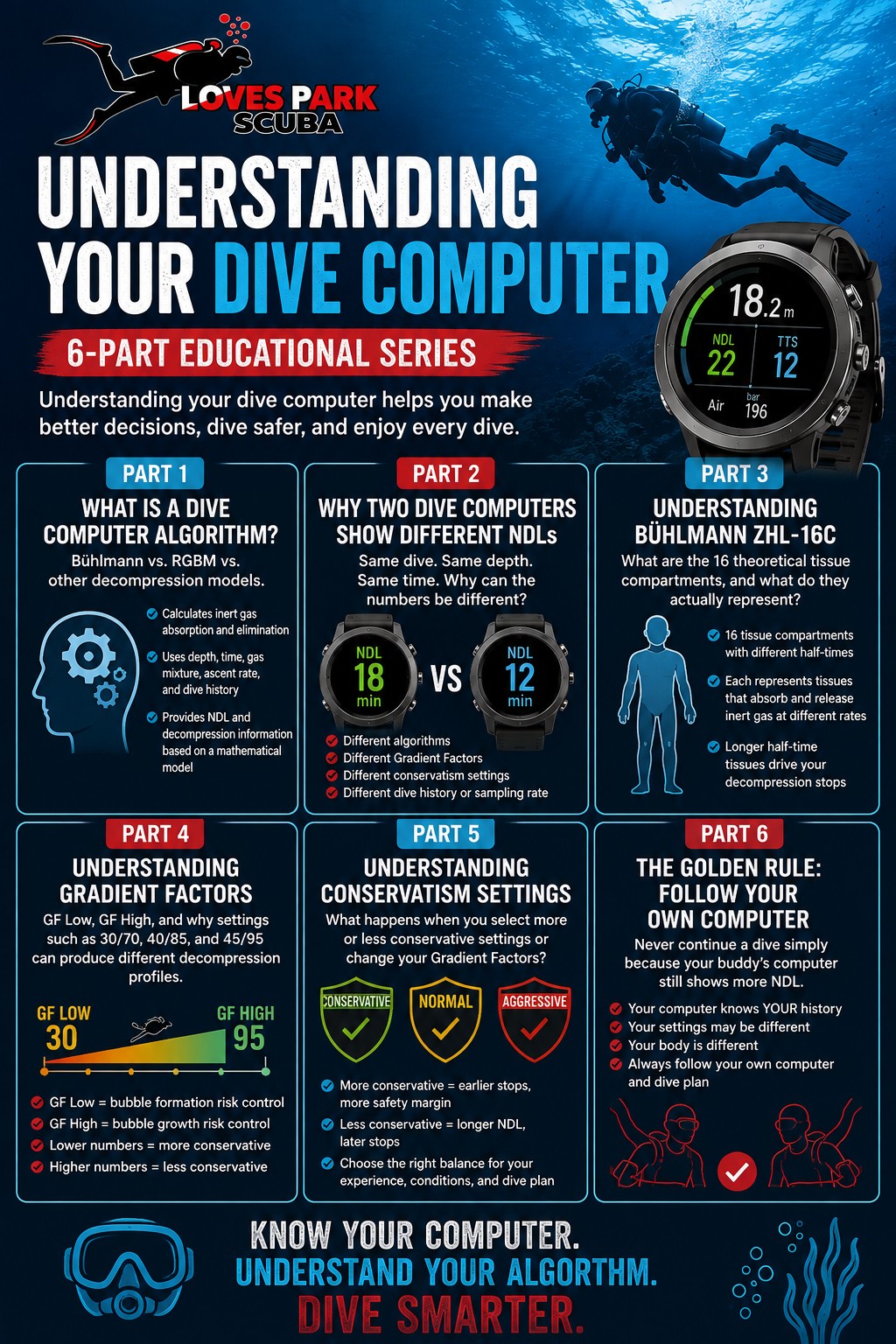
UNDERSTANDING YOUR DIVE COMPUTER
6-Part Educational Series
PART 1 — What Is a Dive Computer Algorithm?
Bühlmann vs. RGBM vs. other decompression models.
PART 2 — Why Two Dive Computers Show Different NDLs
Same dive. Same depth. Same time. Why can the numbers be different?
PART 3 — Understanding Bühlmann ZHL-16C
What are the 16 theoretical tissue compartments, and what do they actually represent?
PART 4 — Understanding Gradient Factors
GF Low, GF High, and why settings such as 30/70, 40/85, and 45/95 can produce different decompression profiles.
PART 5 — Understanding Conservatism Settings
What happens when you select more or less conservative settings or change your Gradient Factors?
PART 6 — The Golden Rule: Follow Your Own Computer
Never continue a dive simply because your buddy's computer still shows more NDL.
