
What Does It Mean to Be a Master Diver?
Martin Gomez Aug 17, 2026
What Does It Mean to Be a Master Diver?
Your Open Water certification was the beginning. Where will diving take you next?
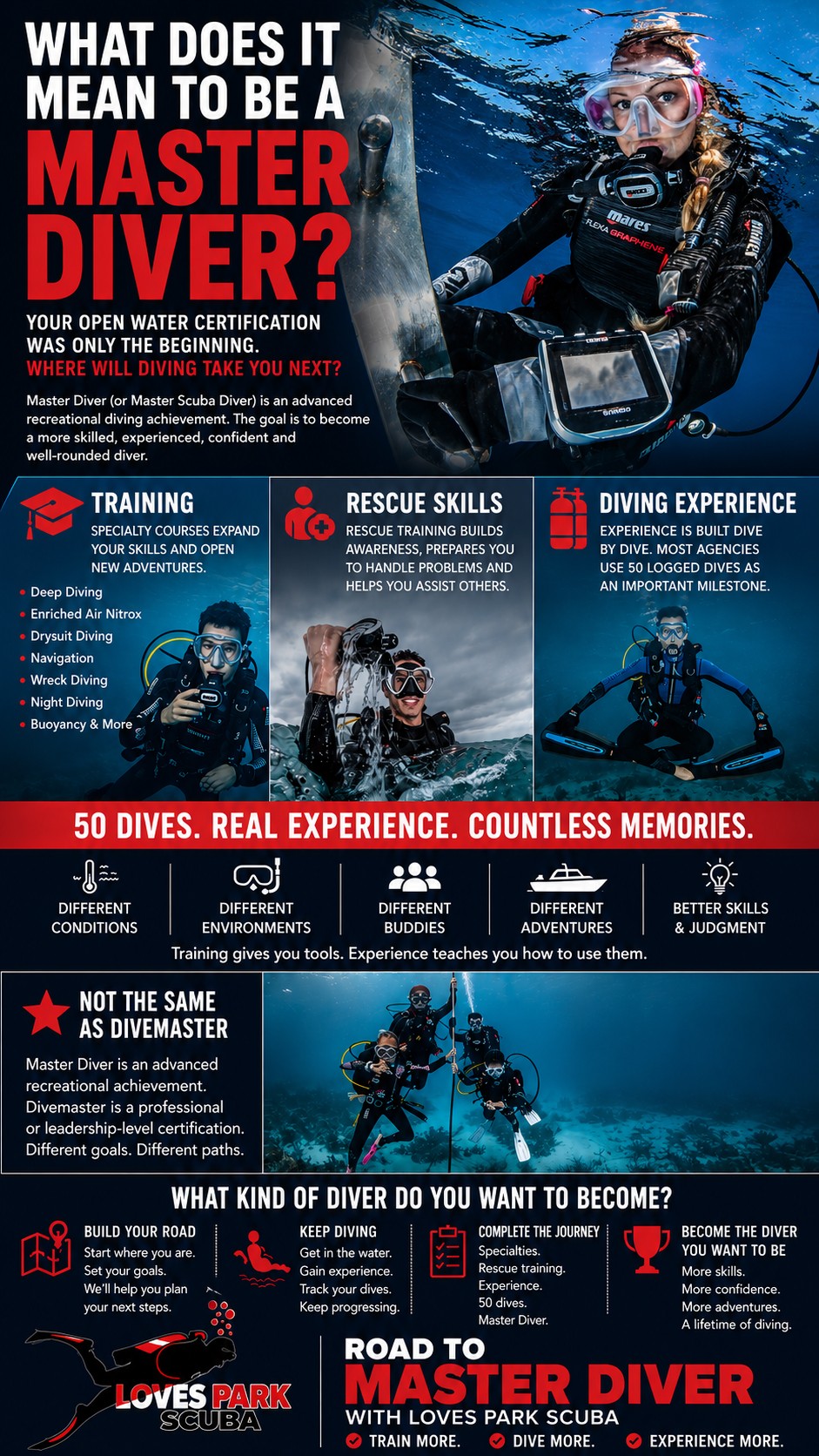
Getting your Open Water certification is an incredible achievement.
It gives you the training and knowledge to begin exploring the underwater world as a certified diver. But ask an experienced diver about their first certification, and they will probably tell you something important:
That was when the real learning began.
Every dive after Open Water adds something.
Your first dive in colder water. Your first night dive. Your first experience with a current. Your first deep dive. Your first wreck. The first time you solve a small problem underwater without becoming stressed. The first time another diver needs your help.
Little by little, you stop feeling like someone who has a scuba certification and start feeling like a diver.
That journey is what the concept of Master Diver is really about.
What Is a Master Diver?
Master Diver—or Master Scuba Diver, depending on the certification agency—is an advanced recreational diving achievement.
It represents a diver who has moved beyond entry-level training and developed broader knowledge, additional diving skills, rescue training and meaningful real-world diving experience.
Different scuba certification agencies have different requirements and names for their Master Diver programs.
Some require a specific combination of specialty certifications.
Some recognize a combination of advanced training, rescue skills and logged dives.
Others approach Master Diver as a dedicated advanced training course.
The exact path may be different.
The idea behind the destination is remarkably similar.
A Master Diver should be more than someone who has collected certification cards.
A Master Diver is becoming a well-rounded, experienced and capable recreational diver.
Certification Is Only the Beginning
There is an important difference between training and experience.
A scuba course can teach you how to perform a skill.
Experience teaches you when and why you may need it.
Consider buoyancy.
During Open Water training, you learn the fundamentals of buoyancy control.
But then you dive.
You dive with different exposure protection.
You change cylinders.
You dive in fresh water and salt water.
You carry more equipment.
You encounter different visibility and conditions.
Eventually, buoyancy becomes less of something you consciously perform and more of something you naturally control.
The same thing happens with navigation, gas management, buddy awareness, equipment configuration and many other diving skills.
That development requires something no certification card can replace:
time underwater.
Why 50 Dives Matters
Many Master Diver pathways use 50 logged dives as an important experience milestone.
There is nothing magical that suddenly happens between dive 49 and dive 50.
The value is in the journey required to get there.
Think about the difference between a diver with six or eight training dives and someone who has completed 50 dives in different environments and conditions.
Those dives create opportunities to experience:
Different temperatures.
Different visibility.
Different equipment configurations.
Different dive buddies.
Different entries and exits.
Different depths.
Different buoyancy challenges.
Different underwater environments.
And occasionally, situations that do not go exactly according to plan.
That is how judgment develops.
Training gives you tools. Experience teaches you how to use them.
Specialty Training Expands Your World
One of the most enjoyable parts of the journey toward Master Diver is discovering what kind of diving interests you.
There are many directions you can explore.
You might discover Deep Diving and learn to plan and conduct deeper recreational dives responsibly.
You might learn Enriched Air Nitrox and better understand gas planning and oxygen exposure.
If you live and dive in a colder climate, Drysuit Diving can dramatically expand your local diving season.
Navigation can help transform you from a diver who follows someone underwater into a diver who understands where they are and how to return.
Night and Limited Visibility Diving introduces an entirely different underwater environment.
Wreck Diving can open the door to history beneath the surface.
And advanced Buoyancy training can refine one of the most important foundational skills in scuba diving.
The objective isn't simply to collect specialties.
The objective is to create a diver with a broader range of experiences and capabilities.
Then Comes Rescue Training
Ask many experienced divers which recreational course changed them the most, and Rescue Diver will often be somewhere near the top of the list.
Why?
Because the focus changes.
Early scuba training naturally concentrates heavily on you.
Your mask.
Your regulator.
Your buoyancy.
Your gas.
Your equipment.
Your problems.
Rescue training begins asking you to look beyond yourself.
Is your buddy comfortable?
Is another diver becoming stressed?
Could you recognize a problem before it becomes an emergency?
How would you respond if another diver needed assistance?
You begin developing greater situational awareness.
And that represents an important transition in recreational diving.
A capable diver manages themselves.
A more experienced diver is also increasingly aware of what is happening around them.
Master Diver Does Not Mean You Have Mastered Diving
The name can occasionally create the wrong impression.
Becoming a Master Diver does not mean you know everything about scuba diving.
Nobody does.
It does not mean every dive environment is now appropriate for you.
It does not eliminate the need for additional training when entering new environments or using unfamiliar equipment.
And it does not automatically make someone a professional diver.
Instead, Master Diver represents something much more useful:
progress.
You have moved beyond the beginning stages of recreational diving.
You have invested in education.
You have developed rescue skills.
You have accumulated meaningful experience.
And perhaps most importantly, you have continued diving.
Master Diver Is Not the Same as Divemaster
These two names sound similar, but they represent very different things.
Master Diver / Master Scuba Diver is an advanced recreational diving achievement.
Divemaster is generally a professional or leadership-level certification within agencies that use that designation.
You do not need to become a diving professional to have a meaningful goal in scuba diving.
For many recreational divers, Master Diver can be exactly that goal.
You can become a better-trained, more experienced recreational diver simply because you love diving and want to become better at it.
Your Certification Agency Doesn't Define Your Entire Diving Journey
Maybe your Open Water card says SSI.
Maybe it says SDI.
Maybe PADI, NAUI, SNSI or another recognized training organization.
You may even have certifications from several different agencies.
That's more common than many new divers realize.
Your certification agency provides the training standards and certification structure, but ultimately you are the diver.
Your experience belongs to you.
Your logged dives belong to you.
Your skills travel with you.
And your previous training may be recognized when building a continuing-education path with another agency, depending on that agency's standards and the specific certification involved.
That's why the first question shouldn't necessarily be:
“Which certification card do I need next?”
A better question is:
“WHAT KIND OF DIVER DO I WANT TO BECOME?”
Build Your Road to Master Diver
Imagine looking at your diving experience as a road instead of a collection of unrelated courses.
You start here:
OPEN WATER DIVER
Then you begin building.
TRAIN.
Develop new skills through continuing education and specialty training.
↓
DIVE.
Put those skills into practice and accumulate real-world experience.
↓
EXPLORE.
Try different environments and discover the types of diving you enjoy.
↓
RESCUE.
Develop greater awareness, problem-solving skills and the ability to assist other divers.
↓
50 LOGGED DIVES.
Reach an important recreational experience milestone.
↓
MASTER DIVER
Now the individual classes have a purpose.
The dives have a purpose.
You have a destination.
How Close Are You?
You might be closer than you think.
Maybe you already have 32 logged dives.
Maybe you already completed Nitrox.
Perhaps you have a Deep or Drysuit certification from another agency.
Maybe you have 70 dives but never completed Rescue training.
Or perhaps you just earned Open Water and are wondering what comes next.
Every diver's road will look a little different.
That's why your first step should be understanding where you are today.
Look at:
Your current certification level
Your specialty certifications
Your rescue training
Your logged dives
The diving environments in which you have experience
Then you can determine what training and experience are still needed to reach the Master Diver requirements of your chosen certification agency.
Don't Race to 50. Dive Your Way to 50.
There is one more important idea.
The objective shouldn't be to accumulate 50 dives as quickly as possible just to qualify for another certification card.
Make those dives count.
Dive locally.
Travel.
Try different environments.
Improve your buoyancy.
Practice navigation.
Dive from boats and shore.
Experience colder water.
Dive with different buddies.
Continue learning.
Become comfortable with your equipment.
Ask questions.
Dive with experienced divers.
And occasionally make a dive for no other reason than because you love being underwater.
One day you will open your logbook and discover something interesting.
Those 50 dives weren't the destination.
They were the education.
YOUR ROAD STARTS HERE
At Loves Park Scuba, we believe great divers aren't created by collecting certification cards.
They are created through:
TRAINING.
EXPERIENCE.
TIME UNDERWATER.
AND A DESIRE TO KEEP LEARNING.
That's why we're building:
ROAD TO MASTER DIVER
WITH LOVES PARK SCUBA
A pathway designed to help recreational divers understand where they are, where they want to go and what training and diving experience can help them get there.
Already have certifications?
Bring them.
Have certifications from different agencies?
Bring those too.
Have a logbook with 10, 25 or 40 dives?
Let's see it.
We'll help you review your training and experience and determine the appropriate path toward Master Diver based on your chosen certification program.
Because the goal isn't simply to put another card in your wallet.
The goal is to look back at the diver who completed that first Open Water course and realize just how far you've come.
DON'T JUST COLLECT CERTIFICATIONS.
BUILD EXPERIENCE.
BECOME THE DIVER YOU WANT TO BE.
ROAD TO MASTER DIVER
Loves Park Scuba
Train More. Dive More. Experience More.
Este artículo nos sirve como parte superior del embudo: no presiona al lector para comprar SSI o SDI y deliberadamente deja la pregunta “¿qué tan cerca estoy yo?” en su cabeza. El siguiente artículo puede capturar exactamente esa intención: “How Do I Become a Master Diver? SSI vs. SDI Road to Master Diver”, donde ya presentamos las dos rutas que ofrece Loves Park Scuba y llevamos al cliente hacia una evaluación de sus certificaciones y logbook.
