
Who Establishes International Standards for Scuba Diving Certification?
Martin Gomez Jul 06, 2026
Who Establishes International Standards for Scuba Diving Certification?
One of the most common questions new divers ask is:
"Who makes sure scuba certification agencies like SSI, SDI, PADI, NAUI, and SNSI meet international training standards?"
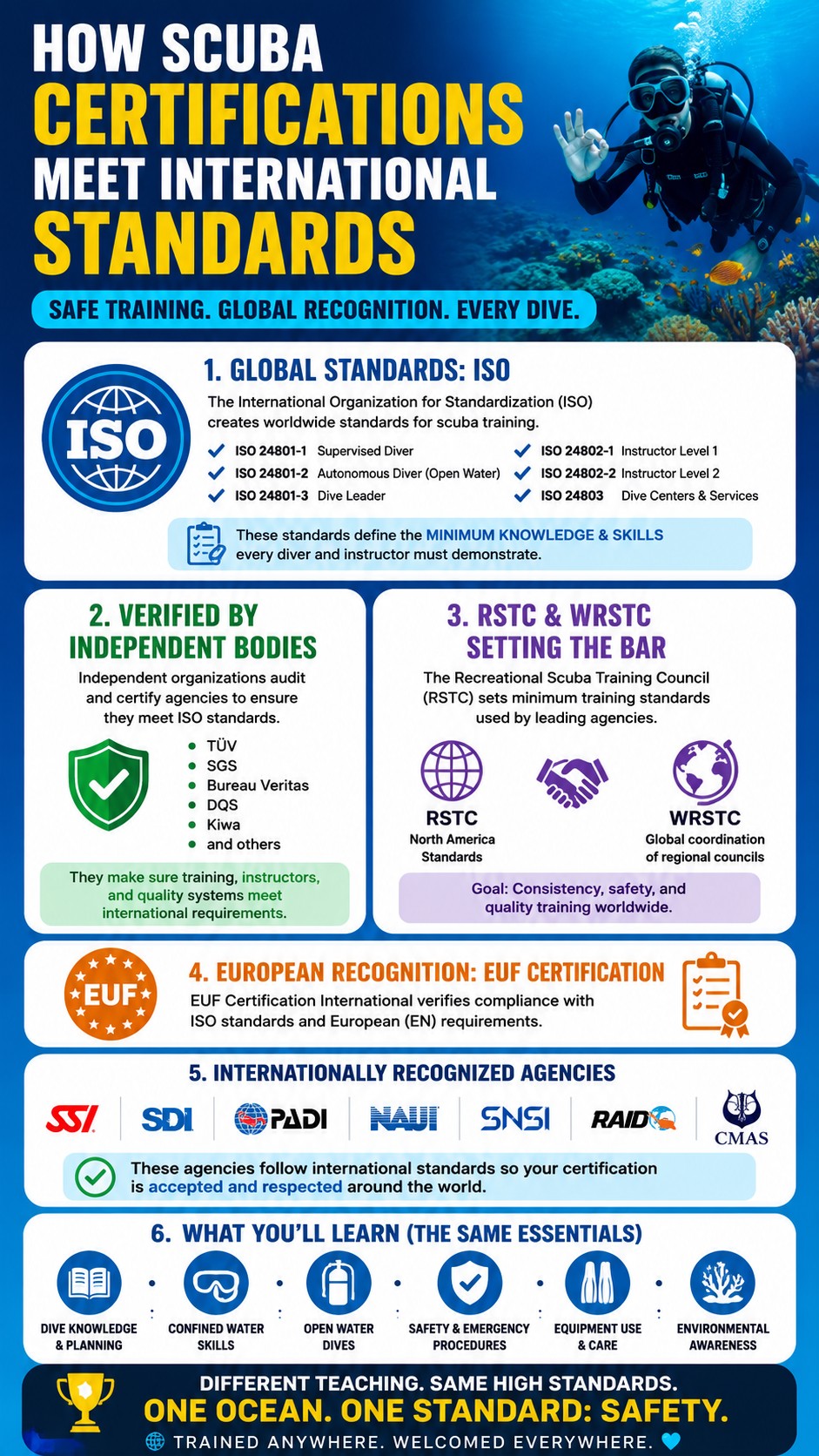
The answer is that no single scuba agency regulates the entire industry. Instead, internationally recognized organizations develop standards, while independent certification bodies verify that agencies comply with them.
1. ISO (International Organization for Standardization)
The International Organization for Standardization (ISO) is the world's leading organization for developing international standards across thousands of industries, including recreational scuba diving.
For diver training, the most important ISO standards include:
-
ISO 24801-1 – Supervised Diver
-
ISO 24801-2 – Autonomous Diver (equivalent to Open Water Diver)
-
ISO 24801-3 – Dive Leader
-
ISO 24802-1 – Scuba Instructor Level 1
-
ISO 24802-2 – Scuba Instructor Level 2
-
ISO 24803 – Requirements for Recreational Diving Service Providers and Dive Centers
These standards define the minimum knowledge, skills, and competencies that divers and instructors must demonstrate. They do not dictate how an agency teaches—only what students must be able to do upon successful completion.
2. Independent ISO Certification Bodies
ISO itself does not audit or certify scuba agencies.
Instead, independent accredited organizations perform audits to verify compliance with ISO standards.
Examples include:
-
TÜV
-
SGS
-
Bureau Veritas
-
DQS
-
Kiwa
-
Other nationally accredited certification bodies
These organizations evaluate whether an agency's training system, materials, instructor requirements, and quality management meet ISO requirements.
3. RSTC (Recreational Scuba Training Council)
In North America, another major organization is the:
Recreational Scuba Training Council (RSTC)
RSTC does not certify divers or instructors.
Its mission is to develop and maintain minimum training standards that member agencies agree to follow.
The RSTC standards were created through collaboration among leading training organizations to ensure consistency and diver safety across the recreational diving industry.
Traditional RSTC Member Agencies
Historically, RSTC membership has included agencies such as:
-
SSI
-
SDI
-
PADI
-
NAUI
-
PDIC
-
YMCA Scuba (formerly)
-
Other regional organizations
Agency participation may vary over time and by region, but the RSTC remains an important reference for recreational diver training standards.
4. WRSTC (World Recreational Scuba Training Council)
The World Recreational Scuba Training Council (WRSTC) coordinates regional RSTCs around the world.
Its goal is to promote international consistency among recreational diving standards.
Regional councils include organizations representing:
-
United States
-
Europe
-
Canada
-
Japan
-
Asia
-
Oceania
-
Latin America (where applicable)
5. EUF Certification International
In Europe, many agencies seek certification through:
EUF Certification International
EUF is an independent certification body that verifies compliance with:
-
ISO Standards
-
European Standards (EN)
-
International quality requirements
Many European diving organizations use EUF certification as an additional demonstration of quality and international recognition.
6. CMAS
The Confédération Mondiale des Activités Subaquatiques (CMAS) is not a regulator of other scuba agencies.
Founded in 1959, CMAS is an international underwater federation that operates its own diver training system (One-Star, Two-Star, Three-Star Diver, etc.).
Many CMAS federations also align their training programs with applicable ISO standards.
Who Actually Approves Scuba Training Standards?
No government or single organization grants permission for an agency to teach scuba.
A training agency develops its own educational materials and teaching methods while ensuring that:
-
It complies with applicable laws in the countries where it operates.
-
It meets ISO requirements if it chooses to obtain ISO certification.
-
It follows RSTC minimum standards if it is an RSTC member.
Internationally Recognized Scuba Agencies
The following agencies are widely recognized around the world and generally operate in accordance with internationally accepted training standards:
| Agency | ISO Compliant | RSTC (Current or Historical, Depending on Region) | International Recognition |
|---|---|---|---|
| SSI | Yes | Yes | Excellent |
| SDI | Yes | Yes | Excellent |
| PADI | Yes | Yes | Excellent |
| NAUI | Yes | Yes | Excellent |
| SNSI | Yes | Varies by Region | Excellent |
| RAID | Yes | Varies by Region | Excellent |
| CMAS | Many Federations Yes | No | Excellent |
What Does This Mean for Divers?
Whether you earn your Open Water certification through SSI, SDI, PADI, NAUI, SNSI, RAID, or another internationally recognized agency, you are expected to demonstrate a very similar set of core competencies.
These include:
-
Fundamental diving knowledge
-
Confined water skill development
-
Open water training dives
-
Safe dive planning
-
Emergency procedures
-
Equipment use and maintenance
-
Environmental awareness
The primary differences between agencies lie in their teaching philosophy, educational materials, digital learning platforms, instructor methodology, and additional program requirements, rather than in the fundamental safety competencies expected of a certified diver.
The Bottom Line
International scuba certification is built upon globally recognized standards—not individual agency opinions. Organizations such as ISO, RSTC, WRSTC, and EUF Certification International help ensure that reputable training agencies maintain high levels of safety, consistency, and professionalism.
As a result, certifications issued by recognized agencies such as SSI, SDI, PADI, NAUI, SNSI, RAID, and CMAS are accepted by dive centers around the world, giving divers the confidence to explore the underwater world wherever their adventures take them.
