
The Life-Changing Benefits of Scuba Diving
Martin Gomez Jul 01, 2026
The Life-Changing Benefits of Scuba Diving
How Scuba Diving Improves Your Body, Mind, and Quality of Life at Every Age
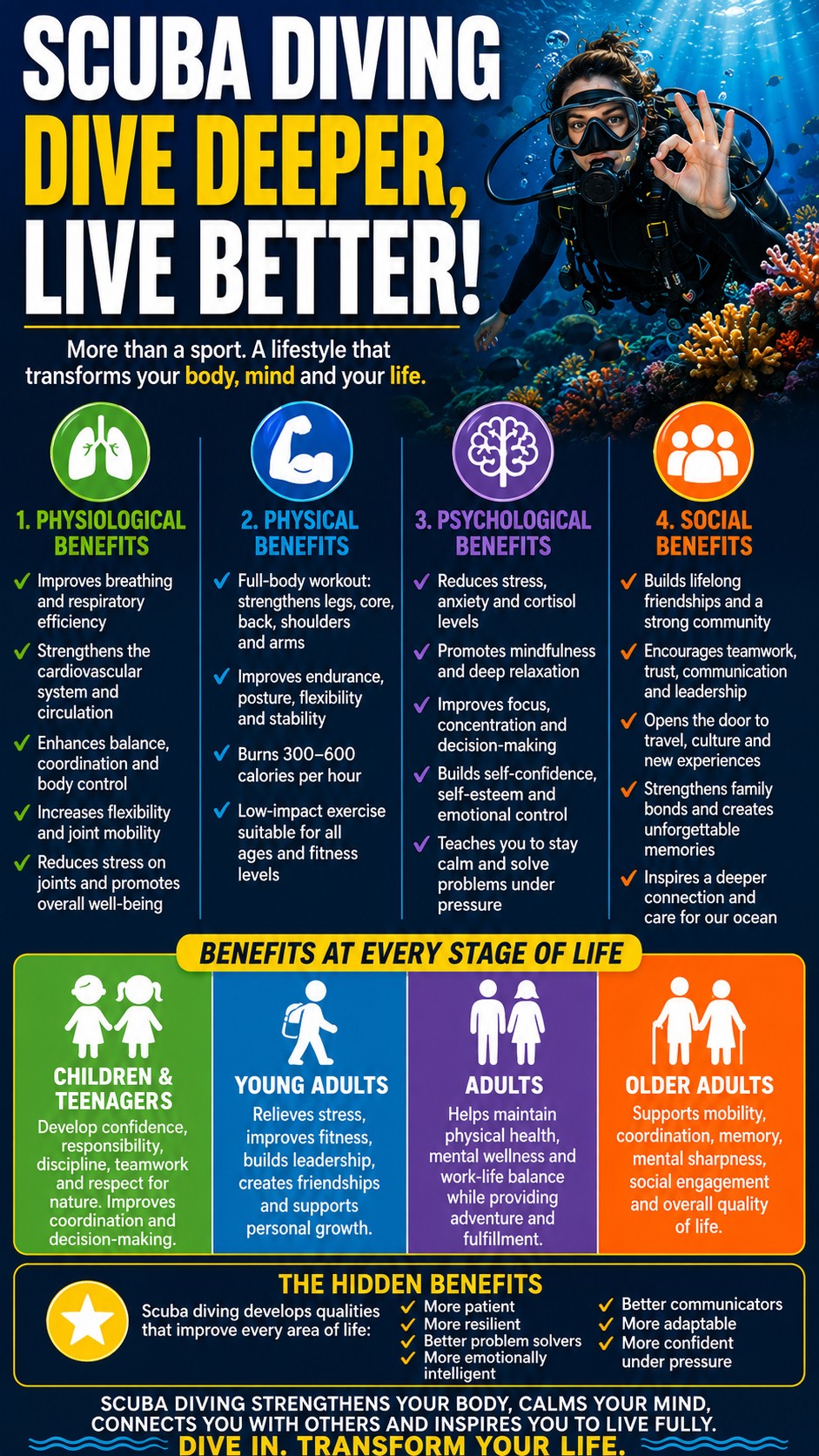
Inspire a Lifetime of Adventure
Most people see scuba diving as a hobby or an exciting vacation activity. But those who truly become divers quickly realize it is much more—it becomes a lifestyle that transforms how they think, feel, move, and connect with the world.
Every dive is an opportunity to strengthen your body, calm your mind, build confidence, and discover that you are capable of much more than you ever imagined.
Imagine taking your first breath underwater. At first, it feels unfamiliar. Then, as your breathing slows, your heart rate settles, and the underwater world opens before you, something remarkable happens—you begin to relax. That feeling becomes the foundation for every dive and often carries into everyday life.
1. Physiological Benefits
Your Body Learns to Work Smarter, Not Harder
Scuba diving teaches one of the most valuable life skills: efficient breathing.
Instead of shallow, rapid breaths, divers learn slow, deep, controlled breathing. This simple habit improves respiratory efficiency while activating the body's natural relaxation response.
Better Breathing
Divers naturally develop:
-
Improved breathing control
-
Greater respiratory efficiency
-
Better oxygen utilization
-
Reduced breathing effort
-
Lower air consumption
NLP Perspective
"Every calm breath reminds your body that you are in control."
Over time, this breathing pattern becomes automatic—even outside the water.
Improved Cardiovascular Health
A typical dive provides moderate aerobic exercise while remaining gentle on the joints.
Benefits include:
-
Improved circulation
-
Better cardiovascular endurance
-
Increased oxygen delivery
-
Enhanced heart efficiency
The hydrostatic pressure of water also assists blood returning to the heart, promoting healthy circulation.
Better Balance and Coordination
Underwater, your brain constantly processes three-dimensional movement.
Divers improve:
-
Balance
-
Spatial awareness
-
Coordination
-
Body control
-
Proprioception
These skills transfer directly into everyday activities.
Increased Flexibility and Joint Mobility
Because water supports nearly 90% of body weight, movements become smooth and low impact.
This allows people of many ages to remain physically active with less stress on:
-
Knees
-
Hips
-
Ankles
-
Spine
2. Physical Benefits
A Full-Body Workout Without Feeling Like Exercise
Scuba diving engages nearly every major muscle group.
Every dive strengthens:
-
Legs
-
Core
-
Back
-
Shoulders
-
Arms
while constantly improving posture and stability.
Builds Functional Fitness
Unlike repetitive gym exercises, diving develops practical fitness through:
-
Swimming
-
Finning
-
Equipment handling
-
Buoyancy control
-
Balance
-
Endurance
The result is a body that moves efficiently rather than simply becoming stronger.
Burns Calories Naturally
Depending on water temperature and effort level, divers typically burn between:
300–600 calories per hour
Cold water dives may require even more energy as the body works to maintain temperature.
Low-Impact Exercise
Unlike running or contact sports, scuba diving places minimal impact on the joints.
This makes it an excellent lifelong activity.
3. Psychological Benefits
Perhaps the Greatest Gift Scuba Diving Offers
Many divers say the underwater world feels like therapy.
Science helps explain why.
Reduces Stress
Slow breathing activates the parasympathetic nervous system, lowering:
-
Heart rate
-
Blood pressure
-
Cortisol levels
The result is deep relaxation.
Many divers describe diving as active meditation.
Reduces Anxiety
Training teaches divers to:
-
Pause
-
Breathe
-
Think
-
Solve problems calmly
These same skills become valuable in everyday life.
Instead of reacting emotionally, experienced divers learn to respond intelligently.
Builds Self-Confidence
Every certification represents proof that you can accomplish something extraordinary.
Each dive quietly reinforces a powerful belief:
"I can handle challenges."
This confidence often carries into careers, relationships, and personal goals.
Improves Focus
Underwater, distractions disappear.
No phones.
No emails.
No traffic.
No noise.
Only the present moment.
Divers naturally strengthen:
-
Concentration
-
Situational awareness
-
Decision making
-
Mental discipline
Creates Mindfulness
Scuba diving may be one of the purest forms of mindfulness available.
Every breath...
Every movement...
Every fish...
Every bubble...
keeps you completely present.
4. Social Benefits
The Friendships Last Long After the Dive Ends
One of the greatest surprises for new divers is discovering the incredible diving community.
Lifelong Friendships
Divers share experiences unlike almost any other activity.
Those shared adventures build friendships that often last a lifetime.
Teamwork
The buddy system develops:
-
Trust
-
Communication
-
Responsibility
-
Leadership
-
Cooperation
These are valuable life skills both underwater and on land.
Travel and Cultural Experiences
Scuba diving opens doors to destinations around the world.
Every dive introduces:
-
New cultures
-
New people
-
New marine ecosystems
-
New perspectives
Travel becomes education.
Environmental Awareness
People protect what they love.
Divers witness the beauty of marine life firsthand, inspiring many to become passionate advocates for ocean conservation.
Benefits Throughout Life
Children and Teenagers
Scuba diving helps young people develop:
-
Confidence
-
Responsibility
-
Self-discipline
-
Teamwork
-
Respect for nature
-
Better decision-making
-
Emotional maturity
Rather than simply teaching diving skills, it teaches life skills.
Young Adults
For adults beginning careers or college, diving provides:
-
Healthy stress relief
-
Physical fitness
-
Adventure
-
Leadership opportunities
-
Lifelong friendships
-
Personal growth
Adults
As careers and family responsibilities increase, diving becomes an escape from everyday pressures.
It helps maintain:
-
Physical health
-
Mental wellness
-
Work-life balance
-
Continued learning
-
Personal fulfillment
Older Adults
Many divers remain active well into their seventies and beyond.
With proper medical clearance, scuba diving can help maintain:
-
Mobility
-
Coordination
-
Memory
-
Mental sharpness
-
Social engagement
-
Overall quality of life
Age often becomes less important than attitude.
The Hidden Benefits
Scuba diving quietly develops qualities that improve every aspect of life.
Divers become:
-
More patient
-
More resilient
-
Better problem solvers
-
More emotionally intelligent
-
Better communicators
-
More adaptable
-
More confident under pressure
These skills are rarely taught in a classroom—but they are learned on every dive.
The Neurolinguistic Perspective
Your Brain Learns What You Repeatedly Experience
Neuro-Linguistic Programming teaches that our minds build powerful associations through repeated experiences.
Every successful dive reinforces positive internal beliefs:
✔ I stay calm under pressure.
✔ I solve problems logically.
✔ I trust myself.
✔ I keep learning.
✔ I am capable of more than I imagined.
Over time, these beliefs become part of your identity—not just underwater, but in every area of life.
Scuba diving becomes more than an activity. It becomes a mental blueprint for confidence, resilience, and lifelong growth.
Final Thought
Scuba diving is one of the few activities that simultaneously strengthens the body, sharpens the mind, reduces stress, builds confidence, creates lifelong friendships, and inspires a deeper appreciation for our planet.
At Loves Park Scuba, we don't simply teach people how to dive—we help them discover a healthier, more confident, and more adventurous version of themselves.
